

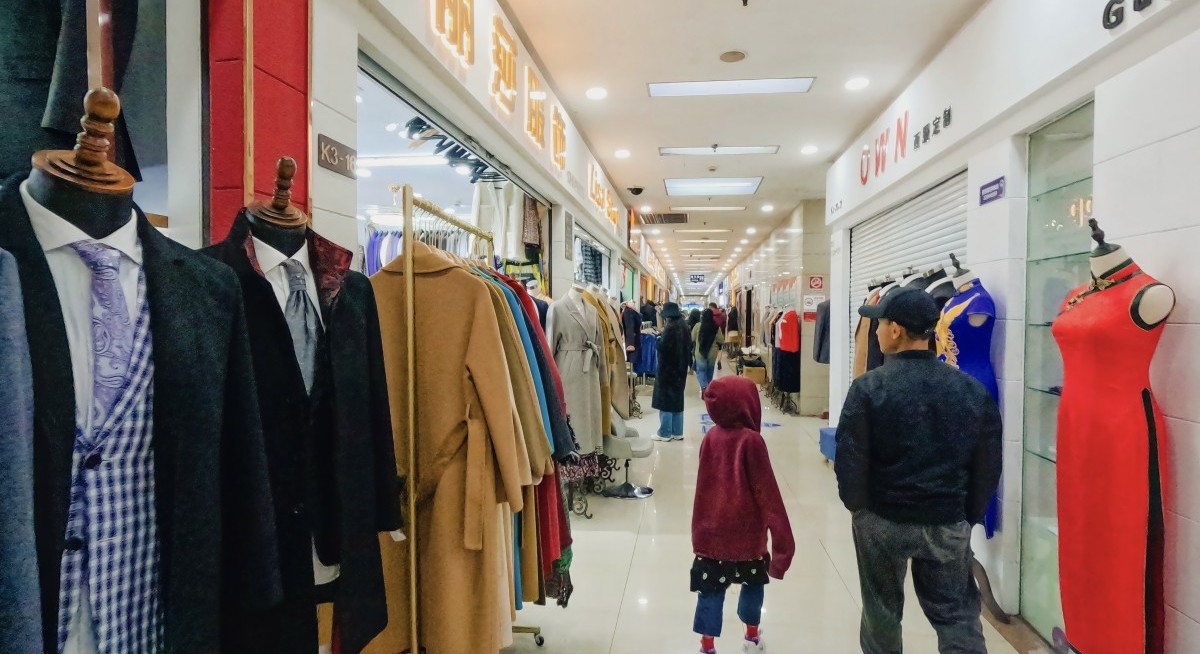

It turned out my colleague was a very aggressive haggler. He boasted with pride how he had bargained down the price of this suit. It was the same method he used when buying from street-side stalls elsewhere in Asia.
Forget for the moment the undignified and demeaning aspects of these transactions, where winning a few pennies may seem trivial to you, but could mean the difference between eating or not eating that day for the vendor.
In some cases, it’s ok to bargain, but it should be within reason. The tailor in question accepted the bargain down price, and he produced a suit of a quality that exactly matched the low price my colleague was prepared to pay. He got a shoddy suit for a shoddy price.
Many businesses go to China searching for the so-called cheap ‘China price’ for the production of their product, be it shoes, electronics or other manufactures. After all, China is renowned for its low prices, and that has been the big attraction for the first wave of those doing business with China a quarter of a century ago. Times have changed, and so has the ‘China price’.
See also: Yuan funding hits record US$200 bil as China’s ambitions grow
The national policy objective is to move the country into a moderately prosperous society. Access to education is a key driver because educated workers can take on more complex tasks and manage more sophisticated machine processes. But this must be rewarded by higher wages. The government has mandated higher minimum wages, increasing year over year.
The foreign companies complained, and many shifted their production facilities to Vietnam, Thailand and other places where wages were lower. China was not concerned. Those low-value jobs were replaced with higher-value jobs, bringing better wages and feeding into the path towards moderate prosperity.
The ‘China price’ has become more expensive, and the quality of production and fabrication has improved alongside this wage increase. The increase in production costs is more than offset by the efficiencies of production that were developed in the era of low wages.
See also: China’s US$600 bil tech stock rout risks deepening on AI costs
Clusters of industry were created, supported by smaller companies located nearby that were able to fabricate the necessary components without involving geographically long supply chains. When Apple asks Foxconn to make last-minute changes to its iPhone, the component provider is most likely located within walking distance. It is rarely on the other side of the country.
These clusters contribute to speed, innovation and adaptability. Higher wages and product costs reflect this efficiency. It keeps prices lower, but not at rock bottom. And just like the Hong Kong tailor, components can be produced to match the low price buyers are prepared to pay.
Overbearing, abrasive haggling with a street vendor won’t work in the boardroom. You get what you pay for, and quality costs. The new ‘China price’ proves it.
Technical outlook for the Shanghai market
As with all regional markets this week, the Shanghai Index gapped down, falling below current trend lines and support levels. This is either a temporary reaction or the beginning of a more substantial trend reversal. At the time of writing, it is unclear which of these outcomes will prevail, so we can only identify the trigger points which give early confirmation of outcomes.
The short-term uptrend shown by trend line A has been broken. Additionally, the index moved below the support and resistance level near 4,100.
If this is a temporary over-reaction, then we can see the market fall to previous lows around 4,000 and then develop a rebound recovery to retest resistance near 4,100.
For more stories about where money flows, click here for Capital Section
This would be consistent with the way the index has oscillated around 4,100 since mid-January.
A development of concern is the way the long term group of moving averages in the Guppy Multiple Moving Average (GMMA) indicator have started to show signs of compression. This suggests investors have quickly turned bearish in reaction to the initial short-term selling.
In previous retreats, the long-term GMMA has not compressed, which was evidence that investors were optimistic and actively buying in the market at the point of price weakness.
A sustained fall below 4,000 has a stronger support level near 3,900. A fall to this level would indicate a significant change in trend behaviour and potentially signal the beginning of a new downtrend.
It is unlikely in the short term that the index will resume a longer-term uptrend. An index move above the value of the trend line A and above 4,200 would be an exceptionally bullish development.
The most benign outcome is for the index to continue to oscillate around the 4,100 level.
Daryl Guppy is an international financial technical analysis expert. He has provided weekly Shanghai Index analysis for mainland Chinese media for two decades. Guppy appears regularly on CNBC Asia and is known as “The Chart Man”. He is a former national board member of the Australia-China Business Council. The writer owns Chinese stock and index ETFs.


