
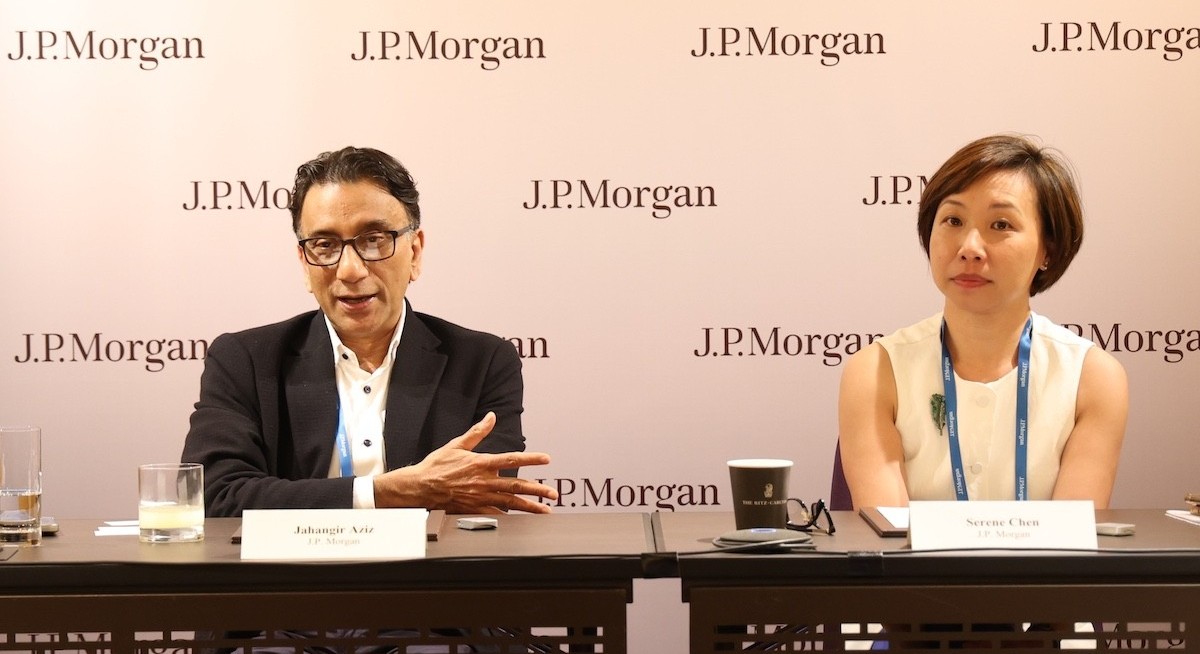

Jahangir Aziz, head of emerging markets economic research at JP Morgan (JPM), frames the issue as less about the headlines and more about the transmission mechanism. “Clearly, the link is oil and what happens to oil prices,” he says in a media briefing on macro trends on March 3. “There is a lot of uncertainty surrounding it.”
He adds: “The impact will be in the region, but for the global economy, you will need to see a sustained increase in oil prices.” He also notes that the increase in oil prices over the past few days since the start of the war has not been “that large”.
Markets are watching duration and the risk of supply disruption. “Unless we get evidence that either oil infrastructure is being damaged, or we see that the Hormuz Strait is blockaded for weeks or months, I believe this should remain a regional conflict, and the impact on the global economy is not going to be positive,” he says. He also cautions that, for now, he does not see the conflict as an automatic global breaker. “But at this point, I don’t really think this is going to be a systemic shock to the global economy,” he adds.
JPM argued in a March 1 report that tail risks will stay elevated until the conflict subsides even if physical supply is not disrupted. Brent crude was expected to be repriced higher as markets reopened, with the bank anticipating an immediate pricing of this risk and that Brent could move well above US$80 ($102) per barrel (bbl). It adds: “Even under a reasonable scenario in which supply is not disrupted, elevated premia are likely to persist for some time”.
See also: First Venezuela, now Iran. For the markets, it’s one battle after another
In that alternative scenario, the bank considered oil holding at elevated levels through the first half before easing back. “Under a persistent risk premia scenario in which Brent crude oil prices remain at US$80/bbl through mid-year, our model estimates point to 1H2026 global GDP growth being depressed by an 0.6% annualised rate (ar), with 1H2026 global CPI inflation being lifted by more than 1% ar,” the report says. It describes this as “a modest macroeconomic shock” that is unlikely to pose a threat to the global expansion or materially alter the path of global monetary policy.
Jahangir’s broader oil view is shaped by supply dynamics that pre-date the latest escalation. “In our view, the oil market has gone into a structural excess supply,” Jahangir says, pointing to new supply sources as incremental contributors that could keep prices capped absent a sustained disruption. In other words, oil can jump on risk, but for it to change the macro outlook meaningfully, the shock needs to remove supply for long enough to override a structural surplus.
For investors, that uncertainty has translated into classic positioning. Serene Chen, head of credit, currency & emerging market sales Apac and head of sales Singapore for global clients Apac at JPM, describes the initial “flight to safety” playbook. “If you look at market reactions and client flows, I think the reaction is always flight to safety when conflict arises,” she says, adding that this then caused gold prices to trend higher and investors rushing for USD and US Treasuries.
See also: The power of pieces: From fractional horses to digital tokens
While gold has been under the spotlight for a while, Chen and Jahangir merely see gold as a hedge against geopolitical shocks, inflation surprises and currency volatility. Aside from gold, JPM has pinpointed emerging markets (EM) as another strong diversifier to the US market. In a Feb 12 report on the EM outlook and strategy, the bank argues that stronger EM growth and well-behaved inflation are combining with positive fund flows to support EM assets.
JPM has moved back its “overweight” rating on EM foreign exchange, while staying “overweight” on EM rates. It has also pointed out concerns about long-term US policy and institutional predictability leading to a sharp rally in precious metals and non-USD currencies in January, linking safe-haven demand to questions about the USD’s longer-term trajectory.
Chen notes however that while clients are increasingly seeking diversification, they are still not abandoning US markets wholesale. “We have not seen a big shift away from US assets, because nowhere, for now, can compete in terms of the liquidity and depth of the market,” she adds.
Where the shift is more visible is in how Asia-based investors manage currency risk and broaden allocations — including into EM. Chen says: “Asia overall, as a region, is a capital-exporting region.” She adds that clients are increasingly including hedging decisions in their portfolios.
That context matters for Singapore’s positioning in periods of heightened volatility. Singapore has increasingly been treated as a regional anchor, thanks to the country’s highly rated sovereign, long-standing reputation for rule of law and policy continuity, deep financial-market infrastructure, and currency regime focused on stability. In practical terms, that can make Singapore a preferred “safe haven” for Asian exposure, with a reduced political and currency risk that are typically associated with higher-beta markets.
Singapore’s role as a wealth-management hub also means risk-off flows can show up through portfolio rebalancing, hedged positioning and demand for high-quality SGD assets.


