



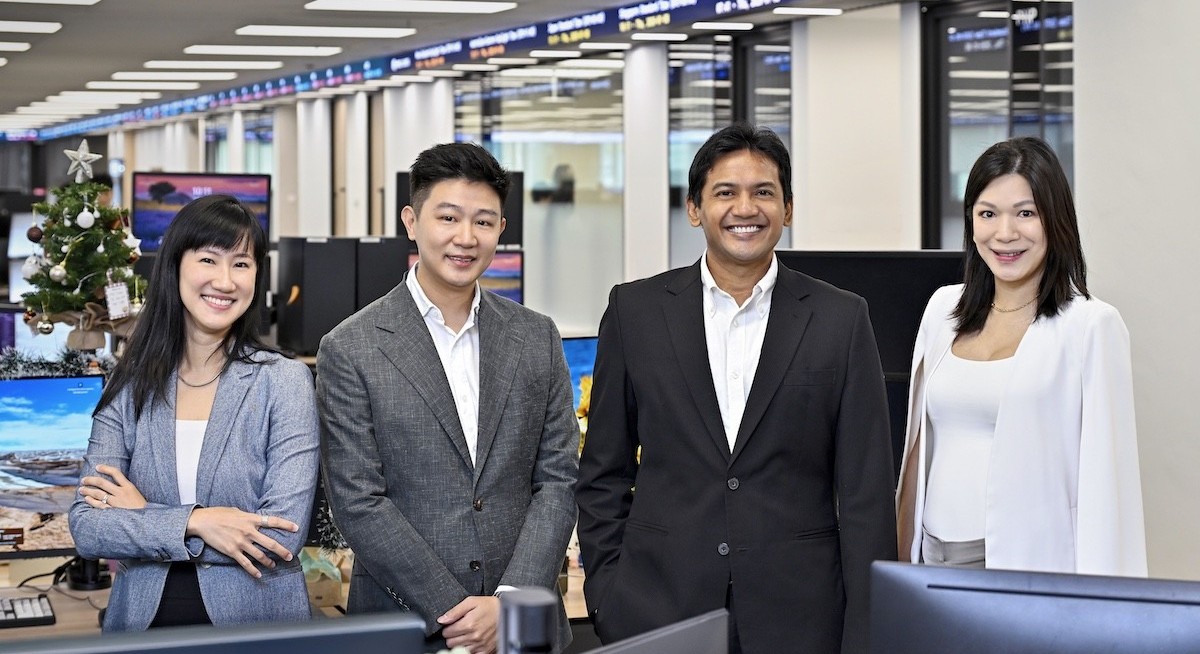



QuantEdge Capital launched in October 2006 with just shy of US$3 million under management. “To say that we started small would be an understatement,” says Suhaimi Zainul-Abidin, CEO of QuantEdge. “Today, in our 20th year in operation, we are managing roughly US$6 billion, making us one of the largest Singapore-born hedge funds around.”
The ambition, he says, was clear from day one. “We wanted to achieve an unprecedented investment feat of delivering outsized investment gains over the long term, with quantitative techniques as our edge.” But the firm began in a market where quant investing was not widely understood. “Very few people were familiar with quantitative investing in Singapore 20 years ago, and very few people would give the founders a second look as they were the new kids on the block. So, QuantEdge had a small start. But it was a good start.”
Suhaimi joined QuantEdge in 2013 after first being an investor in the fund. He left Allen & Gledhill, where he was a banking and finance partner, to join what he describes as a mission to build “a world-class, Singapore-based, investment management company”. At the time, QuantEdge had just about 20-plus employees and half a billion dollars under management. “It’s been 13 years and the QuantEdge of today is different in many ways,” he says. “We’ve grown in many ways — in terms of our people (more than 120 employees now, based in Singapore and New York City), our investment approach, our trading and risk-management systems, our reputation, and our responsibilities.”
That “Singapore-born and Singapore-built” framing is not just branding. QuantEdge’s early backers, Suhaimi recalls, were based on local networks and relationships. “Many of our early investors… were family and friends of people we knew well — from school, from sports, from work.”
He adds: “Even though most of them would not attest to fully understanding what we set out to do, they nevertheless believed in us and gave us a chance. And for that we are eternally grateful.”
Singapore, he notes, was a great base for their fledgling fund management business. “We rode the wave of Singapore’s growth as a financial centre and a wealth management hub. You want a sound legal and regulatory framework, ease of doing business, supportive regulators and a deep pool of capital and investors — Singapore provided that and more. And now, as one of Singapore’s largest home-grown investment management firms, we have a responsibility to Singapore and the industry — a responsibility to fly the Singapore flag high.”
He is also explicit that QuantEdge does not look anything like the hedge funds portrayed in popular culture, such as Axe Capital in the hit Netflix series Billions. Aside from the lack of drama, Suhaimi says: “We’re not the typical hedge fund because we don’t meet many of the usual characteristics of hedge funds as they are often defined. We don’t set out to deliver the low-volatility uncorrelated returns which many other hedge funds do. Instead, we aim to deliver high absolute returns, for investors with a very long-term investment horizon.” That explains QuantEdge’s investor base today, which is heavily tilted towards high-net worth (HNW) individuals and family offices, who account for more than 80% of the firm’s AUM.
“We force investors to think long term because we accept only investors who can invest for minimally three years,” says Suhaimi. “That’s the starting point. Most investors stay for much longer. In fact, many of our early investors are still with us.”
He frames the firm’s objective as compounding capital, rather than asset gathering. “We want to meaningfully compound capital for our investors,” he says. “Our day-one investors have compounded their initial capital more than 30 times in less than 20 years. That’s $1 to over $30.” He adds that the firm’s focus is about “being good, rather than being big”. This way, QuantEdge places the focus of delivering quality long-term investment returns to existing investors, which is more important than hunting for the next investor. In that context, he says, fundraising is not the internal scorecard. “We don’t fixate on the size of assets we manage or set fundraising goals, because we care first and foremost about generating excellent long-term returns for our existing investors. We have delivered 20% net annualised returns to investors over 20 years since inception, but we think we can do better.”
Systematic approach
QuantEdge’s pitch to investors is discipline over theatrics, with quantitative research and systematic execution at the core.
“In simple terms, quantitative investing is a data-driven investment approach that codifies and augments human intuition with mathematical models, statistical analysis, and computer algorithms,” says Leonardo Jong, portfolio manager at QuantEdge. “Our ‘quants’, guided by fundamental economic principles, sift through vast amounts of historical and real-time data to develop rules-based strategies such as risk premia and factor-based long-short strategies that are rigorously back-tested to understand their performance across varying market cycles.”
He adds that the process is designed to formalise risk controls and reduce behavioural errors. “The systematic process is designed for optimal performance under a variety of risk constraints, including position and risk limits. More importantly, the approach forces us to strip away any emotional biases, such as fear or greed, that often cloud traditional decision-making.”
In QuantEdge’s strategy, the portfolio is diversified across major asset classes and resized in response to changing market conditions. Jong makes a similar point on breadth and capacity. “QuantEdge doesn’t just diversify; it trades across close to 300 different markets. It won’t be easy to find a more diversified investment portfolio,” he says. “This statistical breadth not only enhances our risk-adjusted returns, it also means our portfolio is seriously robust and has a massive strategy capacity (meaning that we can run many times our current capital before we see any degradation to our returns).”
From QuantEdge’s standpoint, the goal is not to forecast specific macro outcomes but to design a process that can respond quickly to the dynamic market environment and absorb shocks that will inevitably occur from time to time.
Pinpointing price actions and price changes, Jong adds that markets can go up or down based on any number of factors and triggers. “What we’re concerned about is: Can the portfolio withstand market declines across the different asset classes or markets, including historically unprecedented events? How should the portfolio best react — so that we are defensive initially until the markets gain a stable footing, then we rebuild the portfolio.”
When markets move abruptly, Jong says, the firm relies on predetermined risk targets and prudent liquidity planning. That approach also shapes how the firm describes itself relative to the “AI hedge fund” label that is often applied to systematic managers. Suhaimi says: “Another common misunderstanding is that quantitative hedge funds like QuantEdge rely on AI to autonomously make all investment decisions. That’s not quite true. We prize deterministic and interpretable outcomes in our investment process, which means AI currently has little to add to our current core portfolio management workflows.”
However, Suhaimi adds, the company uses AI tools in many supporting functions. “We do in fact leverage on AI for a great many things, including primary research, trade execution and programming. But we don’t run an AI-driven investment strategy.”
One portfolio, one culture, one set of incentives
QuantEdge positions itself as a single-portfolio firm, which it says aligns the team, the operating model and investor outcomes. While other large fund managers launch several products, QuantEdge believes in focusing on a single investment portfolio, offering a single product that the team “pours their hearts and souls into”.
Suhaimi describes it as a “one fund, one goal” approach. “This ‘one fund, one goal’ approach ensures that every individual in the QuantEdge family — every researcher, trader, and developer — is focused on the same P&L,” he says. He emphasises that this eliminates conflicts of interests as all investors invest on the same footing, and collectively get access to the best ideas, trades and strategies.
The firm’s stance on alignment of interest extends to employee capital, which it says sits alongside client capital in a material way.
“Complete alignment,” says Suhaimi. “At QuantEdge, the employees are collectively the largest investor group in the fund. Not only that — we invest the vast majority of our own net worth in the fund.”
He adds: “This is not a token investment; it is a firm and decisive commitment to investors that we will always be there with them. It ensures that we feel just as much ‘pain’ and ‘gain’ as our external investors, depending on the fate of the fund.” QuantEdge reported a net year-to-date return of +19% as at Feb 23.




