



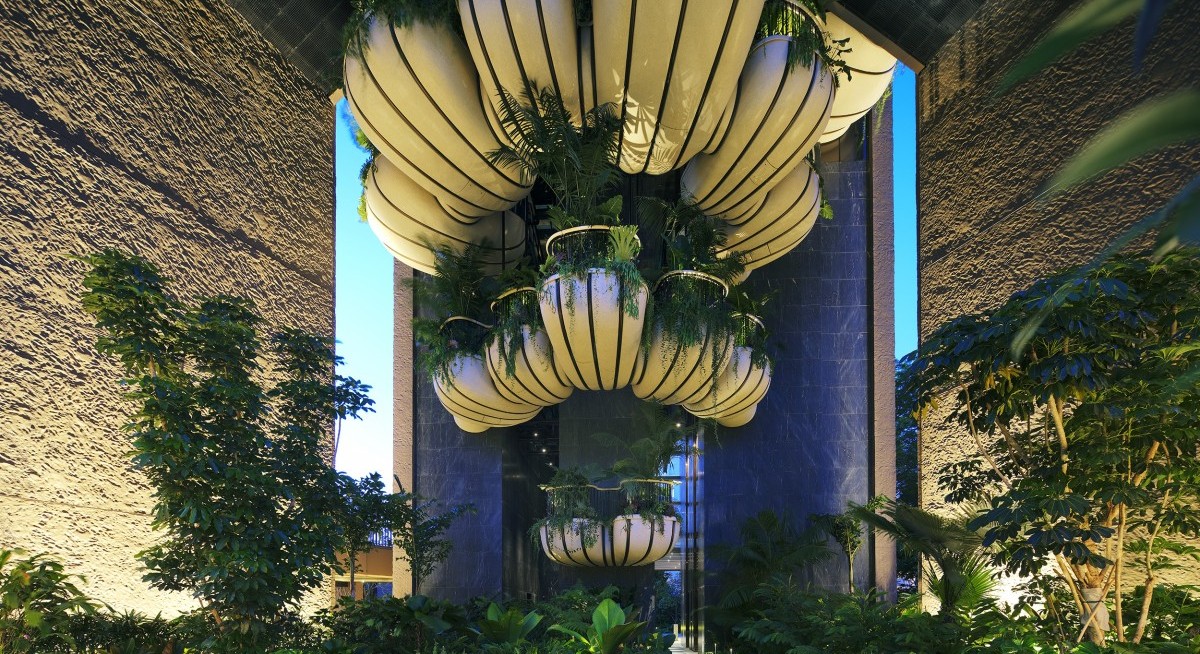



The shift towards sustainability has been “profound”, especially for real economy sectors like the built environment industry, says Tan Sew Guan, executive director, RSP Architects Planners & Engineers. “Sustainability has evolved from a checkbox exercise into a core design driver — embedded from the earliest stages of a project.”
There is now a much broader acceptance and adoption of sustainable materials like low-carbon concrete, recycled aggregates, green steel, engineered timber and other design for manufacture and assembly (DfMA) solutions, adds Tan. “Material selection is no longer guided solely by strength and durability, but increasingly considers embodied carbon, life-cycle impact and responsible sourcing.”
Stronger regulatory requirements, certification benchmarks and evolving client expectations have accelerated adoption across the industry, says Tan, whose portfolio includes the ultra-luxury condominium Eden, the WuXi Biologics Plant, Soitec Microelectronics and the Singapore Institute of Technology’s (SIT) Campus Court in Punggol Digital District.
“This transformation has also been significantly driven by Singapore’s national frameworks. Initiatives like Building and Construction Authority’s (BCA) Green Mark scheme have raised industry standards, expanding the focus beyond energy efficiency to include whole-life carbon, health, well-being and climate resilience,” he adds.
Certification is important for commercial expansion and transparency, says Farizan d’Avezac de Moran, board member of the Singapore Green Building Council (SGBC). “Global regulatory compliance for carbon declaration in products is essential. In some countries, it has become almost a licence to operate.”
In order to achieve long-term viability, businesses must recognise that profitability and sustainability “need to coexist”, adds Farizan, who founded GreenA Consultants in 2009.
The Singapore-based sustainability consultancy for the engineering, architecture and construction sectors has worked on key projects such as DBS Newton Green, an old office building retrofitted into Singapore’s first net-zero development by a bank. GreenA Consultants also advised on the A330 Multi-Role Tanker Transport (MRTT) hangar at Changi Air Base (East), the Singapore Armed Forces’ (SAF) first net-positive energy building.
Outside of Singapore, Farizan’s firm has also completed sustainability projects in East Africa, Macedonia, Panama and the Middle East. From her experience, no amount of persuasion will be effective unless property owners and developers themselves believe in the importance of sustainability in their projects. “It’s very difficult to change someone’s decision when they have [already] decided before even [having a conversation],” says Farizan.
The ‘definitive challenge’ of construction today
See also: Singapore’s built environment must build a collaboration advantage
Achieving the “golden quadrilateral” dilemma of cost, deadlines, quality and sustainability is the “definitive challenge” of modern construction, says Kajima Overseas Asia (Singapore)’s Dharmasurendranath Tharmasirirajah, who goes by Suren.
“Historically, the industry operated under the compromise that one could only prioritise two of these factors. However, by shifting the construction paradigm from traditional site-based building to factory-controlled manufacturing… all four requirements can be satisfied simultaneously,” he adds.
The project director at the regional hub of one of Japan’s oldest and largest construction companies says “front-loading” the design phase and locking in decisions early can help projects keep costs under control. “By freezing the design early, firms protect the project timeline and quality from the volatility of on-site changes, which are prohibitively expensive in a prefabricated context.”
Moving from the planning stage, an integrated workflow relies on Building Information Modelling (BIM) to act as a “digital bridge” between design and assembly. Instead of building all parts of a building on-site, factory precision reduces raw material waste by up to 30%, says Suren.
“By integrating sustainability into the core of the digital workflow, the firm proves that a faster, more cost-effective build is inherently a higher-quality and greener one,” he adds.
Matti Mikkola, group CEO of Eastern Industries, agrees. “Balancing cost, deadlines, quality and sustainability is achievable — but it requires the right approach from the outset.”
The key, he adds, is early planning and collaboration. “When projects are designed with prefabrication in mind from day one, components can be standardised and optimised for manufacturing. This reduces material wastage, shortens construction time and improves overall cost efficiency.”
Eastern Industries is a specialist contractor and supplier of prefabricated buildings and infrastructure components. Precast or DfMA methods support sustainability goals, as it uses materials more efficiently and reduce waste and rework, says Mikkola. “With proper planning, these benefits come naturally rather than as an added cost.”
A ‘practical enabler’
Mikkola will join Suren, Farizan and Tan on a panel at The Edge Singapore’s Sustainable Construction Symposium 2026 later this month. The four experts form the second panel at the half-day conference, happening April 29 at Pan Pacific Orchard, and the session will be moderated by Goola Warden, executive editor at The Edge Singapore.
Operating in a highly demanding environment like Singapore, sustainability is closely aligned with effective project management, says Suren. “The principles that underpin sustainable outcomes, minimising waste, optimising material use, enhancing coordination and adopting DfMA methodologies are the same drivers that improve cost efficiency, productivity and quality.”
Suren sees sustainability considerations not as an “additional constraint”, but as a “practical enabler” of better project delivery. “By embedding these considerations early, my team and I are able to reduce rework, minimise inefficiencies and achieve more predictable and controlled outcomes.”
The construction sector plays a critical role in shaping the future of our cities, but it is also a significant consumer of resources, says Mikkola. “We recognise the responsibility and the opportunity to drive change.”
As buildings and infrastructure are “inherently long-term in nature”, the standards established today will shape their performance for decades, adds Suren. “In this regard, sustainability becomes a key measure of value — one that goes beyond cost, schedule and delivery.”

See also:
Concrete, bamboo and clay: How future building materials can be more sustainable
MIA Design Studio exemplifies Vietnam’s cultural identity and environmental sensitivity
YTL Cement balances business, sustainability and ecosystem-building
Transforming Singapore’s construction industry through mindsets, innovation and value creation




