



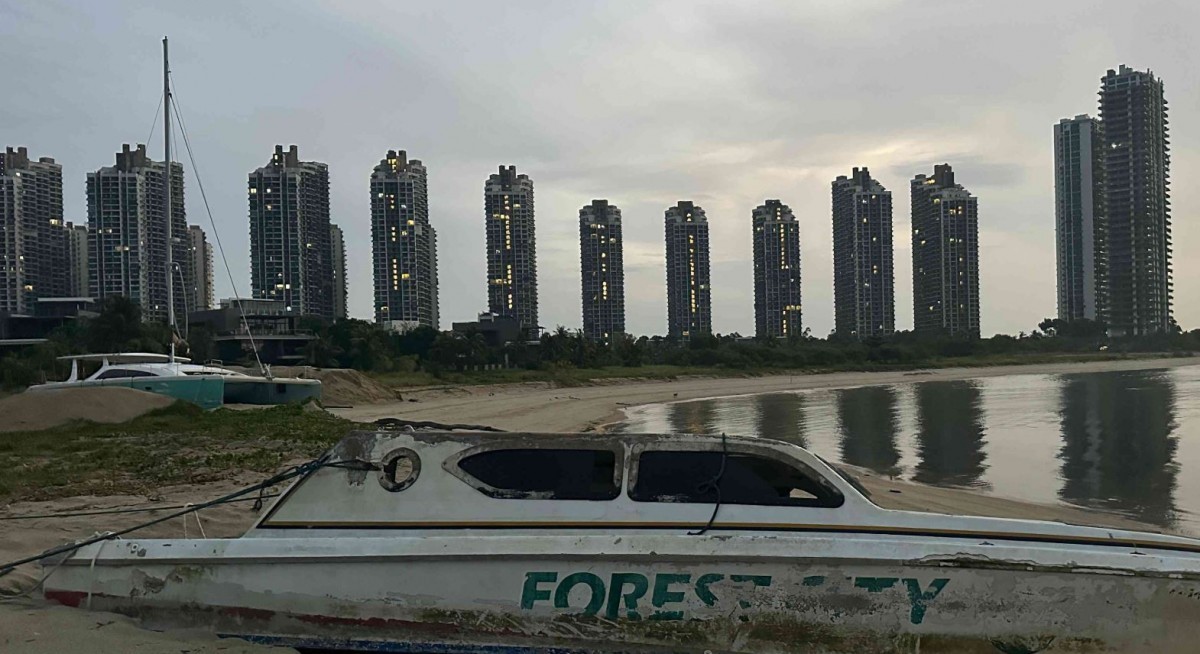



The dominant image of Forest City as a vast, under-occupied development remains its greatest challenge. Being tagged as a “Ghost City” creates a vicious cycle: a lack of vibrancy deters buyers and tenants, which in turn reinforces the image of emptiness.
This negative narrative is often amplified by social media. Past remarks by Malaysian politicians on visa restrictions created lasting fear among potential buyers about their long-term residency.
Policy consistency is a major concern. This is fundamentally a challenge of geopolitical and policy uncertainty. For international investors, currency volatility and capital controls pose significant risks. The investment is often perceived as illiquid and overly exposed to ringgit fluctuations.
Furthermore, while Forest City is close to Singapore, physical and bureaucratic border crossings remain a hurdle. Its “in-between” status — not quite Singapore, yet removed from Johor Bahru’s core — leaves it feeling isolated without an organic pull of its own.
Ultimately, the development lacks the “messy vitality” of a functional city — small businesses, street life and cultural events. It currently feels manufactured and sterile, struggling to compete with the established vibrancy of Johor Bahru and the premium allure of Singapore.
A strategic reimagination
See also: Resorts World Sentosa suit: Malaysian court rules gambling debt not enforceable
To attract investors and residents, Forest City must pivot from a property-sales model to an ecosystem-creation model. Possible solutions include:
1. Radical repositioning and niche focus
Green tech and digital hub: Position Forest City as a “green tech and digital hub” rather than a generic residential project. It should offer aggressive tax incentives, pre-built labs and fast-track visas for research and development centres and environmental, social and governance-focused firms.
See also: Malaysia eyes regional leadership in low-altitude economy as drone rules take shape
Silver economy: With ageing populations in Singapore, China and Japan, Forest City can become a world-class integrated retirement community featuring top-tier healthcare and hassle-free residency packages.
Education hub: Building on Malaysia’s reputation as an education destination, Forest City’s quiet setting is ideal for international university branches and boarding schools, which would provide a year-round student population to drive demand.
2. Financial innovation and de-risking
REITs: Create real estate investment trusts (REITs) for completed commercial and residential blocks, offering investors liquid exposure to rental yields without the burden of direct property ownership.
Foreign exchange mitigation: Offer currency-hedged products or leaseback guarantees in stable currencies (SGD/ USD) to mitigate exchange rate risks.
Trial periods: Introduce “Try Before You Buy” long-term corporate leases (three to five years) with flexible terms to allay investor uncertainty.
3. Policy clarity and government partnership
The government should establish a Special Administrative Zone with guaranteed long-term policies, such as 10-year visa-free permits and tax holidays locked in by law.
While the Special Financial Zone (SFZ) and revised Malaysia My Second Home are steps in the right direction, further refinement is needed to attract high-networth individuals and fintech firms.
Transforming Forest City into a Special Access Zone — allowing tourists to enter with minimal processing — would significantly boost its attractiveness. Specific housing policies could also be curated to clear unsold inventory and occupy completed units.
Major transport hub Improved connectivity is vital. Forest City can be positioned as a regional transit node through:
• Maritime links: Establishing ferry services to Singapore and other Malaysian coastal points.
• Road connectivity: A direct link connecting Pulau Satu to the Malaysian section of the Second Link would drastically reduce travel time from Singapore.
• Rail integration: A dedicated link (light rail transit, monorail or automated rail rapid transit) should connect the Johor Bahru-Singapore Rapid Transit System Link to Forest City. If the high-speed rail project is revived, a station here — potentially linking through to Indonesia — would be a massive catalyst for investment.
Creating compelling experiences
To move beyond golf and attract tourists, Forest City must:
• Leverage the coast: Develop a world-class marine ecology park (mangrove tours, snorkelling) and eco-adventure trails.
• Meetings, incentives, conferences and exhibitions (MICE) destination: Aggressively bid for international conferences and sustainability festivals that align with the “Green City” theme.
• Anchor attractions: Develop a next-generation indoor theme park or a large-scale interactive science museum to draw families from both sides of the border.
Injecting culture and vibrancy
Arts and nomads: Offer subsidised studios for Southeast Asian artists and musicians. By fostering a creative community, the city can attract digital nomads seeking a high-quality lifestyle.
Culinary destination: Actively curate a mix of famous Malaysian hawker stalls and trendy cafés to ensure the city feels lived-in rather than hollow.
Conclusion
The fundamental shift required is a move away from bulk property sales towards tangible economic value. In the short term, marketing must focus on existing assets (golf, hotels, MICE) to challenge the “ghost town” narrative through high-profile events.
Long-term success depends on branding Forest City as a “Special Economic Zone for Sustainable Living and Innovation”.
Beyond the SFZ, it must attract family offices and tech firms by offering a unique value proposition that differentiates it from Singapore, Hong Kong or Dubai.
With the right communication strategy and tangible development — rather than just social media hype — Forest City can flourish.
The remaining three islands can then be developed with distinct themes (green industrial, leisure and “trophy assets”), eventually realising the vision of a 750,000-strong population.

Samuel Tan is founder and CEO of Olive Tree Property Consultants. This story first appeared on Feb 3 in The Edge Malaysia




