



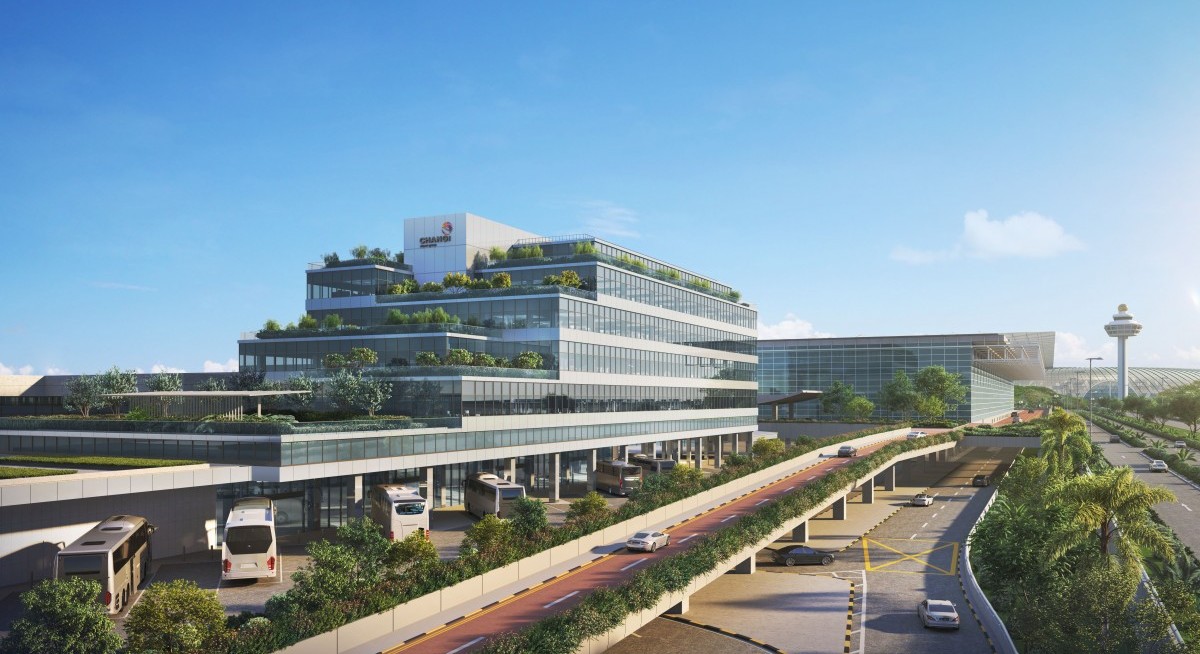



Changi Airport Group (CAG) has awarded a contract to Nakano Singapore to construct a new six-storey office development that will be integrated with a revamped coach stand at Terminal 3 (T3).
Located on the landside of T3 — accessible to the general public — the building is Changi Airport’s first standalone office block, with a dedicated drop-off bay and lift lobby. Providing approximately 9,600 sqm of office space on five levels, the development will be integrated with a refreshed coach stand.
The construction will be carried out in two phases to minimise impact on existing operations. The first phase, which involves the construction of the office block, is expected to be completed in 1H2028, with the remaining works on the revamped coach stand to be completed in the 2H2028.
According to a July 15 announcement, the development will provide purpose-built workspace to meet the growing demand from airlines, airport partners and other businesses seeking proximity to Changi Airport.
Across Terminals 1 to 4, Changi Airport currently offers about 80,000 sqm of landside office space to support CAG and a broad network of aviation partners, including airlines, ground handlers, government agencies, concessionaires and contractors.
“Many of these organisations require an onsite presence to carry out day-to-day operations, while others are based at the airport for convenience and operational efficiency,” says CAG. “With existing capacity nearing its limits, additional space is needed to support the air hub’s growth in the lead-up to Terminal 5’s opening in the mid-2030s.”
The building features cascading landscaped terraces, offering tenants on every floor natural light and fresh air. A spacious terrace on the second floor will serve as a flexible communal space for activities and programmes throughout the day, according to CAG.
Steve Tay, CAG’s vice president, rentable properties, says the development will provide a “conducive and well-designed workspace environment” that supports operational needs while enabling closer collaboration across the airport ecosystem. “It also reflects CAG’s continued investment to support the air hub’s growth.”




