






With Singapore set to become a super-aged society by 2030, healthcare spending continues to surge even as the nation raises the retirement age to support a longer-living workforce.
The Ministry of Health’s 2026 budget has risen 10.4% to $22.5 billion, the second-largest increase from last year. But this fiscal trajectory signals a deeper, urgent reality: public wellness cannot be sustained by bigger budgets, policy discipline or efficiency alone. Prevention needs to be built into the city itself.
The city is the first line of care
Long before hospitals and clinics intervene, well-integrated neighbourhoods, seamless transport networks and accessible green spaces form Singapore’s first line of care. The World Health Organization defines health as physical, mental and social well-being, not merely the absence of disease.
By this definition, urban environments become spatial determinants of national health outcomes, capable of either reinforcing or diminishing our quality of life.
From clinical to social infrastructure
See also: From maintenance to experience: Rethinking facilities management in commercial real estate
Singapore’s next bound in healthcare lies not only in higher investment, but in mainstreaming salutogenic design — environments that reduce stress and promote well-being through environmental clarity, sensory comfort and contact with nature.
New health campuses like Woodlands Hospital illustrate this shift. The hospital dissolves traditional boundaries between the medical compound and community spaces: active ground floors link to public plazas and retail streets, while traffic moves underground, freeing surface areas for shaded walks and therapeutic landscapes.
These car-lite settings calm patients and staff alike. Waiting, arrival and movement are choreographed as part of the healing process rather than being a stressful prelude.
See also: Frasers Property Australia sells Sydney retail asset to PGIM, AFM JV for A$248 mil
Health beyond healthcare
For Singapore to become a “Blue Zone 3.0” city as described by Health Minister Ong Ye Kung, wellness cannot be remedial. It must be systemically embedded through proximity, permeability and access — not only in hospitals.
The same level of design intentionality needs to be extended across residential estates, commercial belts and industrial districts.
Distributed extensions of care
Housing estates like Rivervale Shores, Punggol Waterway Ridges and The Pinnacle@Duxton set the benchmark for healthier and more inclusive urban design. This newer housing typology integrates active-mobility loops, fitness nodes and green corridors into our daily circulation, thereby encouraging habitual walking, restoring contact with nature and improving one’s immediate environment.

Housing estates like Rivervale Shores (pictured), Punggol Waterway Ridges and The Pinnacle@Duxton set the benchmark for healthier and more inclusive urban design
Mature towns such as Jurong East and Tampines can evolve into transit-oriented hubs where stacked amenities and community spaces cluster around shared walkable catchments, fostering social interaction while improving safety and access.
Beyond functioning as conduits of movement, these civic networks create repeated, incidental encounters that shape informal social connections and strengthen community bonds — a proven predictor of longevity, alongside diet and exercise. Urban commons make care visible in everyday space.
The next frontier: industrial wellness
Even industrial estates can extend this philosophy. Historically conceived as hard-edged enclaves dominated by machinery, warehouses and back-of-house functions, they were separated from surrounding communities. Once fenced-off enclaves, they can now be reimagined as mixed, liveable precincts.
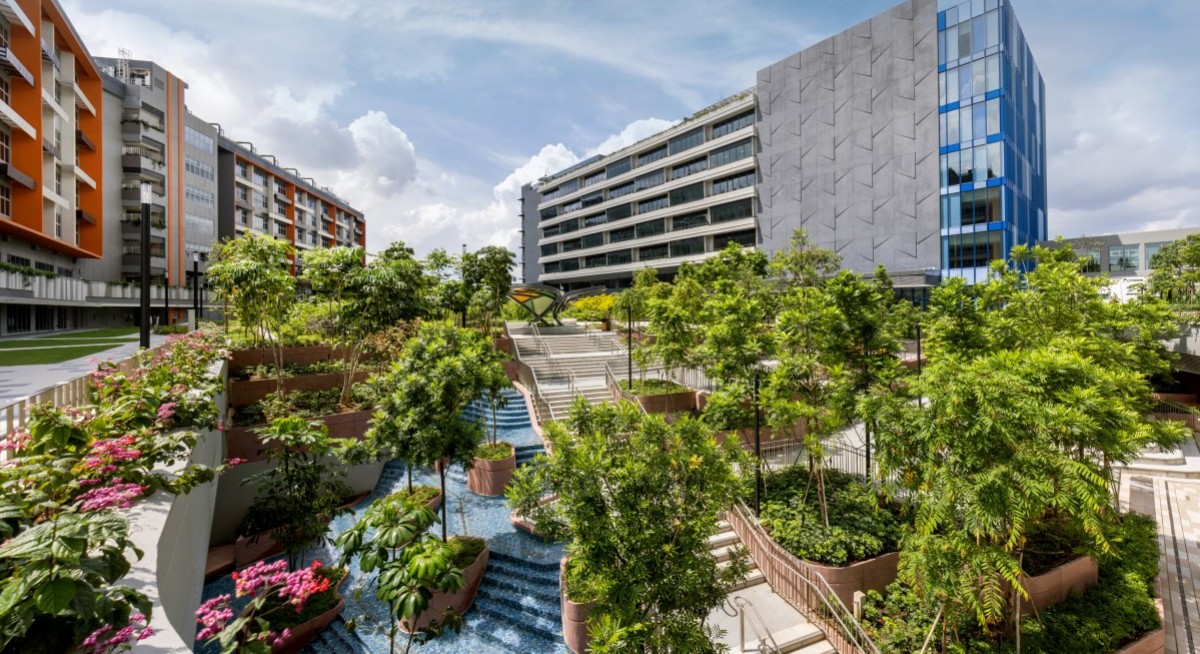
Bulim Square, within the 600ha Jurong Innovation District (JID), signals such a shift. Heavy-vehicle routes are shifted underground, freeing the surface for retail, dining and shaded promenades.

Bulim Square, within the 600ha Jurong Innovation District (JID), will shift heavyvehicle routes underground, freeing the surface for retail, dining and shaded promenades
In the future, an 11km elevated Sky Corridor will link different precincts through greenery — a linear park that doubles as a social street for Bulim. It gathers the working community and nearby residents around retail, dining and lifestyle amenities atypical of traditional industrial areas.
The result is a quieter, healthier and more connected work environment, where productivity and well-being coexist.
Extending the same care applied to healthcare facilities into overlooked urban territories advances health equity across the metropolitan fabric. This reframes industrial estates as “Blue Zone 3.0” testbeds, where work environments support healthier living.
Singapore as a living urban testbed
Singapore’s compactness and planning coherence position it as a living laboratory for wellness-led urbanism. In tandem with formal research and public policies, on-ground observations work to form a feedback loop between academia, institutions and practice.
Our routines — how people linger, gather or withdraw — reveal whether spaces support spatial well-being. These patterns reflect how safe, legible and restorative common spaces are.
Liu Thai Ker, the late former chief planner and CEO of the Urban Redevelopment Authority, who is recognised as the founding architect of modern Singapore, urged Singapore’s urban planners to “romance the land with an artist’s eye, especially where people labour” — this reminder remains prescient. Health equity cannot be spatially selective, particularly in places of work.
When the design of such spaces is conceived as a civic responsibility, the city itself becomes a preventive remedy through an integrated ecosystem of care.
In a super-aged Singapore, architecture’s double mandate is clear: to build a healthy nation where hospitals heal, and environments prevent, and to design environments where well-being is not an exception but embedded as the norm.
Capitalising on Singapore’s potential as a “Blue Zone 3.0” can propel us towards the next generation of cities designed as preventive remedies.
Michael Leong is senior executive director, architecture and design; and global design chief at SJ Group

Photos: SJ Group, SAA Architects
For more property trends and breaking news, visit City & Country’s microsite at theedgesingapore.com/cityandcountry




