



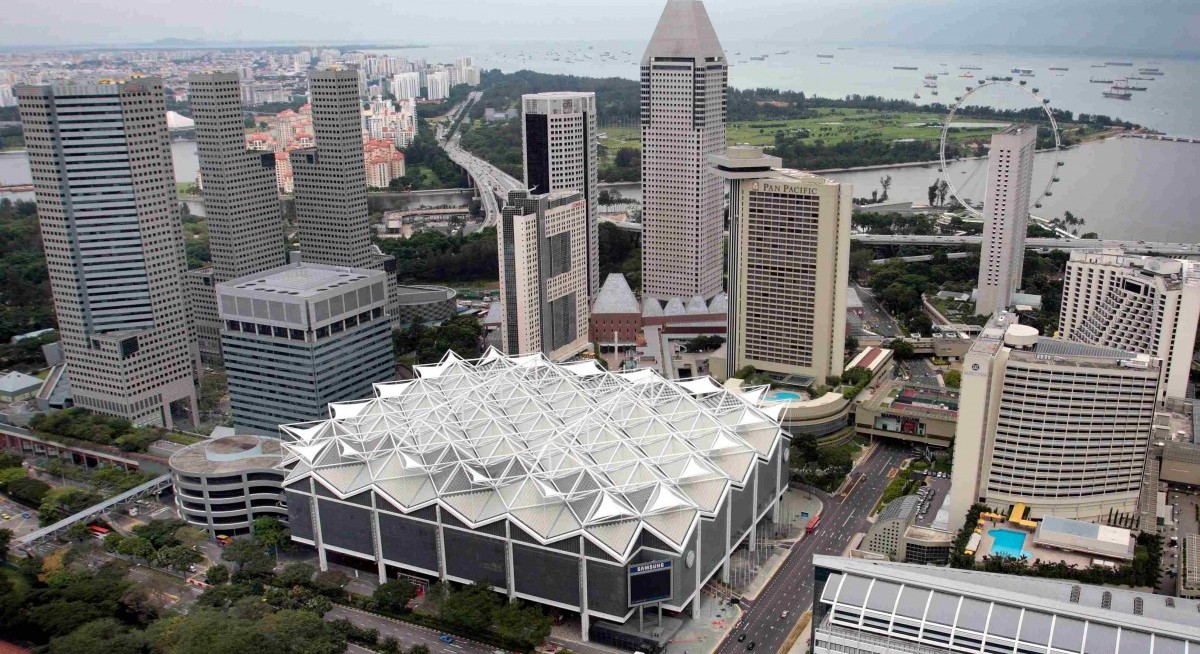



The building I am thinking of is 38 years old. It is younger than most of the people planning to demolish it, younger than the architectural firm that designed it and considerably younger than the carbon clock that started when its foundations were poured.
The industry has a word for it — obsolete.
It is a building type you will recognise. Every third block of Singapore’s CBD has one example of it — quietly awaiting the more photogenic replacement. It would be built between the late 1980s and the early 2000s, clad in something reflective and fitted out for a working world that has since left the room.
The air-conditioning system labours. The lighting buzzes. The lift arrives with the air of having given up on ambition. On the evidence of the building alone, it is not something anyone would design today.
On the evidence of the land beneath it, it sits on a freehold or 999-year plot in a city that stopped making them decades ago.
The default move — when a building of this kind changes hands — is to demolish it. The developer taking possession will publish a rendering of the replacement under a hoarding that promises, in large environmentally-responsible typeface, a greener tomorrow. The rendering will show planters on the balconies, solar panels on the roof and a tree in the lobby.
See also: Can JustCo bury the ghost of WeWork?
No one has ever produced an architectural rendering in which the weather is anything other than perfect. The building behind the hoarding will be reduced to its constituent elements and sent to a landfill.
There are two phases of greenhouse gas emissions in a building’s lifecycle. The first, embodied carbons, is released long before anyone moves in — in the making of the steel, the pouring of the concrete, the years of extraction and haulage it took to put the building where it sits.
The second, operational carbon, is released by operating the building: the cooling, the lighting, the lifts — everything that has to be on for people to work.
See also: This ‘millionaire EC’ in D19 has recorded 100% profitable transactions
The first bill is a one-off, like capital expenditure. The second is ongoing, like operating expenditure. The building, by the time you stand in front of it, has paid the first in full.
To tear the building down is not to reset the ledger. It is to pay the same bill a second time — and a larger bill. The demolition is a cost. The new materials are a cost. The act of construction is a cost. None of these is subtracted from the carbon already spent on the building being erased; they are added to it.
This is the trick of demolition accounting, and like most accounting tricks it depends on our forgetting something. The building was paid for, in carbon, decades ago. Tearing it down does not recover that payment. It means we pay again, and more — and then we persuade ourselves that the second payment was the only one that counted.
The replacement tower, whenever it opens, will spend 30 to 50 years paying down the carbon debt of its own creation. By which point the climate targets the demolition was notionally serving will be either met or made irrelevant.
The greenest building is the one already standing. The phrase has enjoyed, over some years, polite circulation among architects and very little traction with anyone holding a chequebook. This is not because the mathematics is obscure; it is because the mathematics is inconvenient.
Human beings have a weakness for the new. It has not yet disappointed us. It does not yet remind us of anything. We forgive the new of almost everything, because it has not been around long enough to earn our scepticism. This could be seen as a charming habit when we are buying shoes. It is a more expensive one when we are making decisions about cities.
The tilt is ending.
The money that moves these buildings has changed its mind. The large pools of capital that used to buy any reasonable Singapore office tower now answer to rules they cannot negotiate with. Above a certain line of environmental performance, they will still write the cheque; below it, they will not — at any price. Owners who have not cleared the line tend to discover this at the worst possible moment, which is the moment they are trying to leave.
The banks have quietly done the same. A building that looked fundable five years ago on the strength of its tenants and its rent now requires a second story about its carbon — priced accordingly, or not at all. What was treated as ethics has, with very little announcement, become credit.
The buildings already standing — the unloved middle of the market, too old to be new and too young to be heritage — are sitting in an unusual place as a result. They are unwanted by the owners who last held them, and not yet claimed by the owners who will hold them next. The gap between those two states is where the interesting transactions happen. It is also where the work has to be done, by whoever is willing to do it.
A building is not obsolete; our imagination is.
The carbon we spent 30 years ago is the carbon we still own. The greenest buildings of the next decade will mostly have been built in the last one. The title of this piece is not, as it has usually been treated, a slogan. It is an accounting statement — and the market, in its unhurried way, has begun to read it as one.

Jaelle Ang developed the Four Seasons Hotel and Capella Hotel in Bangkok, co-founded The Great Room and sits on the boards of the Singapore Land Authority and United Hampshire US REIT




