

Floating Button
Home Digitaledge Artificial Intelligence

STT GDC and SuperX open AI innovation centre in Singapore as firms struggle to scale AI projects

Nurdianah Md Nur
Nurdianah Md Nur • 3 min read
STT GDC and SuperX open AI innovation centre in Singapore as firms struggle to scale AI projects
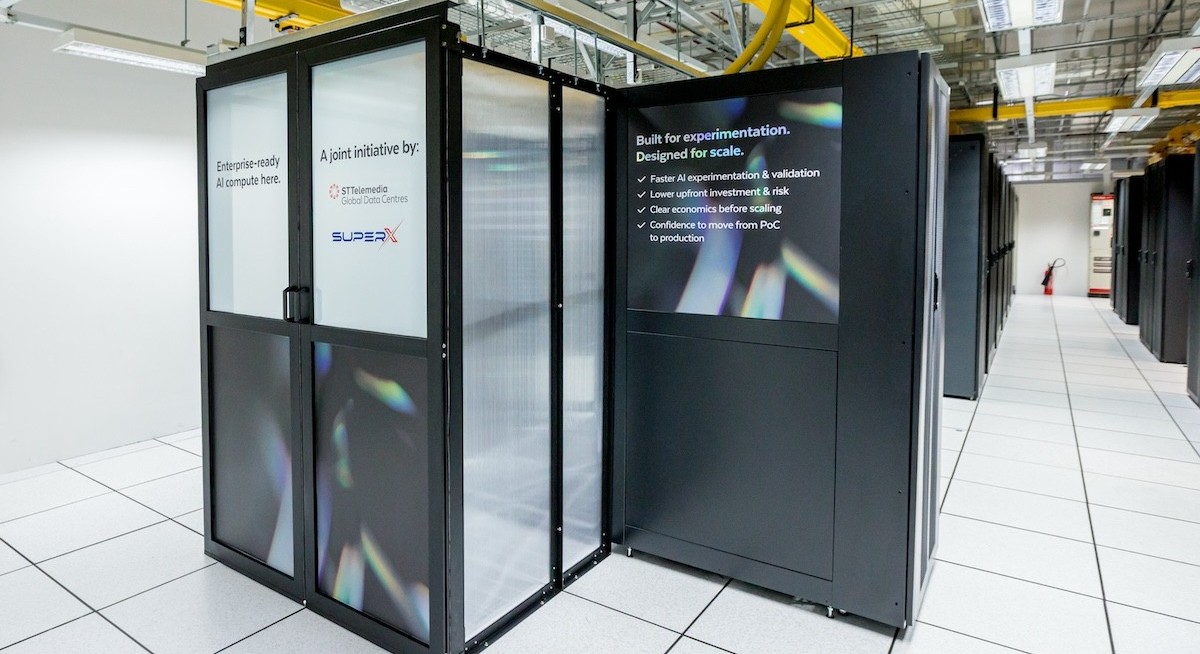
STT GDC and SuperX's AI innovation centre at STT GDC's Singapore 5 data centre in Tai Seng. Photo: STT GDC and SuperX
Font Resizer
Share to Whatsapp
Share to Facebook
Share to LinkedIn
Scroll to top
Follow us on Facebook and join our Telegram channel for the latest updates.

ST Telemedia Global Data Centres (STT GDC) and Nasdaq-listed SuperX AI Technology have opened an artificial intelligence (AI) innovation centre in Singapore to help companies move AI projects beyond the pilot stage into production.

Located at STT GDC's Singapore 5 data centre in Tai Seng, the facility combines the company's data centre infrastructure with SuperX's AI orchestration platform. Users can access Nvidia Blackwell GPUs, 400-gigabit high-speed networking and a self-service portal that allows teams to provision and deploy workloads in days.

The centre is open to enterprises, regional businesses and institutions of higher learning. Qualified organisations can test the setup through a 14-day free trial, with options to expand into private or hybrid configurations within STT GDC's global footprint.

The launch comes as new research commissioned by STT GDC with research partner Ecosystm points to a widening gap between AI adoption and execution across the region.

The study, which surveyed more than 600 enterprise and digital-native leaders across nine Asian markets, reveals that nearly 90% of organisations have begun adopting AI, but 71% remain stuck in an intermediate stage where projects struggle to move beyond pilots. Only 17% are considered ready to operate AI at scale, with the infrastructure, governance and expertise required to sustain it.

"Across Asia, organisations are moving quickly from experimentation to implementation, but many are discovering that AI success now depends less on training models and more on foundations. Without scalable infrastructure and operational readiness in place, it becomes difficult to convert early AI ambition into consistent business value,” says Chris Street, group chief revenue officer at ST Telemedia Global Data Centres.

See also: AI agents gain traction in Singapore, but data gaps hold back adoption

The new AI Innovation Centre is designed to address the specific bottleneck where pilots stall. Early users are already running workloads, including advanced modelling and large-scale data simulations. The setup is aimed at proofs of concept and model testing, where projects often break down due to cost and operational complexity.

All workloads run locally in Singapore, helping organisations in regulated industries meet data residency requirements.

"Many enterprises struggle with the cost and complexity of setting up dedicated AI environments. The AI Innovation Centre reduces that friction, enabling teams to deploy models from a built-in catalogue or third-party marketplaces in days, not months,” says Kenny Sng, chief technology officer at SuperX.

See also: ASML raises 2026 sales forecast as AI investment fuels growth

However, the challenge goes deeper than access to compute. The study found that organisations frequently launch AI on infrastructure that cannot support production use, limiting their ability to demonstrate returns and making it harder to justify further investment in purpose-built systems.

That dynamic is compounded by a shortage of specialised skills needed to manage AI infrastructure at scale, trapping many projects in a cycle of testing without broader rollout.

Singapore reflects the same pattern at a more advanced stage. While 40% of local organisations have progressed to an integrator level, where AI is being actively deployed, only 3% have reached full leadership maturity.

Mingcheng Lim, STT GDC's country head for Singapore, frames the issue plainly. "For Singapore, AI adoption is relatively mature. The defining challenge now is scaling deployments fast enough to support real-world demand."

The findings also point to a sustainability blind spot that complicates the infrastructure picture. Despite rising energy and cooling demands driven by AI workloads, 64% of organisations across Asia continue to prioritise performance or cost when evaluating infrastructure partners, even as power density and thermal efficiency become more consequential at scale.

In Singapore, where regulatory expectations have raised awareness of sustainability issues, the gap between stated priorities and actual procurement decisions persists.

×
The Edge Singapore
Download The Edge Singapore App
Google playApple store play
Keep updated
Follow our social media
© 2026 The Edge Publishing Pte Ltd. All rights reserved.

