

Floating Button
Home Digitaledge Data centres

Schneider Electric backs NUS’ Sustainable Tropical Data Centre Testbed phase 2 on Jurong Island

Nurdianah Md Nur
Nurdianah Md Nur • 4 min read
Schneider Electric backs NUS’ Sustainable Tropical Data Centre Testbed phase 2 on Jurong Island
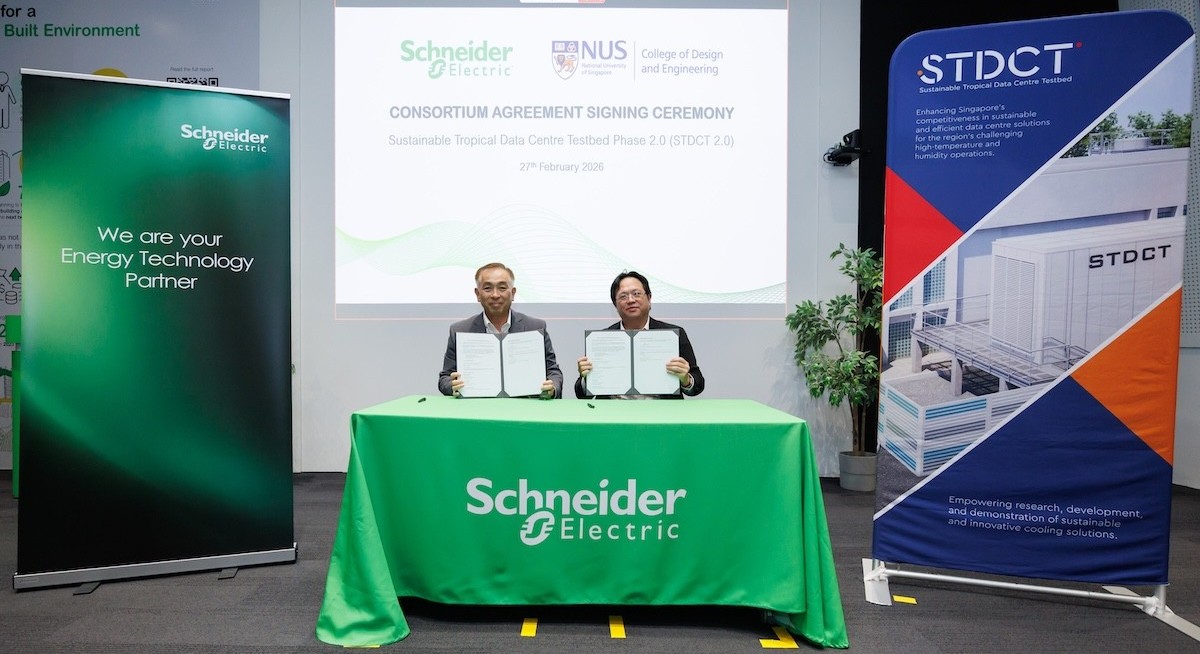
(From left) Yoon Young Kim, cluster president for Singapore and Brunei at Schneider Electric; and Professor Lee Poh Seng, head of Mechanical Engineering at NUS CDE and programme director of STDCT 2.0. Photo: Scheider Electric
Font Resizer
Share to Whatsapp
Share to Facebook
Share to LinkedIn
Scroll to top
Follow us on Facebook and join our Telegram channel for the latest updates.

Schneider Electric Singapore is partnering with the National University of Singapore's (NUS) College of Design and Engineering (CDE) to develop and test data centre technologies suited to Singapore's tightening sustainability requirements.

The energy technology company has signed on as the first anchor sponsor of the Sustainable Tropical Data Centre Testbed Phase 2.0 (STDCT 2.0), a second-phase expansion of the university's tropical data centre testbed. It is also the first organisation to formalise a partnership under the programme.

Slated to begin this year, STDCT 2.0 will scale up from an original testbed launched in November 2023 into a multi-megawatt pilot facility on Jurong Island, within a 20-hectare zone earmarked for Singapore's largest low-carbon data centre park.

NUS signed a memorandum of understanding with JTC in November 2025 to anchor the STDCT 2.0 facility in an industrial precinct already home to hydrogen-ready power plants, sustainable fuels and carbon capture projects. The location is deliberate. Researchers intend to link data centre operations with surrounding industrial decarbonisation work, including waste-heat recovery and grid integration with low-carbon power sources.

The programme is shaped by a fast-moving hardware reality. Rack densities have surged from 5 to 10 kilowatts (kW) a few years ago to more than 200 kW today, driven by the heat output of AI accelerator chips. Speaking at an SGTech seminar on “Sustainable AI-ready data centres” on Feb 27, Professor Lee Poh Seng, head of Mechanical Engineering at NUS CDE and programme director of STDCT 2.0, says Nvidia's roadmap and recent Open Compute Project discussions point to densities of 600 kW per rack by next year, with some projections reaching one to four megawatts.

Lee argues that the conventional view of data centres as passive energy consumers needs to change. "If we build in flexibility, we are able to build in demand response, we are able to build in solutions that allow us to convert waste to resources. [That way], AI data centres can in fact enhance the resiliency of the [energy] grid," he says.

See also: Singapore’s SIT and Hitachi to co-develop hybrid AC/DC rack power testbed for data centres

Cooling sits at the centre of the technical challenge. Air cooling is hitting its physical limits at high rack densities. Meanwhile, rear-door heat exchangers (which are used widely as an interim fix) remain fundamentally an air-cooling approach that cannot handle the thermal loads of the latest GPU chips. Liquid cooling, including two-phase refrigerant systems, would allow waste heat to be recovered at temperatures high enough for industrial reuse.

On the power side, switching from conventional AC infrastructure to an 800-volt DC bus architecture could substantially reduce copper use, lower failure points and cut energy losses — savings that compound at the scale of a multi-hundred-megawatt facility.

STDCT 2.0 frames these challenges across three integrated workstreams covering thermal management, power architecture and digital twin-based control. The programme also intends to pilot bi-directional grid interaction, where data centres equipped with battery storage can help stabilise the grid during demand peaks rather than simply drawing from it.

See also: Digital Realty to open AI testing labs in Singapore and Japan this year

DC-CFA2, Singapore's second data centre call for application, sets a power usage effectiveness (PUE) target below 1.25 for tropical facilities. Lee describes the threshold as demanding but achievable with a whole-systems approach.

Under the partnership with Schneider Electric, the company will contribute cooling units and prefabricated data hall solutions to the testbed. Both NUS CDE and Schneider Electric will co-host events for NUS staff and students, conduct joint research and development, and share findings through conferences and seminars.

"STDCT 2.0 will go beyond efficiency standards by validating AI-ready, low-carbon tropical data centre solutions in real operating conditions, helping the industry scale adoption and reinforcing Singapore's role as a global hub for AI-driven operations," says Lee.

Yoon Young Kim, cluster president for Singapore and Brunei at Schneider Electric, says advanced cooling and intelligent energy management could improve thermal performance while cutting carbon emissions. "Our collaboration with NUS shows how industry and academia can create real-world impact and support Singapore's ambition to grow its digital economy efficiently and sustainably.”

The programme includes a talent development component, with plans for specialised courses, training and internships preparing engineers for roles spanning AI workloads, advanced cooling systems, microgrids and low-carbon power.

×
The Edge Singapore
Download The Edge Singapore App
Google playApple store play
Keep updated
Follow our social media
© 2026 The Edge Publishing Pte Ltd. All rights reserved.

