



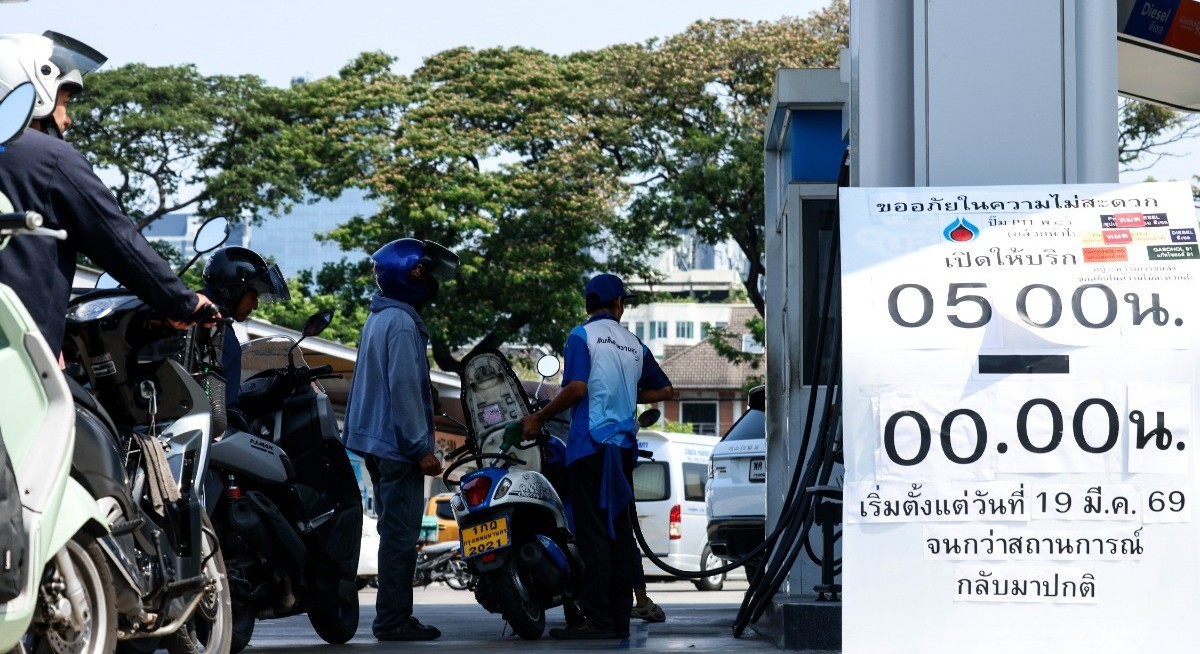


(April 7): Thailand’s year-long stretch of falling prices is nearing an end, as higher oil costs and Middle East supply disruptions begin feeding through to inflation.
Consumer prices fell 0.08% in March from a year earlier, marking a 12th straight month of declines but a quick acceleration from a 0.88% drop in February, Commerce Ministry data showed Tuesday. The reading was below the 0.2% median estimate in a Bloomberg survey of economists.
The rapid narrowing of price declines highlights Thailand’s vulnerability to energy shocks. More than half of its oil imports come from the Middle East, much of it shipped through the Strait of Hormuz, leaving inflation highly exposed to geopolitical disruptions.
On a monthly basis, the index rose 0.6% in March, accelerating from a 0.24% decline in February. Core inflation edged up 0.57%. Nantapong Chiralerspong, director general of the ministry’s Trade Policy and Strategy Office, said at a briefing that he expects consumer prices to rise “substantially” in the second quarter, with April’s reading likely turning positive.
The Commerce Ministry has raised its inflation forecast for this year to 1.5%-2.5%, from a previous range of 0%-1%, citing higher oil prices. Under its base-case scenario, inflation is expected to jump to 3.67% in the second quarter from an average of -0.54% in the first quarter, assuming elevated oil prices persist for about two months. If prices remain high for three months, full-year inflation could rise further to 2.5%-3.5%.

See also: Philippines’ VP Sara Duterte petitions court not to go ahead with impeachment case
Monetary policy
The Bank of Thailand has said that headline inflation could return to its 1%-3% target range earlier than expected. Still, economists see inflation remaining contained. Standard Chartered plc economist Tim Leelahaphan expects consumer prices to rise to 2.2% this quarter and 2.9% in the second half, remaining within the central bank’s target band.
For policymakers, the acceleration is unlikely to trigger an immediate response. Officials have stressed that the current inflation pickup is largely supply-driven, limiting the effectiveness of monetary tightening.
See also: Vietnam growth slows as rising energy costs feed uncertainty
Governor Vitai Ratanakorn said last week there is no need for drastic monetary policy changes, as rate hikes would do little to counter energy-driven inflation while risking a hit to demand. Assistant Governor Chayawadee Chai-Anant has also signalled a wait-and-see approach, saying that rate cuts are unlikely to offset an oil shock.
The central bank has already reduced borrowing costs by a cumulative 150 basis points since late 2024. At its February meeting, policymakers unexpectedly cut the benchmark rate by 25 basis points to 1%, the lowest level since September 2022.
Uploaded by Chng Shear Lane




