

In this volatile, tension-filled macroeconomic environment, AI is adding to the complexity by rearranging traditional roles on a large scale. The more optimistic view is that this is a “period of wonderful uncertainty”. However, for many young graduates, the more common sentiment is to wonder how they can navigate what is seen as a “cooked” job market and build a resilient career.
For Deputy Prime Minister Gan Kim Yong, the simple answer is to keep on learning. “You never quite graduate from university, you are always continuing to study,” said Gan on May 19 at the 2026 Financial Industry Fiesta.
This year’s Financial Industry Fiesta was hosted by Singapore Management University (SMU), aimed at highlighting the efforts made by the Institute of Banking and Finance (IBF) and partners — which include financial institutions, the government, unions, and institutes of higher learning (IHL) — to strengthen the bridge between education and employment.
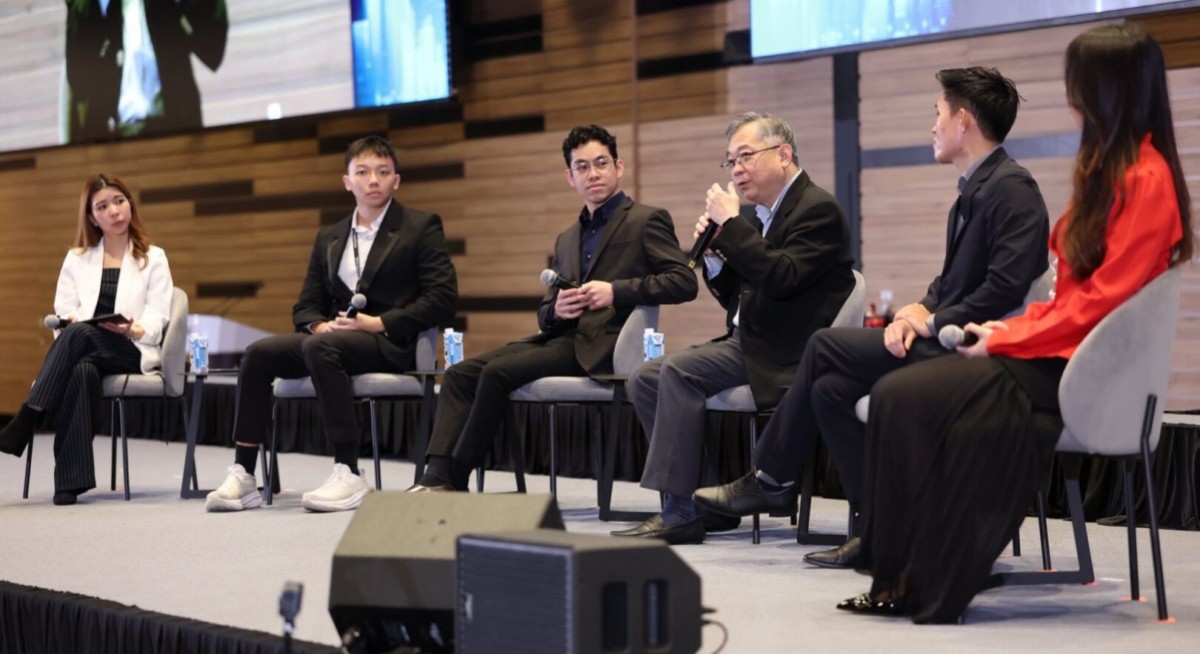
The fireside chat was held between Gan and several young talents, including current undergraduates from NTU and SMU, as well as recent successfully-employed fresh graduates working at UBS, JPMorganChase, and Prudential.
Incidentally, Gan graduated in the 1980s, just when Singapore experienced the most pronounced economic slowdown after two decades of post-independence boom. He was quick to highlight how different the landscape was “some four decades ago” in Singapore, but maintained that the core challenge to keep people employable and industries competitive has not changed.
He recalled that jobs were competitive and peers worried about their prospects, but “all of us were able to find jobs within a short period of time, because opportunities were there.”
What made the difference, he argued, was the system-wide focus on making graduates “well trained, well educated, and very skillful,” with universities working closely with industries so that students would be “job ready when they come out.”
The “tripartite relationship between employers, government, and the workers’ union” remains the backbone of Singapore’s labour market today, just as it did back then, said Gan.
While the exact obstacles facing this generation are completely different, Gan explained this steadfast support system is decidedly still relevant, for both fresh graduates as well as mid-career workers facing disruption from AI, geopolitics, and shifting global supply chains.
Particularly, he named SkillsFuture as one such support, saying such initiatives to upskill Singapore’s workforce would help prepare each cohort to face their unique challenges. He reiterated that Singapore would “continue to develop and evolve new solutions for each generation to come.”
See also: Gen Z is rewriting the rules of wealth
What employers want
When asked what differentiates new graduates, Gan pointed to “adaptability”, “multidisciplinary exposure”, and “leadership”.
Today’s employers, he said, value “varied interests, and varied exposure, and varied skills”, because “the job that you have… will change over time”.
Still, he cautioned that breadth must be balanced with focus, “otherwise you hop from job to job”, resulting in an inability to “develop deep domain knowledge”.
Gan added that employers also want people “willing and ready to learn”, as well as well-rounded leaders who are “also a good follower”.
For fresh graduates headed into finance, Gan was bullish. In a world “full of turmoil, full of volatility,” he emphasised that companies seek “places where they can trust”.
“The financial industry is one sector that is built on trust,” he said, “and Singapore is a hard place of trust — and therefore, the financial sector in Singapore has tremendous growth opportunities.”
Transferring skills
To stay ahead of Singapore and the region’s corporate and economic trends, click here for Latest Section
Chai Zi Jun, a distribution compensation analyst at Prudential and a graduate from NTU’s class of 2022, pointed out that many real problems “cannot be [answered] off a textbook”, instead requiring people “across different functions” to combine experience and “come up with unique solutions”.
Clarissa Bella Jew, a three-time intern with DBS before graduating from NTU in 2024 into a data scientist position at the same company, highlighted “mentorship”, “structured projects” and a “continuous learning mindset” as necessary.
To her, the most notable difference was dealing with data in school versus work, sharing how she was used to data in academia being “pretty clean”, while in “the real world” she found that “data is humongous, messy, sometimes not very understandable.”
“I think there's so much importance placed into understanding your data first,” she noted, “because if you don't get that step right, then everything down from then onwards would not be correct.”
For students, she urged a focus on “transferable skills” — designing tasks so they build reusable capabilities, then deliberately applying past experiences in new contexts.
Another panellist, NTU third-year Haziq Abdullah — who has completed stints across biotech research, tech consulting and financial services — advised peers to “be comfortable with navigating uncertainty” and to show up authentically with employers instead of playing down their strengths.
Doubling-up
When asked to choose between technical competence and resilience, Gan refused the trade-off, explaining: “If you are technically not competent, you cannot be resilient. If you are not resilient, you cannot be technically competent.”
“Actually, it is one and the same thing,” he added.
He reiterated his idea of a “university without graduation”, commenting that graduation is “just a milestone”; universities should keep nurturing alumni, and graduates should keep coming back “to upgrade yourself, update yourself”.
Equally, he urged young professionals to pay mentorship forward.
“As you benefit from mentorship, be generous with your mentorship to the next younger cohorts,” said Gan. “No one succeeds on his own, every success is built on the success of someone else.”
In a labour market defined by “wonderful uncertainty”, that continuous chain of learning and mentorship may be Singapore’s most reliable engine of career resilience.


