



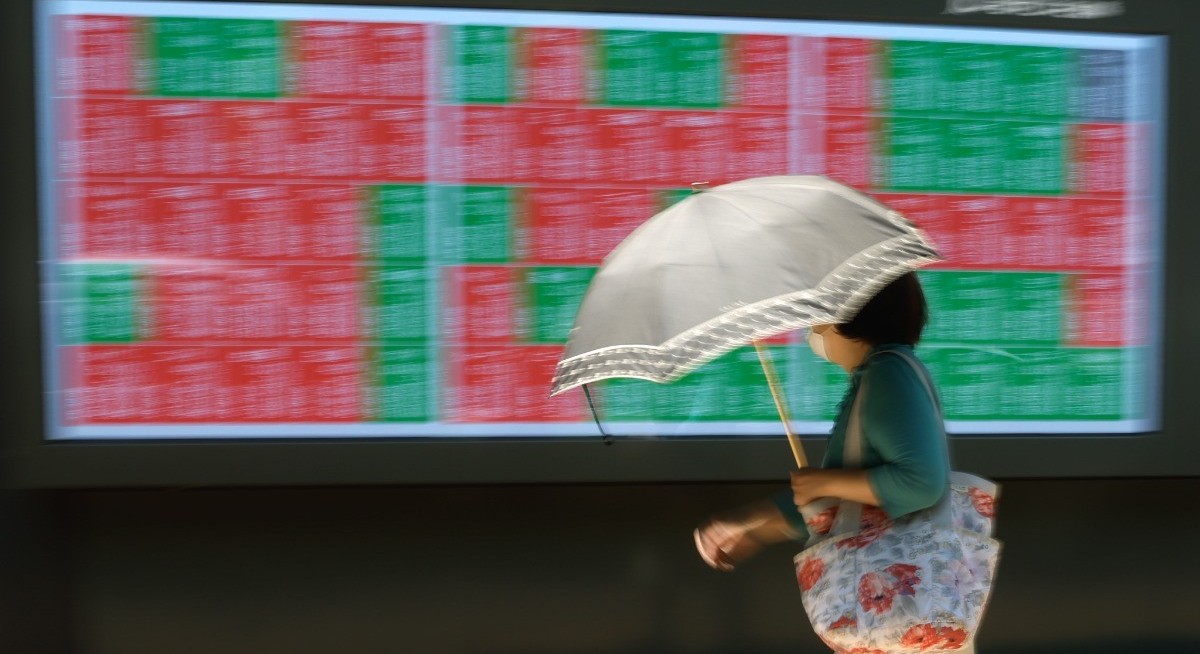



(June 18): Asian stocks and bonds were poised to track US losses after the Federal Reserve (Fed) signalled rates may need to rise further to contain inflation.
Equity-index futures for Japan, South Korea and Australia pointed to lower opens across the region. The S&P 500 fell 1.2% to close near its session low, while the Nasdaq 100 dropped 1%. US stock futures edged higher in early Asian trading, offering a measure of relief after Wednesday’s sell-off. US oil declined at Thursday’s open.
Regional bond markets were set to follow a sharp sell-off in Treasuries. US money markets now imply a rate increase is likely by September and fully priced by October, with roughly half of the Fed committee members expecting rate hikes this year. Two-year Treasury yields, which are highly sensitive to expectations for Fed policy, jumped 13 basis points to 4.18%. The dollar strengthened.
In Asia, the yen weakened to its lowest level against the greenback since July 2024, increasing the risk of official intervention by Japanese authorities.
Fed chair Kevin Warsh, in his first press conference as head of the central bank, declined to offer guidance on the next policy move. He emphasised that inflation has remained above the Fed’s 2% target for several years and reiterated the central bank’s commitment to restoring price stability.
“Half the committee is expecting rate hikes this year, which is a real shot across the bow at the market,” said Bob Michele, JPMorgan Asset Management's chief investment officer and global head of fixed income. “I think they are getting ready for rate hikes.”
See also: India, Indonesia markets enjoy relief rallies after radical interventions
The decision marked the fourth consecutive meeting in which policymakers left rates unchanged. Officials described economic growth as “solid” and highlighted strong productivity gains and capital investment, while making clear that inflation has become a greater concern than labour-market weakness. Warsh also ruled out reconsidering the Fed’s 2% inflation target.
“The Fed’s recent hawkish shift was not just about higher energy prices,” said Kay Haigh at Goldman Sachs Asset Management. “Despite the recent pullback in oil, half of the members of the FOMC expect rate hikes as soon as this year, reflecting strong labour market and inflation data.”
Warsh also announced the creation of a task force to review the Fed’s US$6.7 trillion balance sheet, an issue he has long criticised. The group will examine the relative role of interest-rate policy and balance-sheet policy in transmitting monetary policy.
See also: Stocks rally, oil declines on Iran peace deal
In Japan, investors remained concerned the Bank of Japan was not tightening policy quickly enough to contain inflation and stabilise the yen, even after raising its benchmark rate earlier this week. Deputy governor Shinichi Uchida said the exchange rate is important to the economic outlook but is not a direct policy target.
Investors will also be watching Asian technology stocks after a mixed session for US peers. Broadcom Inc, Micron Technology Inc and Applied Materials Inc were among the biggest contributors to gains in the S&P 500, helping lift the Philadelphia Semiconductor Index 1.4%. At the same time, all members of Bloomberg’s Magnificent Seven Index fell at least 1%, dragging the megacap gauge down 2.8%. SpaceX shares dropped 4.9%, snapping a rally that had lifted the stock roughly 50% since its public listing through Tuesday’s close.
On the geopolitical front, US President Donald Trump defended the interim peace agreement negotiated with Iran and said it could be signed as soon as Thursday. A draft accord would allow the rapid reopening of the Strait of Hormuz, with negotiations on nuclear issues to follow. West Texas Intermediate crude fell 1.4% to near US$76 a barrel on Thursday.
Investors are already looking beyond the conflict, according to Morgan Stanley strategist Mike Wilson, even as the proposed agreement leaves many of the most difficult issues unresolved.
“The market’s moved past the war,” Wilson said, pointing to oil prices that never rose past peaks set during the onset of Russia’s conflict with Ukraine. “We just learned how much supply is out there,” he said.
Uploaded by Isabelle Francis




