



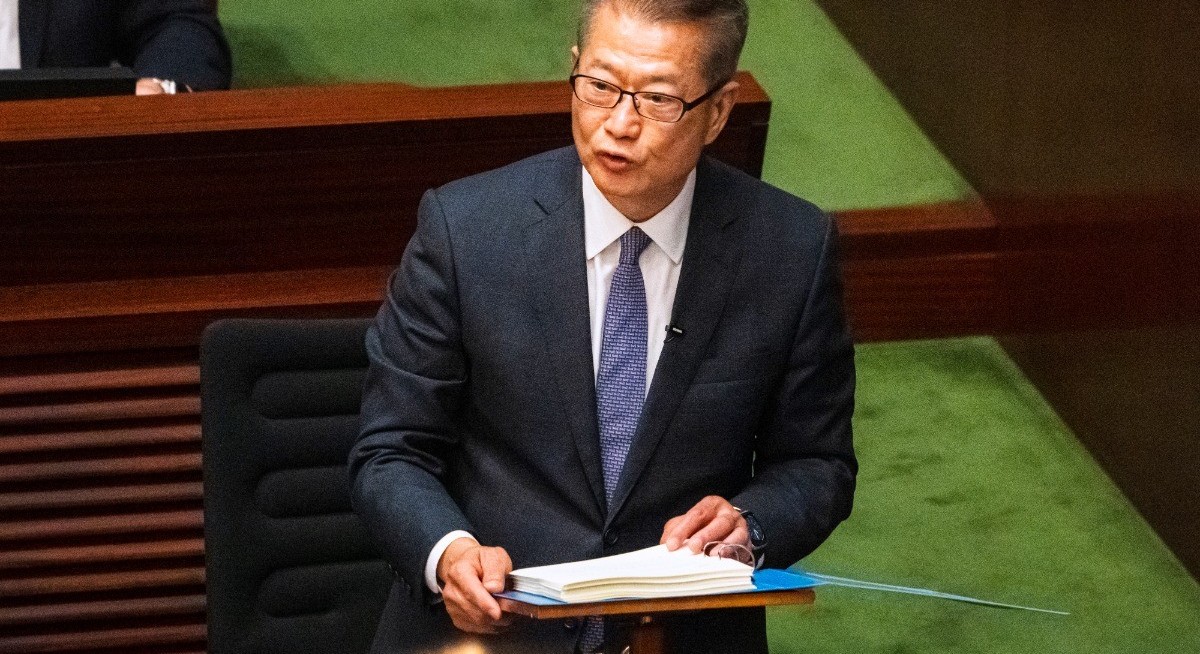


(Feb 26): Hong Kong started to take its first steps away from austerity after public finances ended their longest stretch of deficits in two decades, pledging billions in technology spending and some tax relief to more than two million people.
In an annual budget speech, Financial Secretary Paul Chan reported a consolidated surplus of HK$2.9 billion (US$371.0 million or $468.3 million), a turnaround from the HK$67 billion shortfall originally forecast by the government. He also made a growth projection more bullish than envisaged by most economists.
The upbeat tone on display on Wednesday was in stark contrast to Chan’s address last year, which laid out a blueprint for reducing regular spending with measures such as cutting 10,000 civil servant jobs and freezing government workers’ pay.
But the city’s first fiscal surplus in four years, alongside an economic recovery that brought growth to the fastest since 2021, gave the government room to “suitably reinforce support” for the people while investing more in new industries, Chan said. Hong Kong earmarked at least HK$30 billion to accelerate development of a border tech hub and vowed to boost artificial intelligence (AI) adoption.
“Over the past year, as a result of the booming economy and the capital market, our tax revenue has increased,” Chan said. “Coupled with the reinforced fiscal consolidation programme gradually bearing fruit, our public finances have improved sooner than expected.”
Hong Kong’s Hang Seng Index extended gains to an intraday high during Chan’s speech before paring the gain to 0.7% on Wednesday. Shares of Hong Kong Exchanges & Clearing Ltd jumped as much as 1.2% before reversing and closing down 0.3%.
See also: Hong Kong Exchange’s quarterly profit rises 15% on trading jump
The city’s benchmark rose nearly 28% in 2025 in its best yearly performance since 2017. Chinese investors ploughed a record HK$1.4 trillion into Hong Kong equities and exchange-traded funds last year, driven by optimism over AI.
Coming off a four-year high in 2025, first-time share sales had their busiest-ever January on record, fuelling heavy trading volumes that lifted the government’s stamp-duty revenue.
Chan forecast the economy will grow 2.5% to 3.5% this year. The outlook compares with the consensus projection of 2.6% and last year’s 3.5%.
See also: Hong Kong budget bets on tech, AI to keep growth momentum

Chan also announced modest sweeteners for taxpayers. Authorities are raising tax exemption thresholds, increasing allowances and restoring a salaries tax reduction to the 2024 level of HK$3,000 after halving it last year.
The basic and single parent allowance will rise by close to 10% to HK$145,000, while similarly increasing an allocation for married persons to HK$290,000.
“The government plans to modestly step up fiscal support” in the coming financial year, “mainly through one-off tax reliefs and higher tax allowances”, Goldman Sachs Group Inc economists Xinquan Chen and Chelsea Song said in a report. “Looking further ahead, the government projects modest surpluses over the next five years.”
Hong Kong isn’t abandoning some of the belt-tightening. Chan vowed to cut recurrent expenditure by 2% in the next two financial years, including a decision to slash 2% in civil service headcount in each year.
The city is also hiking stamp duty for luxury home transactions following a recent flurry of activity in the market, with the levy on deals valued above HK$100 million going up to 6.5% from 4.25%.
Still, Chan signalled confidence in a brighter outlook for public finances. The government’s operating account — which covers day-to-day revenue and expenditure — achieved a surplus a year sooner than expected, he said.
To stay ahead of Singapore and the region’s corporate and economic trends, click here for Latest Section

Authorities will resume a mechanism to adjust salaries for civil servants, according to Chan. The review was suspended last year, leading to a pay freeze for government workers.
Families with kids and dependents will also get to enjoy further tax breaks. The child allowance will go up by almost 8% to HK$140,000, while those with dependent parents or grandparents aged 60 or older could see an increase to HK$55,000 from HK$50,000.
Behind the fiscal improvement is a surge in revenue from stamp duties and profits tax — which increased by nearly HK$50 billion compared to the original estimate, mostly on the back of a robust stock market and accelerated economic growth.
Chan also pledged to issue more bonds in the next financial year, when the consolidated surplus is expected to widen to HK$22.1 billion.

As part of Hong Kong’s innovation push, Chan will establish and lead a committee to facilitate greater use of artificial intelligence in various industries, with an initial focus on life and health technology and embodied AI, such as smart robots.
The city is pushing to deploy AI across public sectors, from traffic management and employment services to flood alerts, allocating HK$100 million to accelerate the transformation. It will also spend HK$50 million to train residents how to use the technology.
“We are pressing ahead with the industrialisation of AI and deepening its integration across various industries, while encouraging wider AI application,” Chan said.
Chan said he will seek to inject HK$10 billion in funding to speed up infrastructure development and support startups in the Hetao Park, an innovation hub developed in collaboration with neighbouring Shenzhen with a focus on sectors like AI, data science and biotechnology.
Another HK$10 billion will be allocated to a dedicated company as initial capital to take forward the development of the San Tin Technopole. The government will also set aside the same amount of money to support the development of the Hung Shui Kiu industrial park.
All three zones are part of a broader Northern Metropolis, an ambitious cross-border project the city seeks to turn into a growth pillar. Chan also outlined policies to raise incentives for developers to invest in the vast area spanning 300 sq km.
Chan repeated the Hong Kong government’s vow to accelerate the city’s integration with — and contribution to — China’s overall development. Beijing is set to release its 15th five-year plan in March to outline national priorities.
For the first time ever, Hong Kong will draft its own five-year blueprint to align with the mainland version.
This year’s budget presents a “much stronger alignment” with China’s national programme, reflecting Hong Kong’s role in supporting the key industries including finance and innovation, according to Gary Ng, a senior economist at Natixis SA.
Ng said that as the city deepens its integration with the mainland, it faces challenges in maintaining its global standing amid persistent geopolitical friction.
Uploaded by Tham Yek Lee




