



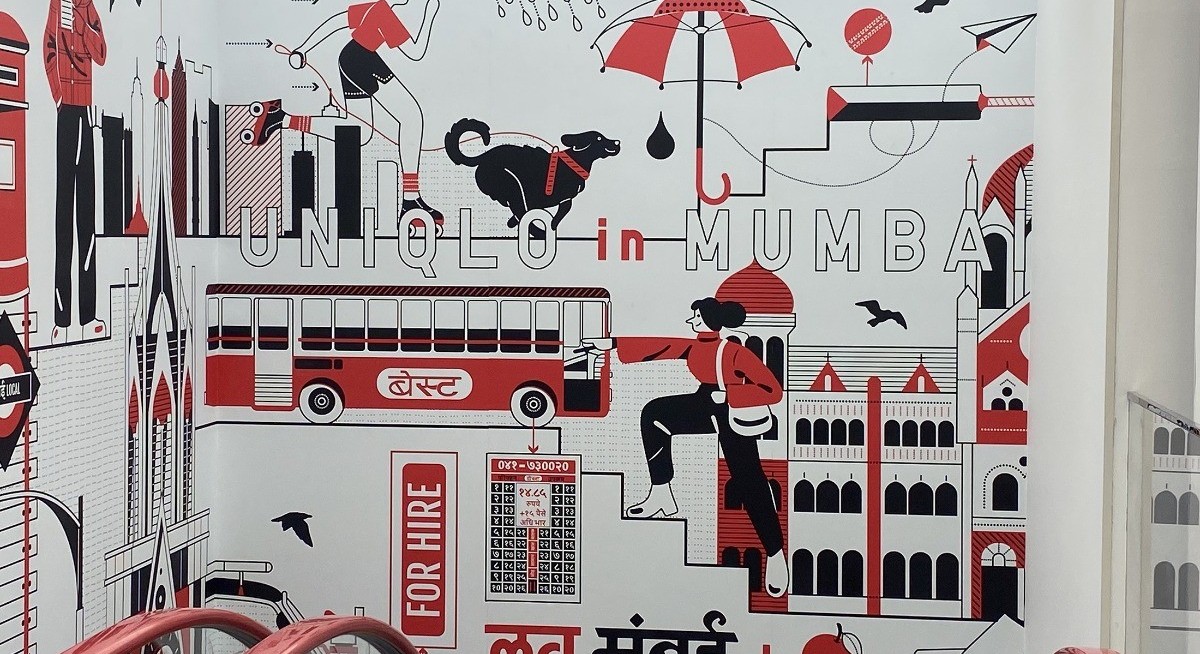


(March 5): Uniqlo plans to accelerate store openings in India, especially in the southern states, as the Japanese apparel maker seeks faster growth and greater market share by targeting more affluent shoppers in the world’s most-populous country.
“There’s big space for us to grow in this market,” Kenji Inoue, chief operating officer and chief financial officer of Uniqlo India Pvt, said in an interview. There’s potential to expand its current market share of about 2% by tenfold, he said. “India is recognised as an extremely important market for our group.”
Uniqlo’s parent company Fast Retailing Co, which has a larger presence in northern India, is working to expand its supply chain in the country’s warmer southern states. It will focus on promoting its linen clothing range — better suited for the region’s tropical weather — and AIRism line with cooling fabrics. With fewer and milder winter months, the region offers limited demand for Uniqlo’s cold-weather HEATTECH line.
The newfound vigour comes after years of relatively slow pace of growth in India, compared with China and other markets where it has made inroads. Six years after entering the country, Uniqlo has only 17 stores in the country of more than 1.4 billion people. But with India’s apparel market projected to double to as much as US$150 billion by 2030, it is attracting a wave of competitors.
H&M and Zara are expanding their footprint, while local giants Reliance Industries Ltd, the Tata Group and Aditya Birla Group are forging international partnerships. The goal is to capture part of India’s growing affluent class of almost 100 million, as rising incomes fuel demand.
Long queue
See also: India rupee hits record low as oil rise sparks regional meltdown
Fast Retailing got a taste of this robust demand. When Uniqlo opened its doors to the first store in Bengaluru last August, the queue was so long and overwhelming that Inoue said he had to pitch in to help at the store — folding clothes, dealing with customers and, ultimately, postponing his flight home.
Uniqlo is seeking to replicate that buzz this week when it opens its second store in the southern city, known as India’s Silicon Valley and home to several startup millionaires. This would be the apparel retailer’s 18th outpost in India.
Uniqlo, known for its functional clothing, sells items priced as high as 4,990 rupees, similar to rivals such as Zara. The Japanese brand opened its first India store in New Delhi in 2019, and is operational in Mumbai, Chandigarh, Lucknow, Pune and Bengaluru. It is now focusing on southern India and select metro cities. “We don’t go everywhere, we focus on dominant cities,” Inoue said.
See also: India’s economy at risk if Middle East conflict persists
Uniqlo India generated 11.76 billion rupees in revenue in India in the financial year ended March 2025, and 1.78 billion rupees in profit, according to financial data provider Tofler.
The clothing company is setting high targets in many markets globally, including aiming for US sales of almost US$20 billion, or about ten times what Fast Retailing currently generates in North America.
The clothing company now aims to “swiftly” achieve ¥100 billion sales here, it said in its annual report. India is among the geographies that are expected to generate double-digit revenue and profit growth over the coming business year, according to a January filing.
It has also overhauled its India e-commerce strategy to capture demand beyond the cities where it operates physical stores, including markets such as Hyderabad. Yearly online sales have jumped 140% in the year through February, according to Inoue.
“By brushing up our operations, our product, our infrastructure, and also marketing, we can grow massively in this market,” he said.
Uploaded by Felyx Teoh




