
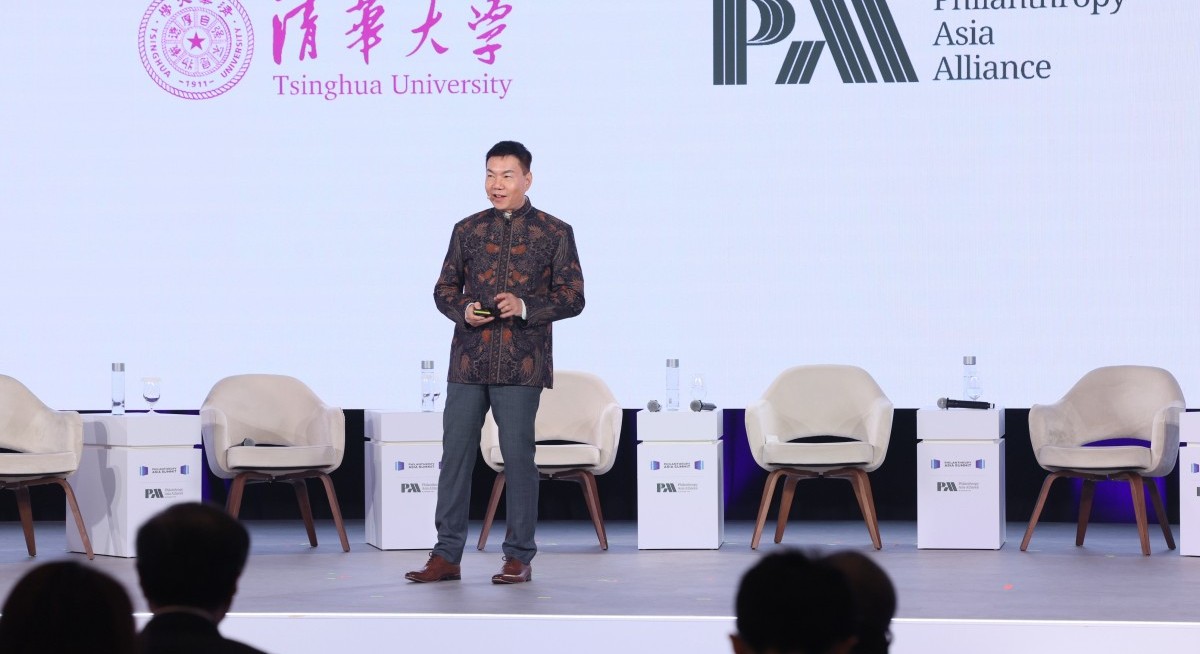

The Philanthropy Asia Alliance (PAA) has announced a new partnership with Tsinghua University, with plans for a joint impact summit in Beijing.
Speaking at the Philanthropy Asia Summit 2026 during Ecosperity Week, PAA CEO Shaun Seow says that the partnership with Tsinghua would focus on knowledge exchange, research and innovation, with discussions centred on leadership, innovation and scale.
“What excites me most about this partnership is that it sits at the intersection of innovation, scale and intentionality,” he remarked in his closing address on May 20.
This partnership announcement came as the summit recorded its strongest Chinese presence yet, with over 30 organisations from the philanthropic, academic and private sectors attending.
Staying power of philanthropic risk capital
Earlier on May 18, PAA released Philanthropy as Risk Capital in Asia, a study it commissioned the Centre for Asian Philanthropy and Society (CAPS) to undertake. The report examined ten cases of early-stage philanthropic funding which collectively benefitted more than 210 million recipients across 13 Asian economies.
See also: Global Coalition for Nuclear Philanthropy launched by The Rockefeller Foundation and Temasek Trust
The study finds that Asian philanthropists distinguish themselves through staying power — noting that the largest and longest commitments came from individual philanthropists and families who built or seeded the organisations they funded — and through early alignment with government, which the report identifies as critical to achieving scale.
One emblematic case cited is the Tahija Foundation's decade-long, US$17 million backing of Wolbachia bacteria as a dengue control method, which yielded a 77% reduction in dengue incidence and is now part of Indonesia's national health plan, protecting an estimated 14 million people.
The report also notes that philanthropy as risk capital remains uncommon across the region, with CAPS's survey of over 2,100 nonprofits and social enterprises across 17 Asian economies finding that 81% say securing unrestricted funding is a challenge.
See also: The Rockefeller Foundation and Temasek Trust announce Global Coalition for Nuclear Philanthropy
“The greatest risk is not in acting, but in doing nothing,” concludes the report.
Deploying capital and growing the PAA
On funds deployment, PAA enters its third year with US$615 million ($786.9 million) mobilised across more than 300 projects in climate, health and inclusive development. Of that, US$50 million has been deployed to 24 catalytic initiatives designed to attract co-funding and validate delivery models transferable to other Asian markets.
Meanwhile, across PAA's five active member communities, momentum is building. The Health for Human Potential Community welcomed three new members including Google.org, which joins with a US$7 million contribution to fund infectious disease and pandemic preparedness work using frontier AI tools, including AlphaFold and Google Earth models.
The Blue Oceans Community saw new members as well: Bloomberg Philanthropies, Minderoo Foundation, Oceankind and SEE (Society of Entrepreneurs and Ecology) Foundation. They also launched three new projects in Indonesia including the 30x30 Southeast Asia Ocean Fund.
Meanwhile, the Just Energy Transition Community has earmarked US$2.6 million in its first year across energy, agriculture, fisheries and jobs initiatives in Southeast Asia, just as the Sustainable Land Use Community opens a grant call in Q32026 for nature-based solutions and sustainable agriculture across Asia.
PAA has grown to more than 110 funder members and partners, and extended its global network through new partnerships with WINGS (Worldwide Initiatives for Grantmaker Support), Latimpacto, Emirates Foundation, the Sustainable Social Value Collaborative in China and Pijar Foundation in Indonesia. Programme partnerships with the Mastercard Center for Inclusive Growth and CapitaLand Hope Foundation were also formalised during the year.
In his remarks, Seow framed the Alliance's broader ambition around Asia's unique position.
“What is achieved in Asia can carry far beyond its borders,” he said, adding that the region offers "demographic weight, development complexity, entrepreneurial energy, and readiness to back ambition at the scale the moment asks for."


