
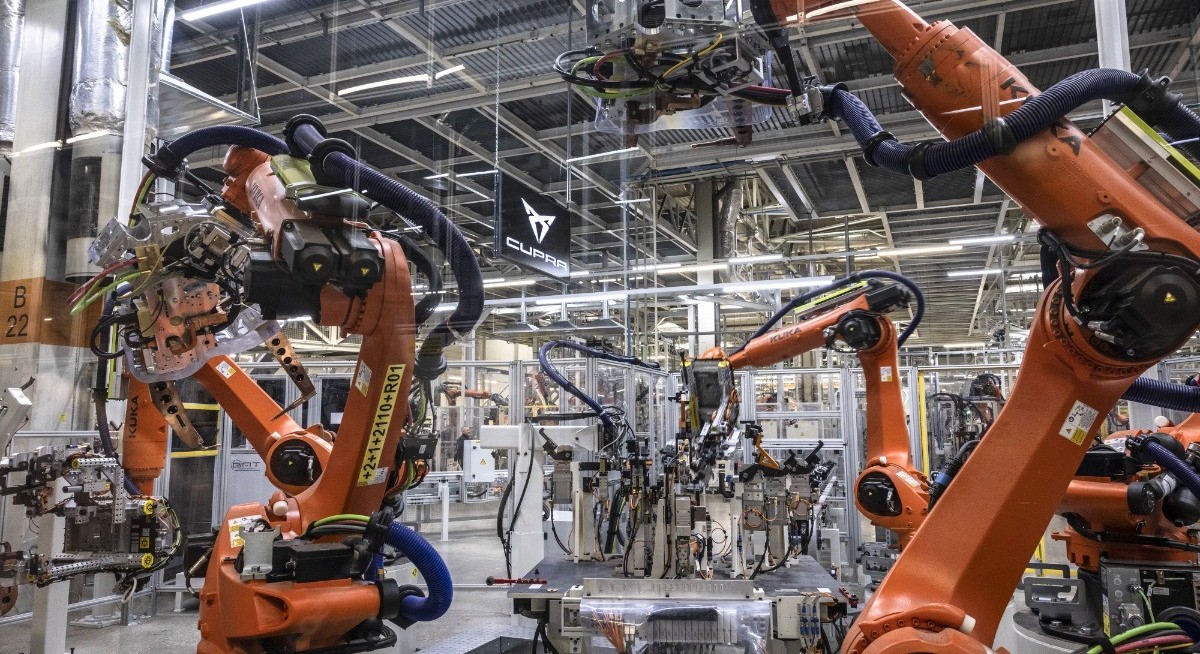

(April 8): Many of Europe’s industrial companies are too slow to adopt artificial intelligence (AI), putting faster-moving global rivals in a position to overtake them, according to German-Chinese robotics maker Kuka SE & Co.
The burden of legacy systems and a reluctance to change mean many factories remain disconnected and make poor use of their data, said chief executive officer Christoph Schell. Kuka, bought by China’s Midea Group Co in 2016, supplies the likes of Volkswagen AG and Airbus SE with industrial robots that handle production line tasks.
This is particularly the case in Germany, he said, where a strong engineering-led mindset favours incremental over transformational shifts. As a result, Kuka is prioritising investments in the US and Asia.
“In Germany, a lot of companies still believe this is just a temporary thing, we’re going to come back out of this, in particular in automotive,” Schell said in an interview with Bloomberg News, referring to the widening gap in digitisation and automation. “The problem is that a lot of the competition products, they’re not just cheaper, they’re better.”
Europe’s biggest economy is fighting to emerge from a years-long period of contraction and stagnation. Public spending pledges on defence and infrastructure yielded some promising signs of a recovery before the onset of the Iran war. Germany’s export-focused car and machinery makers as well as chemical companies like BASF SE remain under pressure from high energy and labour costs.
See also: Science Centre Singapore puts service robots to work in public-facing trial
Midea’s takeover of Augsburg-based Kuka, one of the world’s largest industrial robotics suppliers with annual revenue of €3.9 billion, sparked fierce debate over foreign investment in German industry. The sale to a Chinese entity led Berlin to tighten screening rules for deals involving sensitive technologies such as robotics.
Once a traditional machinery maker, Kuka has since expanded into software and AI, while its orange robots remain ubiquitous in factories. Key competitors include ABB Robotics and Japan’s Yaskawa Electric Corp as industrial automation hurtles towards AI-based offerings. Kuka last month launched a new platform aimed to bridge what Schell calls “hardware-defined, software-defined and AI-defined” manufacturing.
With several major European automaking customers like BMW AG and Mercedes-Benz Group AG, Kuka is exposed to a region where demand has been tepid since the pandemic. The manufacturer is now looking elsewhere for investments, with companies in Asia and the US “more willing to disrupt themselves,” the German-born executive said.
See also: Chinese robot pioneer UBTech offering up to US$18 mil for AI scientist
America is more attractive for spending because of import tariffs driving domestic manufacturing, said Schell, who’s been living in the US for the past 12 years. Meanwhile, growth in China, India and Southeast Asia is fuelled by technology adaption and infrastructure build-out.
“The problem in Europe is there are so many companies that are fighting right now for fewer opportunities,” Schell said. “It’s almost like who is more desperate today? Who is willing to lose 20%, 30% gross margin?”
Uploaded by Felyx Teoh



