



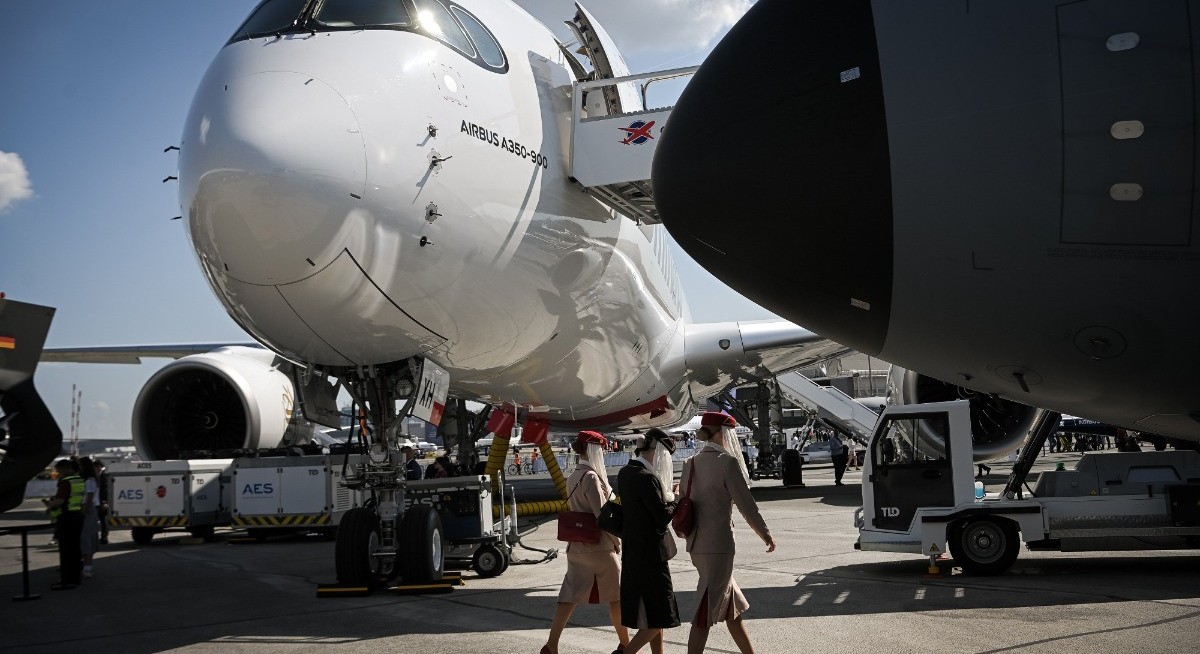


(Feb 19): Airbus SE faulted Pratt & Whitney for failing to provide aircraft engines in sufficient quantities, forcing the plane-maker to pare back ambitious production goals and creating an open dispute with one of its most important suppliers.
The company said monthly output of A320 aircraft may fall short of 75 units by the end of next year because Pratt isn’t able to keep up with demand. Airbus plans to hand over about 870 jets to customers this year, compared with 793 last year, and the company conceded the number would have been higher if engine supplies had come through.
Chief executive officer Guillaume Faury struck a combative tone on Thursday, slamming the engine maker for falling short of contractual obligations and prompting Airbus to seek compensation for lost business. The issue will likely continue into 2027, leaving Airbus with major bottlenecks at a time when archrival Boeing Co continues to improve output.
“We have to bite the bullet in 2026,” Faury told analysts on a call to discuss full-year earnings and the outlook. “We won’t give up. We are not satisfied with the low level, it’s insufficient.”
Airbus fell as much as 8.1% in Paris trading, the biggest intraday drop since December, bringing the decline so far this year to about 5%.
Pratt didn’t immediately respond to a request for comments outside regular US business hours.
See also: Vietnam touts Boeing plane orders while seeking Trump trade deal
The open confrontation between Airbus and one of its main suppliers is an unusual rupture in an industry that relies on just-in-time deliveries of thousands of parts that go into aircraft manufacturing. For years, Airbus has been held back on production of its bestselling A320 family of jets, mainly because of engines but also because it lacks other structural parts such as toilets and other cabin components.
Monthly production of the A320 will be 70 to 75 units by the end of next year and will stabilise at at the upper rate after that, Airbus said.
Chief financial officer Thomas Toepfer said the two sides had a contract locking in deliveries last year before Pratt began wavering. Some analysts previously assumed Airbus would be capable of delivering more than 900 jets this year, a figure that Airbus felt “comfortable” with before the Pratt issues became more acute, Toepfer said.
See also: AirAsia brand unit nearing Nasdaq backdoor listing — Tony Fernandes
“It would have started with a nine,” Faury said in an interview with Bloomberg Television. “It’s a quite frustrating situation to be in. We have the potential to do much more.”
The company said production of the smaller A220 model would reach 13 a month only in 2028, signalling a slow ramp-up after previously targeting a rate of 12 units this year.
The company maintains its monthly targets of five for the larger A330 in 2029, and 12 for the flagship A350 in 2028.
Faury said on a call with analysts that Pratt & Whitney would “significantly” step up output next year to help Airbus reach its production goals.
The company sees free cash flow before customer financing at about EUR4.5 billion (US$5.3 billion or $6.7 billion) in 2026, compared with EUR4.57 billion last year. Airbus expects adjusted earnings before interest and taxes of about EUR7.5 billion this year.
Engine shortages became an acute bottleneck for Airbus last year, forcing the manufacturer to build so-called gliders — planes without engines — in order to keep assembly lines moving. While supplies caught up by year’s end, the discovery of faulty fuselage panels on the A320 family subsequently prompted Airbus to lower its delivery target in the final weeks of December to about 790 units.
Faury wouldn’t say if the company would have to build gliders again this year, saying it’s something the company seeks to avoid and only does if it’s confident of receiving engines soon.
To stay ahead of Singapore and the region’s corporate and economic trends, click here for Latest Section
The A320neo family comes with a choice of two engines: the Pratt & Whitney model or the Leap engine provided by CFM International. While they are both more fuel efficient than previous generations, the Pratt variant in particular has caused problems for Airbus and its customers because of production issues that forced aircraft into lengthy maintenance downtimes.
Pratt’s issues stem largely from the maintenance it needs to perform on the installed fleet, holding back the ability to build more engines, Airbus said. CFM won’t be able to step up output this year, Faury said, providing little hope of raising production thanks to the other engine supplier, Faury said.
“What’s holding Pratt back is the sum of the challenges they face, and the fact that they don’t manage to overcome them all at the same time,” Faury said.
The plane-maker’s deliveries in January sank to their lowest level in any month since 2020, marking the weakest start to a year in at least a decade, which Faury put down in large parts to the panel inspections.
In the meantime, Boeing has been able to recover from years of crisis and hand over the highest number of planes since 2018.
The France-based manufacturer reported adjusted earnings before interest and taxes in the fourth quarter of EUR2.98 billion, coming above the average estimate of analysts tracked by Bloomberg. Revenue rose 5% to EUR25.98 billion, Airbus said. Analysts had estimated revenue of EUR26.38 billion.
In the fourth quarter, operating profit at Airbus Commercial, the biggest unit, rose 7% to EUR2.2 billion, while earnings at the Defense and Space unit quadrupled to EUR378 million.
Airbus is proposing to pay an ordinary dividend of EUR3.20 for 2025.
Uploaded by Tham Yek Lee




