



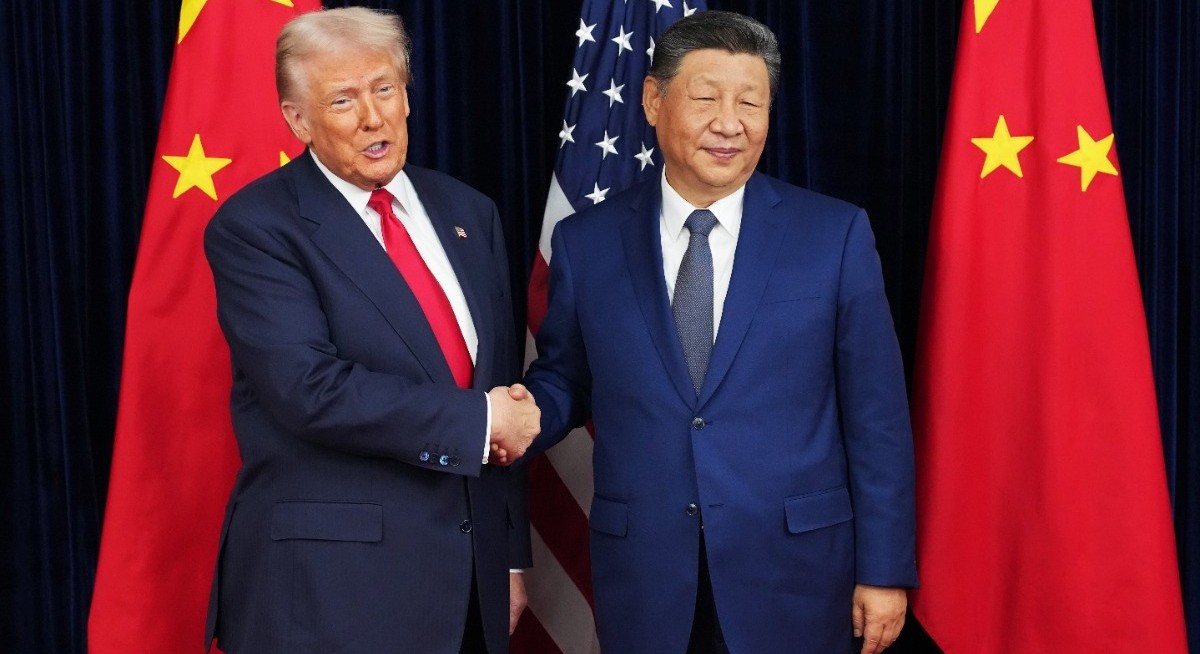


(March 13): The framework for US President Donald Trump’s summit with China’s Xi Jinping is set to be hashed out this weekend as negotiators meet to discuss thorny issues such as tariffs, fentanyl and Taiwan.
Treasury Secretary Scott Bessent, US Trade Representative Jamieson Greer and China’s Vice Premier He Lifeng will convene in Paris on Sunday and Monday to map out deliverables for the leaders’ summit slated for March 31 to April 2 in Beijing. Other issues include the potential for Chinese investment in the US and exports of advanced semiconductors, such as those manufactured by Nvidia Corp.
While China has condemned Trump’s war on Iran, it has shown few signs it’ll back out of the summit as it seeks to stabilise relations with the world’s biggest economy. And even as the US steps up efforts to cut reliance on Chinese rare earths, the lack of alternative supply for now gives Washington strong incentive to avoid any blow-up in talks.
The outcome of the Paris negotiations will give an indication of the scale of deal making that can be achieved when Trump and Xi meet. Already, some Chinese officials have privately voiced concerns that the last minute planning may limit deliverables.
Melanie Hart, senior director of the Atlantic Council’s Global China Hub, says while there may be some tweaks to plans for Trump’s visit, she doesn’t expect the Paris talks to derail the trip.
“It could be a shorter time-frame because of what’s happening in Iran,” she said. “It could be dropped in terms of the pomp and circumstance. There’s plenty of room to move the lever up and down on the optics and on what comes out of it. But I don’t expect either side to walk away.”
See also: Trump now set to travel to China on May 14-15 for summit with Xi

One thorny matter is US weapon sales to Taiwan. In mid- February, Trump said he was discussing the issue with Xi and will “make a determination pretty soon.” A Chinese account of an early-February Trump-Xi call said the US must “handle the issue of arms sales to Taiwan with prudence” — unusually direct language for Xi, who normally sticks to broad statements on Taiwan.
Planning appears to be picking up as advance teams including officials from the White House, Treasury and United States Trade Representative (USTR) have been in Beijing in recent weeks to get ready for the summit, according to a person familiar with the matter.
See also: US, China mull ‘board of trade’ to manage bilateral economy ties
Representatives for Treasury and the USTR didn’t immediately respond to requests for comment sent outside regular business hours.
This is the first time the two parties are meeting since the US Supreme Court struck down a major component of Trump’s trade agenda, ruling he didn’t have the authority to impose tariffs using the International Emergency Economic Powers Act (IEEPA) — a tool he used to threaten tariffs as high as 145% on China.
The invalidation of Trump’s favoured tool, which Bessent has credited with helping to bring the Chinese to the table in the past, could introduce a new dynamic to the relationship.
“There are plenty of tools that the US has outside of the IEEPA tariffs to impose whatever rate the administration wants on China,” said Martin Chorzempa, a senior fellow at the Peterson Institute for International Economics. “But many of those require time to impose.”
The Trump administration has since introduced an across-the-board tariff of 10% and vowed to recreate parts of its tariff wall using other authorities. This week, Greer kicked off the process of imposing tariffs under his agency’s Section 301 authority by initiating an investigation into allegations of industrial overcapacity and forced labour practices for several economies, including China.
Any new tariffs could be seen by Beijing as a provocation. On the other hand, the Chinese have significant leverage over the US with their control over the production of rare earths and critical minerals, which are key to the manufacture of a wide-range of products.
“The Chinese side is extremely confident right now,” Chorzempa said. “Every interaction I have with Chinese officials or think tankers is that we have found our weapon.”
To stay ahead of Singapore and the region’s corporate and economic trends, click here for Latest Section
While US officials have signalled executives will play a role during Trump’s trip to Beijing, including attendance at a banquet dinner, there hasn’t yet been any announcement. That could be clarified during the weekend talks.
Leaders including German Chancellor Friedrich Merz and the UK’s Keir Starmer brought dozens of business executives during their official visits to China earlier this year. Trump was joined by a group of more than 30 business leaders during his trip to Saudi Arabia in May.
In 2017, over two dozen executives including the then-CEOs of Goldman Sachs Group Inc and Qualcomm Inc came to China during Trump’s state visit, when the president claimed US$250 billion in business deals and investment agreements.
Despite planning that has come down to the wire, companies remain hopeful the visit will be a venue to tackle longstanding challenges, while Boeing is closing in on historic sales of planes to China.
Many US companies have submitted proposals to Treasury and the USTR on potential deals, pending approvals, or trade and investment barriers, according to two people with knowledge of the matter.
“I would not be surprised if President Trump put something like investment opportunities in the United States on the agenda,” said Heidi Crebo-Rediker, a senior fellow in the Center for Geoeconomic Studies at the Council on Foreign Relations. “However, I think that the Chinese companies themselves will understand the risks involved.”
Uploaded by Evelyn Chan




