



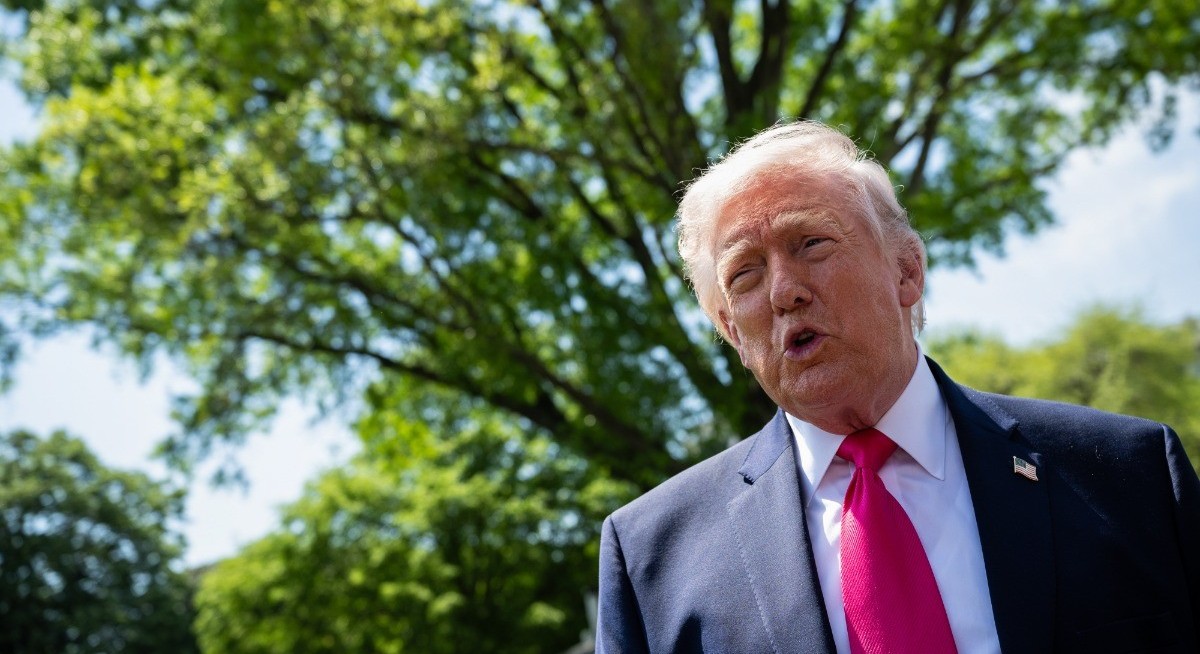



(June 30): The Supreme Court has handed US President Donald Trump sweeping power to bend much of the federal regulatory state to his will, a major expansion of executive branch influence that will enable him to fire the heads of independent agencies that police markets, protect consumers and enforce workplace rules.
Overturning a 91-year-old precedent, the court’s conservative majority said agencies that wield executive power must be ultimately answerable to the president.
That would include not just the Federal Trade Commission (FTC) — where Trump’s firing of Democratic official Rebecca Kelly Slaughter led to the lawsuit decided by the Supreme Court on Monday — but also as many as two dozen other similar agencies from the Securities and Exchange Commission to the National Labor Relations Board.
The court in a separate ruling created a limited carve-out to preserve US Federal Reserve (Fed) independence, citing a long tradition of keeping monetary policy free from political meddling. But the court also described the Fed as “unique”, suggesting few if any other regulatory bodies would be similarly spared.
And even with the Fed, the court laid out a pathway through which the president might be able to remove a governor for sufficiently serious wrongdoing as long as the person had a reasonable chance to mount a defence.
Formerly independent agencies have a “tremendous amount of turmoil in their immediate future”, said Bill Kovacic, a former FTC chair under George W Bush, and a law professor at George Washington University.
See also: John Bolton pleads guilty to mishandling classified material
Nearly every regulatory agency, from those policing Wall Street to those protecting consumers, now appear squarely under the president’s thumb. The decision unravels more than a century of tradition in which Congress tried to insulate many agencies — especially those with rulemaking, enforcement, and adjudicatory powers — from the whims of presidential politics. The arrangement gave those organisations relative stability, allowing them to enforce rules consistently across Democratic and Republican administrations.
“The whole federal enforcement framework is up for grabs,” Kovacic said.
The ruling is the culmination of decades of efforts by conservatives to enshrine what they call the “unitary executive”, championing the idea that the Constitution vests executive power in the president alone, and Congress is limited in its ability to insulate agencies from influence.
See also: Trump’s un-American capitalism
“Subordinates who exercise the president’s power are subject to removal by him,” Chief Justice John Roberts wrote for the six-member majority. “Then, and only then, can they remain accountable to the president, and the president to the people.”
Trump himself depicted the case as a sea change in presidential power.
“It is such an honour to be the sitting president who won this historic and unprecedented ruling, one of the most important ever given with respect to presidential powers,” he said on social media. “To show the importance of the slaughter case, 90 years of precedent has been completely and unequivocally overruled, greatly increasing presidential power at a time when it is most needed!”
At the same time, Trump told reporters that while the ruling gave him the right to undertake more firings, he wouldn’t necessarily exercise that power.
“I don’t think so,” he said in the Oval Office when asked if the Supreme Court had opened the door to more firings.
Despite the claim, it is hard to imagine that officials at agencies won’t feel compelled to advance efforts to crack down on media organisations he perceives as enemies, impose new restrictions on elections, and strip back constraints on businesses.
In the longer term, the case could come back to haunt Republicans, given that a future Democratic president would wield the same power to fire and replace Trump appointees. Business groups nonetheless hailed the ruling, while progressives decried it.
To stay ahead of Singapore and the region’s corporate and economic trends, click here for Latest Section
The Competitive Enterprise Institute said the opinion “continues the healing process as we dismantle an unchecked regulatory state”. The League of Conservation Voters — like other consumer, labour and environmental groups — denounced it as “a dangerous attack on our constitutional checks and balances”.
“Put simply, today the majority reshapes our government,” wrote Justice Sonia Sotomayor, in a dissent joined by fellow Democratic appointees Elena Kagan and Ketanji Brown Jackson. “Dozens of independent commissions are now likely to become purely executive agencies, shifting tremendous power over broad swaths of American life into the president’s hands.”
Uploaded by Tham Yek Lee




