



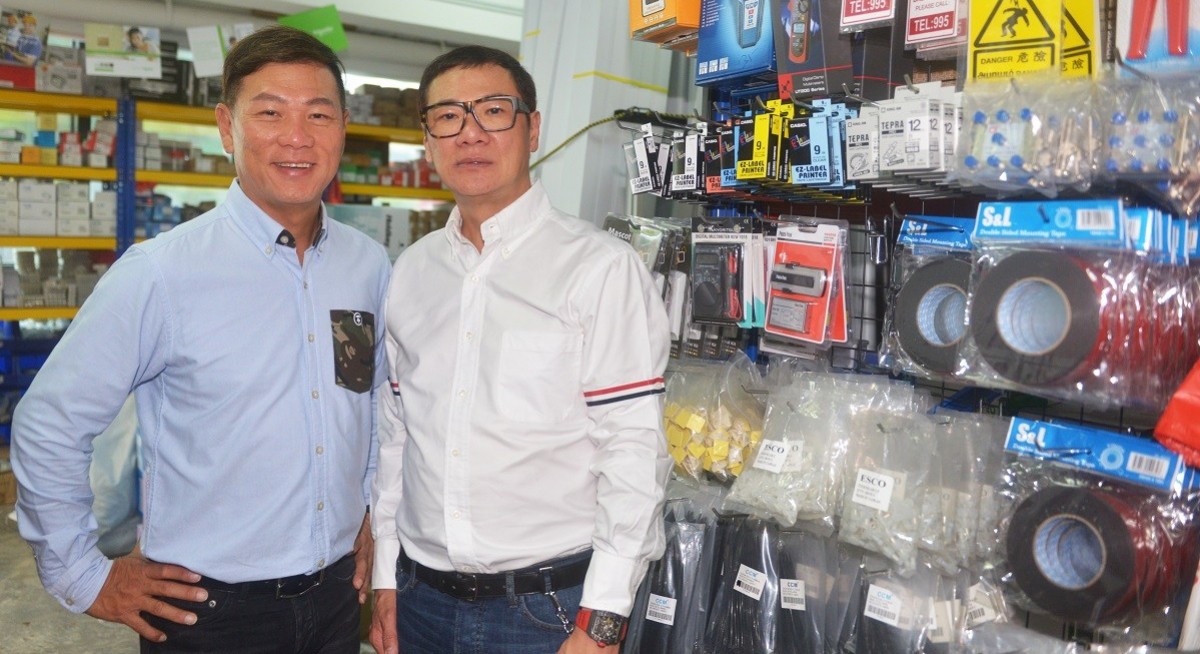


Having both proprietary and third-party brands is consistent with standard distributor economics: established brands drive traffic and credibility, while house brands typically enhance margins and pricing flexibility.
While not exactly glamorous, Choo Chiang boasts a track record that some flashier companies would envy: consistent profitability (even during the Covid pandemic), regular dividends and a cash-rich balance sheet backed by real assets.
The business started as a two-man operation in 1977. Even before it made its trading debut on the Singapore Exchange (SGX) Catalist board in July 2015, the company was already profitable. Today, its business rests on two pillars: electrical hardware distribution and property investment.
The numbers tell a story of resilience. Revenue for 2025 reached a record high of $93 million, with the distribution business accounting for the lion’s share. Gross profit margin held steady at 29%, broadly in line with prior years.
See also: CSE Global conducting 'strategic review' at largest shareholder Heliconia's request
Earnings were down 19% from the previous year at $9.5 million, as one-time gains and impairment reversals were absent. Lower interest income as well as higher bank charges and provisions for receivables also impacted its bottom line. Still, the result represents the third-highest annual earnings in Choo Chiang’s history, underscoring the consistency of its underlying operations despite the year-on-year decline.
Net cash generated from operations in 2025 rose to $12.2 million from nearly $10 million a year earlier, more than enough to fund dividends and capital expenditure.
No debt, dividends galore
What truly sets Choo Chiang apart on Catalist is the strength of its balance sheet. As at Dec 31, 2025, it had $37.2 million in cash, way more than its total liabilities of $20.7 million, which mostly comprised trade payables and lease liabilities. It has no bank borrowings. Finance costs are negligible, arising solely from interest on lease liabilities.
On a per-share basis, Choo Chiang’s cash pile works out to roughly 18 cents. This accounts for 51% of its latest reported net asset value of 35.25 cents a share and 41% of the stock’s 50-day moving average of 44 cents. At this price, investors are valuing its distribution business and property portfolio at only a modest premium to its cash, effectively assigning limited value to its earnings power and asset base.
Choo Chiang’s conservative capital structure is not merely defensive. It provides the firepower to pursue acquisitions, expand selectively or withstand downturns without the need for dilutive equity fundraising.
That flexibility was put to work in February 2024, when it announced a $5.7 million acquisition of five units of a new food factory at 45 Tuas South Avenue 1. Developed by Soilbuild Group, the eight-storey property was completed in October last year. Choo Chiang expects the five units to generate a rental yield of 6% to 7%. Following the acquisition, it now has 14 investment properties for rental.
Rental income isn’t substantial, accounting for less than 1% of the group’s annual revenue. That said, Choo Chiang has monetised some of its investment properties, realising gains and recycling capital into its business.
Its most recent divestment was in December 2024, with the sale of a freehold commercial unit at 421 Tagore Industrial Avenue. The property, previously carried at a net book value of about $1.6 million, was sold for $2.8 million.
While modest relative to distribution revenue, Choo Chiang’s property portfolio provides tangible asset backing and recurring income. In land-scarce Singapore, industrial and commercial space offers rental yield and potential for capital appreciation. This dual structure — an operating business plus property assets — offers a margin of safety for shareholders.
Sink your teeth into in-depth insights from our contributors, and dive into financial and economic trends
Structural resilience is one thing. Delivering cash to shareholders is another. On this front, Choo Chiang has built a credible record. It has no formal dividend policy but shareholders have received payouts annually, even during the pandemic years.
At its IPO, it stated it intended to distribute not less than 30% of net profits for 2015 and 2016. A decade later, dividend payments remain a defining feature. Its biggest payout was in 2024, with dividends totalling 2.9 cents per share, representing 51% of earnings. Last year’s dividends amounted to 2.6 cents a share, a payout ratio of nearly 57%.
This consistency underscores disciplined cash generation and alignment with shareholders. For income-focused investors, particularly in a volatile small-cap landscape, such predictability carries weight.
And for all the noise around trade wars and tariffs, this is not a business caught in the crossfire. Choo Chiang’s revenues are anchored in local consumption and domestic projects, not export arbitrage. Management expects minimal impact from Trump’s reciprocal tariffs, given its negligible exposure to export and re-import flows. Prudence remains the watchword on supply chains, but this is a company largely insulated from geopolitical theatrics outside Singapore.
A defensive outlier
Choo Chiang doesn’t fit neatly into any SGX box. It’s neither a pure construction proxy nor a typical retailer. Unlike Soon Lian Holdings or Ban Leong Technologies (which delisted in August last year), it’s not hostage to steel, marine or consumer IT cycles. It occupies a quieter corner of the market: electrical hardware distribution anchored to Singapore’s maintenance, upgrading and light construction ecosystem.
Electric cables and ceiling fans are functional necessities, driven more by refurbishment and incremental works than boom-and-bust mega projects. The result is a business that may lack drama but avoids sharp industry swings.
Few SGX names combine established electrical brands, a local retail footprint, recurring B2B relationships and a debt-free balance sheet with meaningful cash reserves. Choo Chiang sits somewhere between industrial supplier and defensive retailer, a hybrid that defies easy peer comparison. For investors, the takeaway is clear: consistent profits and dividends, and cash that makes up a chunk of its share price.




