






A year after the launch of City Developments’ (CDL) 2,800 sq ft CDL MicroForest, early findings indicate that the “living laboratory” helps cool temperatures by up to 5°C compared to surrounding and roadside areas.
Nature-based solutions like the CDL MicroForest at City Square Mall’s City Green park offer complementary approaches to traditional infrastructure, helping to reduce ambient temperature and support biodiversity connectivity and ecosystem services in dense city centres, says the Mainboard-listed developer at a March 20 event marking the first anniversary of the CDL MicroForest.
The cooling benefits of dense urban greenery help mitigate local heat even in surrounding areas. Data has shown that areas within 1m to 2m of the microforest edge have recorded temperatures of up to 1°C to 4°C lower than urban surfaces further away.
Environmental DNA sampling suggests “approximately 70% more species richness” within the microforest as compared to another grass patch outside the microforest. Species detected include millipedes and springtails. CDL also recorded higher bird-call activity within the microforest compared to surrounding areas, suggesting that the site may already be providing ecological value for urban wildlife.
In 2024, Singapore recorded its fourth consecutive year of near-record temperatures within a decade, alongside one of its heaviest rainfall years since 1980.
The urban heat island effect here can make urban spaces up to 7°C hotter than suburban forested areas, says Esther An, CDL’s chief sustainability officer. “The CDL MicroForest was set up to prove that nature-based solutions can provide a living shield against the rising heat, cooling urban spaces through greening. First-year data captures how dense, regenerative vegetation can help moderate temperatures and support biodiversity.
See also: City Square Mall’s $50 mil AEI adds 26,000 sq ft of GFA; mall records 9.7% rental reversion
Building on the initial success, the CDL MicroForest has doubled in size under City Square Mall’s asset enhancement initiative, doubling its footprint to 5,600 sq ft. CDL says this will amplify cooling effects, ecological benefits and research opportunities.

An NParks, CDL, NUS collaboration
See also: Singapore targets stronger business competitiveness and value unlocking with listcos
The CDL MicroForest was established in March 2025 as a nature-based solution grounded in the principle of “cooling through greening”. Supported by the National Parks Board (NParks), the collaboration between CDL and researchers at the National University of Singapore (NUS) brings together private-sector leadership and academic expertise in urban nature-based solutions.
By incorporating a diverse range of plant species, the CDL MicroForest mimics a tropical forest, lowering temperatures and providing refuge for Singapore’s wildlife, including native pollinators and dispersers. CDL says the project is a “scalable model” for integrating regenerative tropical microforests into dense urban areas.
Associate Professor Adrian Loo, deputy director of the Centre for Nature-based Climate Solutions at NUS, says: “Despite its compact footprint, the microforest at City Square Mall has indeed surprised us as a green urban sanctuary. Our preliminary data show increased biodiversity and activity alongside a measurable reduction in ambient temperatures.”
To encourage community involvement, the microforest project also began incorporating citizen science earlier this month. The free iNaturalist app encourages visitors to capture biodiversity observations and environmental data by uploading photos and information about the plants, animals, and other organisms they encounter.
According to CDL, the initiative has recorded 65 observations across 46 species within the CDL MicroForest.
CDL’s An says there are two more similar projects in the pipeline. “It’s already on the drawing board. One is a mixed development near residential properties, while the other is a community project.”
Responding to City & Country, An says CDL “has not signed on the dotted line yet”. “But that is our intent; my team and I are very, very committed to hopefully build more MicroForests.”
To scale the project, CDL is receiving support from the $50 million SG Eco Fund, established in 2020 to fund community projects that advance environmental sustainability.

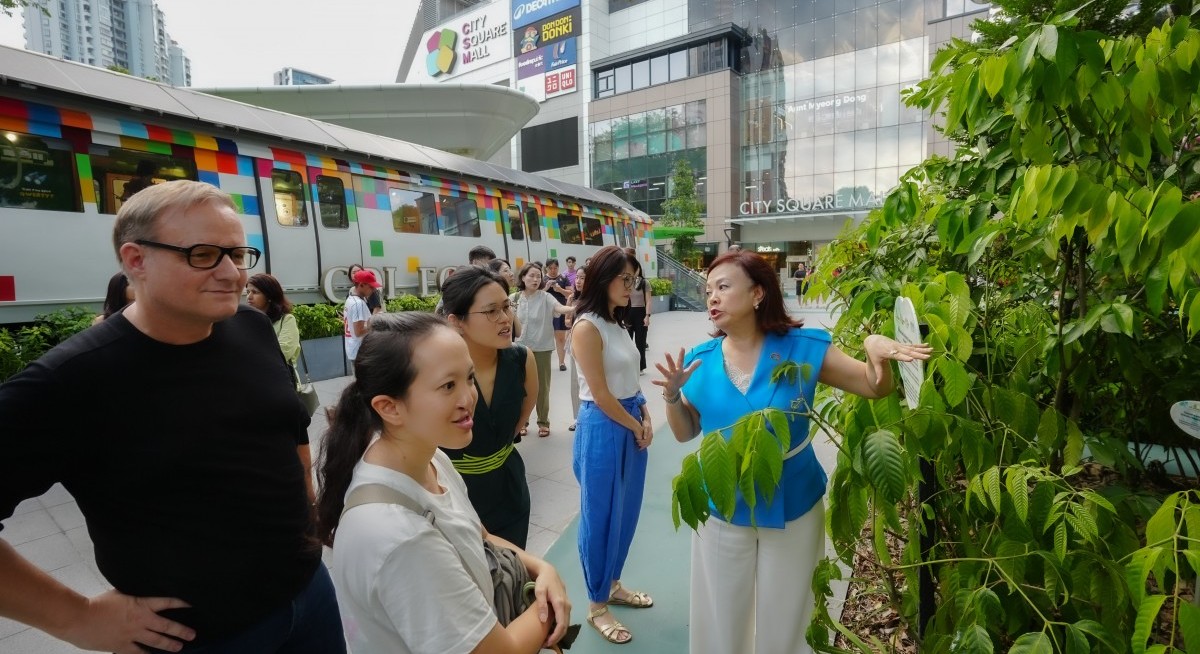
Associate Professor Adrian Loo, deputy director of the Centre for Nature-based Climate Solutions at the National University of Singapore (in black), speaking to guests at the CDL MicroForest
Ornamental versus natural greenery
The CDL MicroForest is “a small patch” of greenery that tries to recreate and mimic nature in our urban context “as much as possible”, says Professor Veera Sekaran, a botanist in the NUS President’s Office. “[We are] trying to recreate something that actually exists in the forest space.”
This stands in contrast to the “manicured landscapes that we are used to as a ‘garden city’”, he adds. “The maintenance guy comes and takes everything out that comes from natural sources, and keeps this as ornamental as possible. He doesn’t allow anything else to grow in between; he considers them weeds. But in a naturalistic environment, you suddenly see some species sprouting up naturally as well. That’s called natural recruitment, and that’s part of the forest ecosystem.”
Veera is involved in an ongoing master plan for the college campus. “I’m on a mission to actually try and ‘de-ornamentalise’ the whole campus as much as possible, because we’ve realised the campus is expensive to maintain. You need to come and cut the grass, prune the hedges and do a lot of work. People are getting used to the fact that a little bit of randomness and spontaneous greenery is appreciated.”
Responding to a question from the Singapore Green Building Council, Veera says the Building and Construction Authority (BCA) would benefit from having more “domain experts” advise on the design of its green building rating system.
The current system does not fully take into account the “tangible and intangible assets of greenery”, he adds. “You can’t have a bunch of people who do not have domain expertise, ecological knowledge or understanding the whole ecosystem, deciding this is what we will give one [or] two marks… We know the value of greenery makes a significant difference to us; so I think maybe we should push it harder.”
Photos: CDL




