
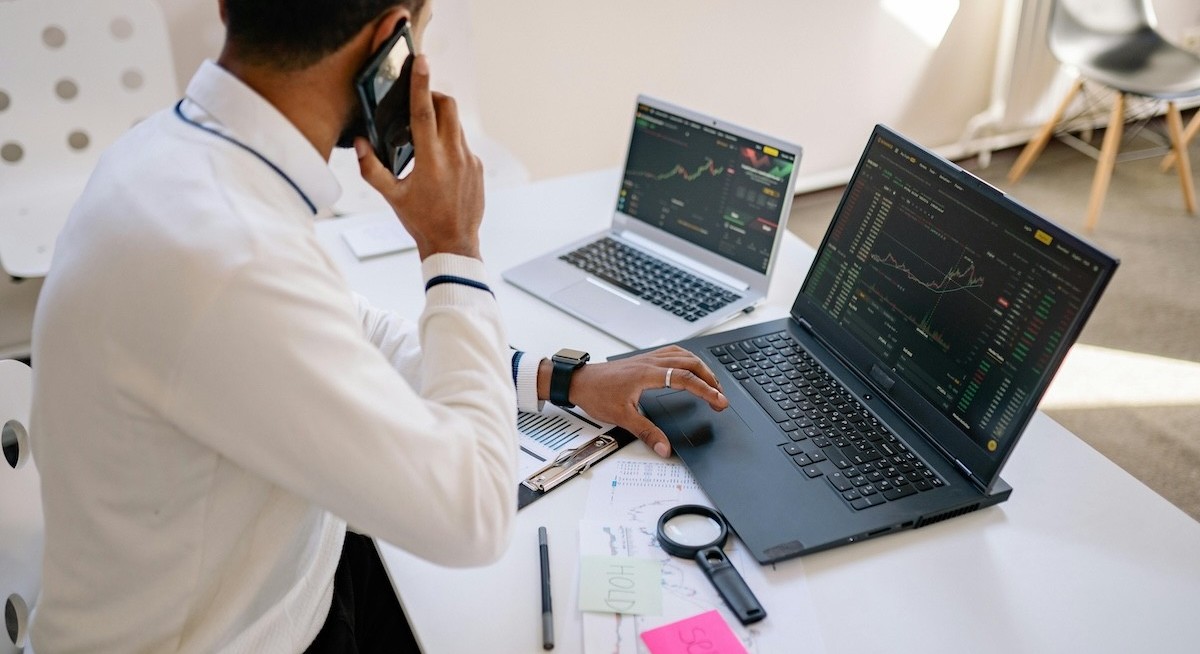

For much of the past year, conversations around artificial intelligence (AI) have centred on a single question: which jobs will AI replace next? The prevailing assumption has been that no industry is immune, least of all the financial industry, where speed, data, and automation play a central role. In fact, KPMG predicted that by 2025, 85% of financial institutions globally will have integrated AI into their operations.
While automation is reshaping workflows and accelerating decision‑making, volatility over the past few months, fuelled by the U.S.–Iran conflict, has exposed a different reality for traders. As uncertainty rises, many are seeking not just tools or data, but real people who can help them make sense of fast‑moving markets.
When geopolitics returns, uncertainty follows
Over the past few months, investors worldwide have been navigating a steady stream of unsettling headlines. Escalating tensions in the Middle East have pushed oil prices sharply higher at times and unsettled currency markets. Assets that once moved predictably have become more sensitive to sudden shifts in sentiment.
As in previous periods of uncertainty, this has driven trading activity. Singapore Exchange (SGX) recorded its highest trading volumes in the first quarter of 2026, fuelled by heightened volatility and strong participation in derivatives. Yet beyond the visible churn of buying and selling, a quieter shift is also underway: more investors are reaching for people.
Digital works until it doesn’t
The past decade has seen investing become more digital and increasingly self-directed. Investors have gained easier access to global markets and tools that support long-term portfolio management, while traders have embraced platforms that enable faster execution across asset classes.
Even in an era of highly automated, digital trading infrastructure, execution traders remain critical because liquidity is neither uniform nor static. Liquidity can vary dramatically across asset classes, instruments, venues, time zones, and even within the same product, depending on market conditions such as volatility spikes, macro events, index rebalancings or local market hours. Algorithms are designed to optimise for predefined conditions, but they can struggle when order books thin out, correlations break down, or market behaviour shifts abruptly. Skilled execution traders add value by interpreting real‑time market depth, understanding the true cost of immediacy versus patience, adjusting execution tactics dynamically, and managing market impact—especially for larger or more complex orders. In stressed or fragmented markets, human judgment, experience, and situational awareness often make the difference between simply “getting filled” and achieving genuinely good execution outcomes.
Where retailisation meets its limits
At the same time, the retailisation of trading has introduced a new challenge. As platforms compete to attract broader participation, much of the focus has shifted towards simplicity, accessibility and scale. For savvy traders who are becoming more active and deploying larger amounts of capital, access is rarely the issue.
What matters more is support around complexity. Managing multi‑asset exposure, navigating drawdowns, and structuring trades around events where liquidity and sentiment can shift rapidly all require a deeper understanding of market dynamics than a simplified interface can provide. In unsettled conditions, the gap becomes more apparent.
When the questions change
In recent months, conversations have increasingly shifted away from market direction and towards execution under uncertainty. Traders are reaching out to discuss how best to manage entry and exit points, whether to scale positions gradually or decisively, and how liquidity might evolve around key geopolitical or macro events.
There is also growing demand for direct market insight — from speaking with sales traders who see flows across regions and asset classes, to engaging with strategists who can frame macro risks and cross‑asset implications.
What this means for the future of trading
What is emerging is not a reversal of progress, but a more balanced phase of it. Traders want the efficiency and access that digital platforms provide, but they also want context, judgement and accountability when conditions become uncertain.
As markets grow more complex and volatility becomes more frequent, traders will increasingly rely on human interaction at critical moments — when deploying larger capital, navigating unfamiliar conditions or responding to rapid market shifts. The future of trading is not human versus machine, but human alongside machine.
Chris Lum is the Singapore head of Sales and Relationship Management at Saxo


