



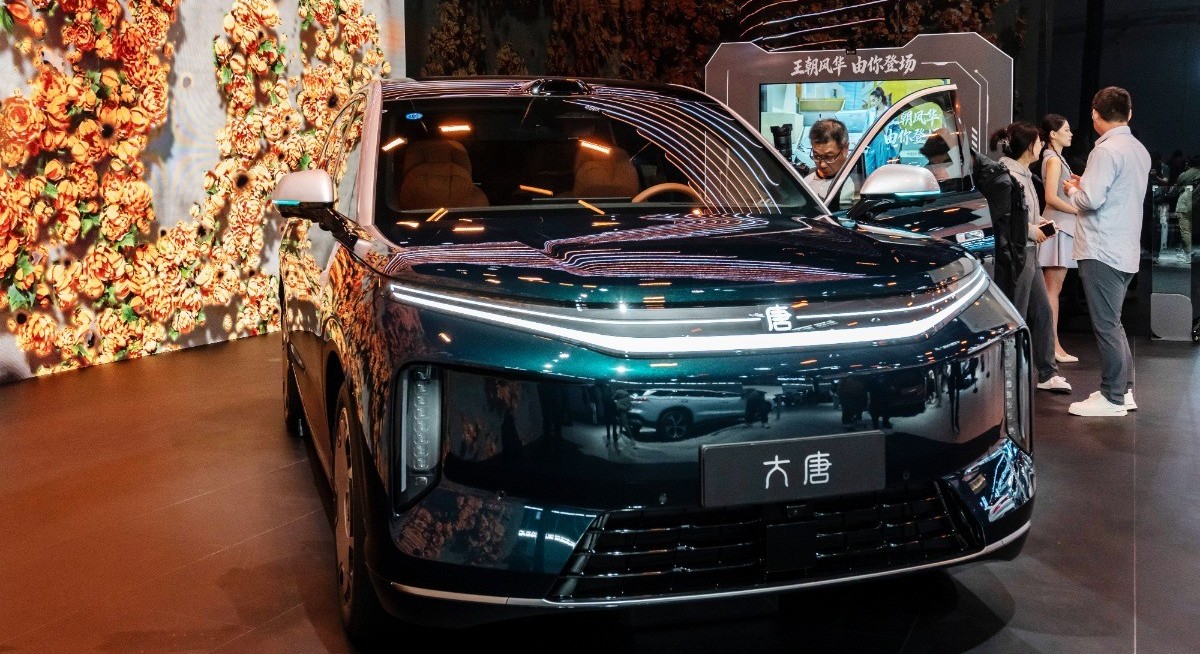



(June 18): China’s BYD Co plans to start selling its Great Tang sport utility vehicle (SUV) in Europe as soon as the end of this year, building on strong demand for the new seven-seater at home, according to senior company executive Stella Li.
Europe and the Asia-Pacific are slated to receive the all-electric Great Tang by year-end or early 2027, Li said on Thursday in an interview at the FII Priority Europe forum in Rome.
The mid-priced model would give BYD another pillar in its European portfolio, intensifying pressure on incumbents after pushing into the market with smaller EVs and hybrids. The Great Tang has racked up more than 150,000 orders since its debut at the Beijing Auto Show in April, giving BYD a domestic hit it’s eager to expand with abroad.
“We got 100,000 bookings in two weeks” during the initial presale period in April, said Li, who is BYD’s executive vice president and oversees its global expansion.

BYD senior company executive Stella Li said Europe and the Asia-Pacific are slated to receive the all-electric Great Tang by year-end or early 2027.
See also: Electric vehicle outlook sinks as US withdraws policy support
BYD has expanded rapidly overseas after a crowd of entrants made the Chinese car market one of the world’s most competitive. International sales were a key contributor to May’s first volume increase for the company in nine months.
In Europe, the company is among leading Chinese carmakers that snapped up 15% of EV sales as a group in April, and nearly 10% of overall unit volume. European carmakers, by contrast, are losing their place in China as they face tougher competition at home.
The Great Tang, priced at the equivalent of about US$35,500 in China, is aimed at a market where brands like Mercedez-Benz, Kia and Volvo compete. The Jaecoo 7 SUV, nicknamed the “Temu Range Rover,” has racked up sales in the UK for China’s Chery Automobile Co, but doesn’t come as a full EV.
See also: Eurosports Global's unit Scorpio Electric receives conditional nod from LTA for electric motorbike
The Great Tang’s blade battery and flash-charging technology have given it an edge against peers in China, according to Deutsche Bank, which projects unit sales of 10,000 per month.
BYD is stepping up investment in Europe, Li added. Its factory in Hungary is ramping up production of both vehicles and components. The company is evaluating a second manufacturing site in the region, though no location has been chosen.
The company also plans to expand its European research and development, Li said, including work on autonomous-driving technologies and data capabilities.
In China, Li said BYD expects its own sales to remain strong even as the broader auto market slows. The company is relying on new technologies and higher-end models to support growth, she added.
“The consumer wants to hold money so we’ll see,” Li said. “Maybe in the second quarter there will be some change.”
Uploaded by Felyx Teoh




