



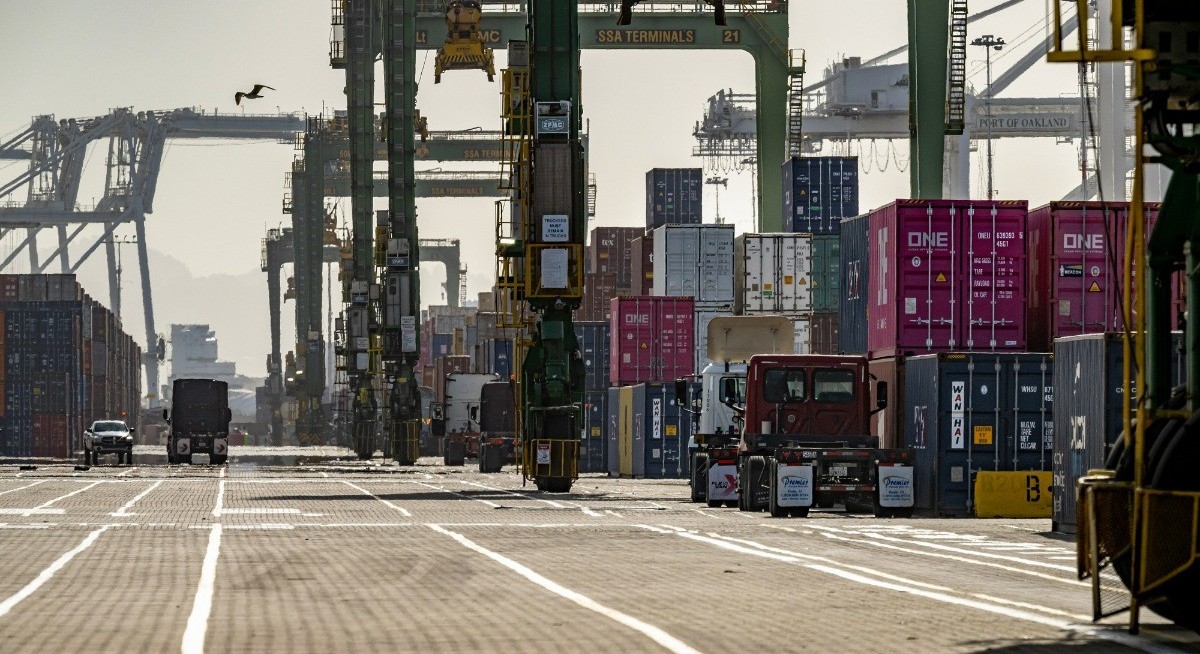



(July 7): A three-day hearing on the US Trade Representative’s latest plan to impose tariffs on major trading partners kicks off in Washington on Tuesday.
The US launched an investigation into the forced-labour prohibition policies of 60 countries in March, citing a law that authorises tariffs on countries deemed to unfairly burden US commerce. That basis is viewed as more legally sound than the emergency power President Donald Trump used last year to impose tariffs that were ruled illegal by the Supreme Court in February.
The USTR determined in early June that each of the investigated economies failed to “impose and effectively enforce a forced labour import prohibition”, and recommended that goods imported into the US from those economies face an additional 10% or 12.5% duty.
As part of the process, dozens of stakeholders will make their case — for or against the duties — to US trade officials. White House officials have already made it clear that they plan to use the forced labour and other investigations to restore import taxes to levels in place under Trump’s emergency tariffs.
In the meantime, the administration has a temporary 10% global tariff in place that expires later this month.
A separate USTR hearing on Brazilian policies and practices is also taking place this week, and Flávio Bolsonaro, Brazilian senator and son of the former president Jair Bolsonaro, is slated to testify on Tuesday. He is expected to urge the Trump administration not to impose new tariffs on Brazilian exports before the October election or target Pix, the country’s popular instant-payment system.
See also: How global value chains are reconfiguring in the Age of Brutal Geonomics
“The proposed tariffs would reward the very offenders they are meant to punish,” Bolsonaro wrote in a filing to USTR, arguing that the measures would benefit President Luiz Inácio Lula da Silva, whose popularity rose after casting earlier US pressure as an attack on Brazil’s sovereignty.
Tuesday
Up first in the forced-labour lineup, USTR will hear from a panel of government officials, including Mexico’s Ernesto Acevedo Fernández, on “how Mexico’s USMCA Forced Labor Mechanism effectively enforces our forced-labour import prohibition”.
See also: Switzerland’s inflation slows for first time in eight months
Diplomats and trade officials from Chile, Ecuador, Guatemala, Guyana, Honduras and Peru are also set to speak.
The second panel on Tuesday will feature the American Line Pipe Producers Association and the Steel Manufacturers Association. The groups will testify in favour of duties to counter what they call a flood of imports of steel mill and steel containing products, in part driven by low labour standards and the absence of import bans on goods produced with forced labour.
The American Petroleum Institute will ask USTR to drop duties on industrial inputs that are critical to the oil and gas industry, which the lobby group says have no link to forced labour and “simply cannot be sourced domestically either at all, or in sufficient quantities, by the industry responsible for meeting the Trump Administration’s aim of US energy dominance”.
Later on, a former USTR official will argue that these investigations betray the intended uses of Section 301 of the Trade Act of 1974, according to prepared testimony shared with Bloomberg News.
“Senior administration officials have described their purpose as not to address unreasonable ‘acts, policies, and practices’ burdening US commerce, but to recreate the tariff rates set under last year’s illegal ‘IEEPA’ decrees,” said Ed Gresser, who is now vice president and director for trade and global markets at the Progressive Policy Institute.
Gresser is set to argue that the USTR’s report does not prove that the listed economies buy imports of goods made with forced labour, nor that they impose a burden on American commerce. “Therefore, the tariffs it recommends — again, roughly US$100 billion ($129.21 billion) a year in new costs for Americans — are inappropriate and ought not to stand,” Gresser said.
Wednesday
To stay ahead of Singapore and the region’s corporate and economic trends, click here for Latest Section
On Wednesday, the Coalition for Fair Trade in Seafood will call for an additional higher rate on seafood from Vietnam, especially in the processing industry, which the group says is particularly vulnerable to forced and child labour.
Representatives from India, Jordan and Pakistan are also scheduled to speak.
Pakistan’s representative is expected to argue the USTR’s recommendations are “disproportionate given the absence of evidence of forced labour in Pakistani export goods and Pakistan’s enactment of an import prohibition”.
Human rights groups including China Labor Watch are supposed to testify. China Labor Watch will argue that “any preferential tariff treatment, including the proposed textile mechanism or similar sector-specific mechanisms, should apply only to products that can be credibly and independently verified to be free from forced labour”.
Thursday
The hearings will wrap up with comments from the Footwear Distributors & Retailers of America and the National Council of Textile Organizations, joined on the panel by the American Cotton Producers.
Government representatives from South Korea, Sri Lanka and South Africa will also speak on the panel, including a representative from Vietnam who will take issue with the finding that the country “has failed to impose and effectively enforce measures addressing goods associated with forced labour”.
Finally, trade officials will hear testimony from a cross-section of the US economy including the American Trailer Manufacturers Coalition, cookware brand Le Creuset, the Cigar Association of America and medical device companies.
Le Creuset pointed out in a filing to USTR the company employs nearly 800 people in the US, despite not manufacturing their cookware domestically. Their enamelled cast iron cookware product “presents no risk to American manufacturing due to the fact that there is no comparable domestic production of such premium enamelled cast iron cookware to satisfy the demand”, the company said.
Uploaded by Chng Shear Lane




