



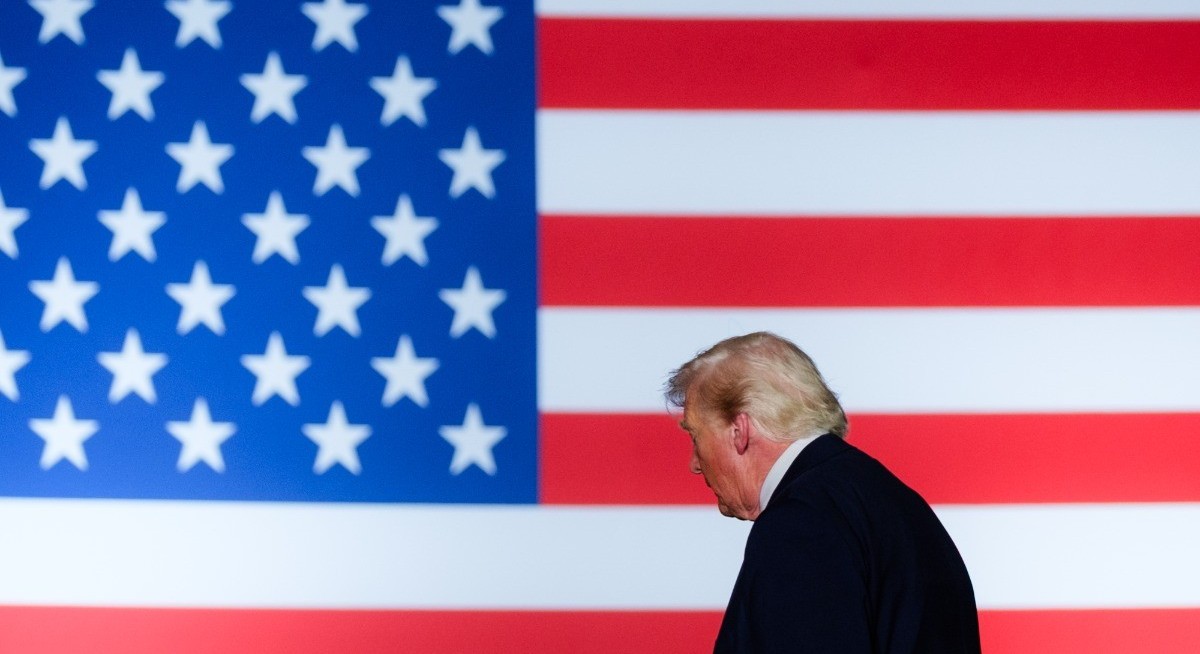


(April 7): As US President Donald Trump muses about seizing control of Iran’s oil sector, one potential upside is looming in his thinking: expanding US global energy dominance to gain trade leverage against China, people familiar with the matter said.
Trump repeatedly discussed the prospect on Monday, casting it as a boon to the US even as he acknowledged the political risks of further entangling the US in the Middle East.
“If I had my choice, what would I like to do? Take the oil, because it’s there for the taking. There’s not a thing they can do about it,” Trump told reporters at the White House “Unfortunately, the American people would like to see us come home. If it were up to me, I would take the oil, I would keep the oil. I would make plenty of money.”
Trump has already demonstrated his belief that controlling oil flows brings power on the world stage: The US ousted Venezuela’s Nicolas Maduro and struck a deal with the remaining government to tap the country’s crude reserves. But the focus on Iranian crude is also fueled by several factors, including Trump’s belief that bringing Tehran’s energy flows under the US sphere could bolster his bargaining power with Chinese counterpart Xi Jinping, according to the people, who asked not to be named to describe his thinking.
Trump administration officials have discussed what they see as Beijing’s diminished leverage as a result of US operations in both Venezuela and the Middle East, according to one of the people. China is a major crude importer, and the Iran war’s effective closure of the Strait of Hormuz has constrained supplies, spiking oil and gas prices.
Exerting long-term control over Iran’s energy represents a massive undertaking that would likely require a far more substantial US investment of money and personnel in the conflict and prompt additional questions about international law. Polls show majorities of Americans want a quick end to the war, as they also grapple with higher gasoline prices at home.
See also: Foreign Minister Vivian Balakrishnan says worst case on war not fully priced
A White House official said Trump likes the idea of taking Iran’s oil but cautioned there are no formal plans to do so and it’s not part of the current programme. Trump did not list control over Tehran’s energy facilities among the conditions for a potential deal to end hostilities ahead of his Tuesday deadline for Iran.
Beijing is likely to see the ramifications of the Iran war differently, as Trump struggles to secure the support of US allies in the conflict and pulls military resources from Asia to the Middle East. Unlike other Asian leaders, Xi still hasn’t commented directly on the war, but China has spent years preparing for just such an eventuality, building up large reserves, boosting home-grown hydrocarbon production and a vast renewable energy industry.
China and its refining sector will suffer if oil remains at current levels — but the country also has significant ability to endure economic pain, a fact the Trump administration already underestimated when it imposed punitive tariffs in 2025.
See also: UK private sector flatlines in March as stagflation fears rise
China’s Ministry of Foreign Affairs in a statement said that it opposes the use of force to “infringe upon the legitimate rights and interests of other countries”, adding that “Iran’s sovereignty security and territorial integrity should be respected, and its full and permanent sovereignty over its natural resources and all economic activities should be safeguarded”.
Trump’s comments on Monday come ahead of his May 14-15 visit to Beijing for a summit with Xi, a key test for the world’s two largest economies. The US and China have traded tariffs and looked to squeeze each other’s supply chains, including for the critical minerals and magnets that are crucial components of modern-day manufacturing. The biggest energy shock to the global economy in decades has only complicated that dynamic.
Winner’s spoils
Trump has often lamented that the US didn’t seize Iraq’s oil following the 2003 US invasion, casting it as a strategic mistake to forgo crude reserves that he said could have reimbursed the cost of military operations there.
“To the winner belong the spoils,” Trump said at a news conference on Monday. “I have said, ‘why don’t we use it?’ To the victor go the spoils, and we don’t have that.”
For now, Trump appears more focused on addressing the near paralysis of oil, natural gas and fertilisers shipped through the Strait of Hormuz — vacillating between demanding Iran open it up and insisting other countries, including China, police the waterway.
Trump said if Iran doesn’t open the strait to “free travel”, the US will attack the country’s bridges and power plants as soon as Tuesday evening, Washington time.
To stay ahead of Singapore and the region’s corporate and economic trends, click here for Latest Section
Asked whether he could tolerate Iran imposing a toll on tankers, Trump floated that the US could instead charge ships for crossing the strait. Separately, he has suggested the US could seize Kharg Island, a key Iranian oil hub.
“Taking the oil, as Trump puts it, might be more about the barrels themselves than bargains with Beijing,” said Kevin Book, a managing director at Washington-based ClearView Energy Partners. “But leverage is leverage — whether it comes from serendipity or strategy.”
China squeeze
Trump’s geopolitical moves are already affecting China.
Before Maduro’s capture, China’s independent refiners were major buyers of Venezuela’s crude, capitalising on discounts for the sanctioned supplies and effectively funding the government in Caracas. While China can still purchase Venezuelan crude, energy analysts say it’s at higher cost and Beijing’s influence in the region has diminished.
Similarly, China was a top customer for Iran’s cheap sanctioned crude prior to the US and Israeli war. But the conflict has turned the discount on Iranian crude into a small premium.
Even a US waiver authorising purchases of previously sanctioned Russian crude has squeezed Beijing. After the US government ordered the sanctions relaxation, tankers of crude bound for China swiftly changed their destinations to India. Other Asia buyers also emerged, prompting prices to jump.
US sanctions previously “opened the door for China to buy distressed barrels at a discount”, Book said, but now, “US military actions are closing it.”
The crisis raises questions for the vast independent refining sector in China which is coming under unprecedented pressure — a crunch that will cause pain but may also help remove some of the significant oversupply.
The Trump administration has encouraged Western oil companies to return to Venezuela, blessed exports from the country and seen its crude output climb, hitting a five-month high of 788,000 barrels in February. While that’s far from Venezuela’s production peak of roughly three million barrels, it means more barrels from the Americas broadly and, under a so-called Donroe Doctrine seeking maximal hemispheric dominance, more US influence globally.
Clayton Seigle, a senior fellow at the Center for Strategic and International Studies in Washington, sees an opportunity for the US to apply its Venezuela playbook to Iran through aggressive enforcement of sanctions on Iranian crude in the Arabian Sea, beyond the reach of most of the country’s weaponry. Seized oil cargoes could be sold by commodity trading firms on the world market, ensuring Tehran doesn’t benefit.
“Destroying Kharg Island is not the way to go, and occupying Kharg Island isn’t the way to go,” Seigle said. “Instead, just do the Venezuela thing again — just seize their oil cargoes away from the Iranian weapon systems.”
Uploaded by Tham Yek Lee




