



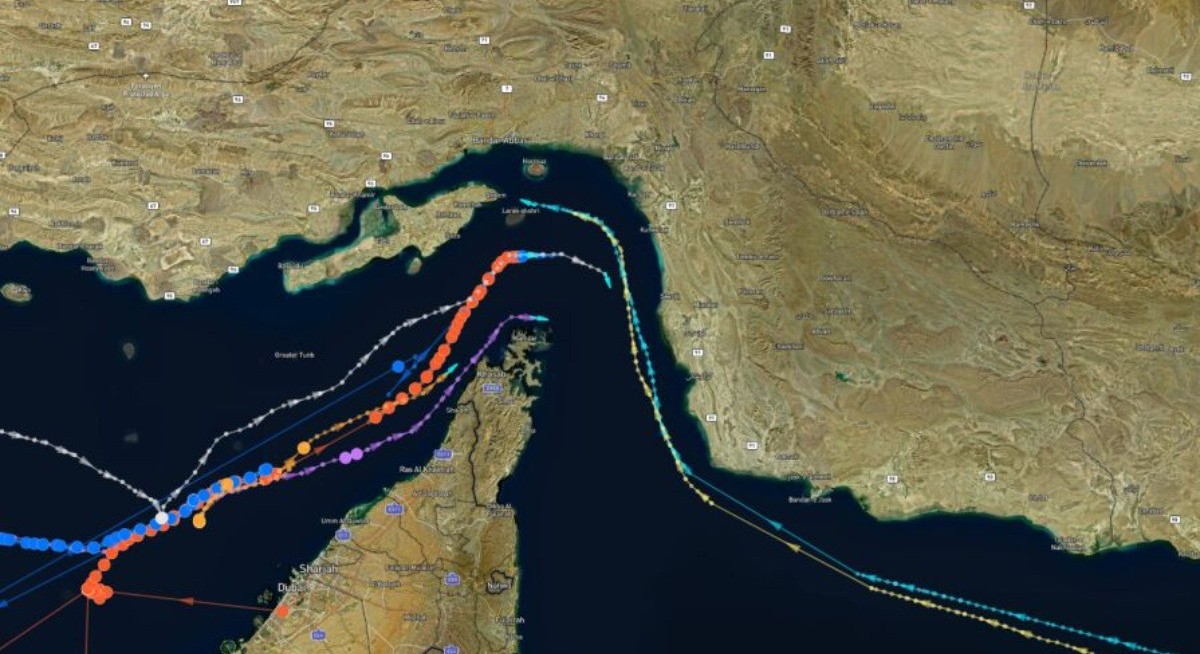



(June 23): More ships are openly signalling their intention to traverse the Strait of Hormuz, pointing to growing confidence among shipowners and traders about sending vessels through the chokepoint as tensions ease.
Seven tankers were in the strait on Tuesday morning, according to conventional, visible tracking signals. Among them are two fully-laden non-Iranian supertankers leaving the Persian Gulf. Three product carriers also sailed outbound, while two Iran-flagged Suezmaxes approached from the other side. An eighth tanker — a very large crude carrier (VLCC) — also sailed into the gulf, but it did so without broadcasting during the passage, reappearing after crossing.
The shift “reflects a degree of strengthening confidence among shipowners, as Iran is expected to refrain from targeting vessels,” said Muyu Xu, senior crude oil analyst at Kpler Ltd. Still, it remains to be seen whether safe and unrestricted passage will indeed materialise, Xu cautioned.
Financial markets including commodities are zeroed in on conditions in the waterway as an interim deal between the US and Iran agreed last week paved the way for a resumption in traffic. In recent days, millions of barrels of crude have been observed passing through the waterway — which links the gulf to global customers — along with inward transits of natural gas tankers.
The marked shift in conditions — coupled with ongoing talks in Switzerland between Washington and Tehran over a permanent settlement — have helped to drag crude futures sharply lower. Brent was below US$77 a barrel on Tuesday. That compares with the pre-conflict price a little below US$73, indicating the bulk of the gains from the war have now been unwound.
Activity in the strait had been at a near standstill since the start of the war in late February. Now, more vessels are willing to broadcast their locations, allowing oil and shipping markets — as well as global investors — to get a better sense of traffic flows through the strait.
See also: Oil steadies as Iran sales waiver signals peace talks progress
In peacetime, about 135 vessels traversed the waterway daily, including vessels carrying energy such as oil, crude products, and natural gas, as well as other cargoes including bulk products, containers and livestock. They typically used a so-called automated identification system, or AIS, to broadcast their locations. The tankers observed on Tuesday all used that system.
The transmissions are typically required by mainstream insurers, financiers and lawyers, who require the visibility in order to support trading. Some major insurers insist that such transponders must be kept on in order to provide coverage.
Among the current transits, the VLCC Universal Glory, entered the strait on Tuesday morning from inside the Persian Gulf, hauling two million barrels of Saudi crude. It’s taking a route near the middle of the strait, and lists South Korea as its destination.
See also: Qatar brings empty LNG ships through Hormuz as exports rise
Trailing it are two products tankers, while a Norwegian-flagged vessel, and another VLCC hugged the Omani coast. A day earlier, three VLCCs with Iranian crude openly signalled crossings.
In the reverse direction, Suezmaxes Sarak and Sobar are making inbound transits. The two tankers sailed from waters near Pakistan. On Monday, a non-Iranian VLCC and four liquefied natural gas carriers broadcast their crossings into the gulf.
Even though more ships have begun signaling their transits, some still opt to turn off their transponders for a portion of the crossing. Hours before Universal Glory began its transit, a Taiwan-bound VLCC entered the strait but then went dark, laden with Saudi and United Arab Emirates crude cargoes. Hours later, it reappeared in the Gulf of Oman.
Universal Glory’s operator HMM Co Ltd, as listed on the South Korean company’s website, didn’t immediately respond to emailed requests for comment. An email sent to the account listed on database Equasis as belonging to Sobar’s India-based manager, Vaniya Ship Management Pvt Ltd, failed to get through.
Uploaded by Felyx Teoh




