



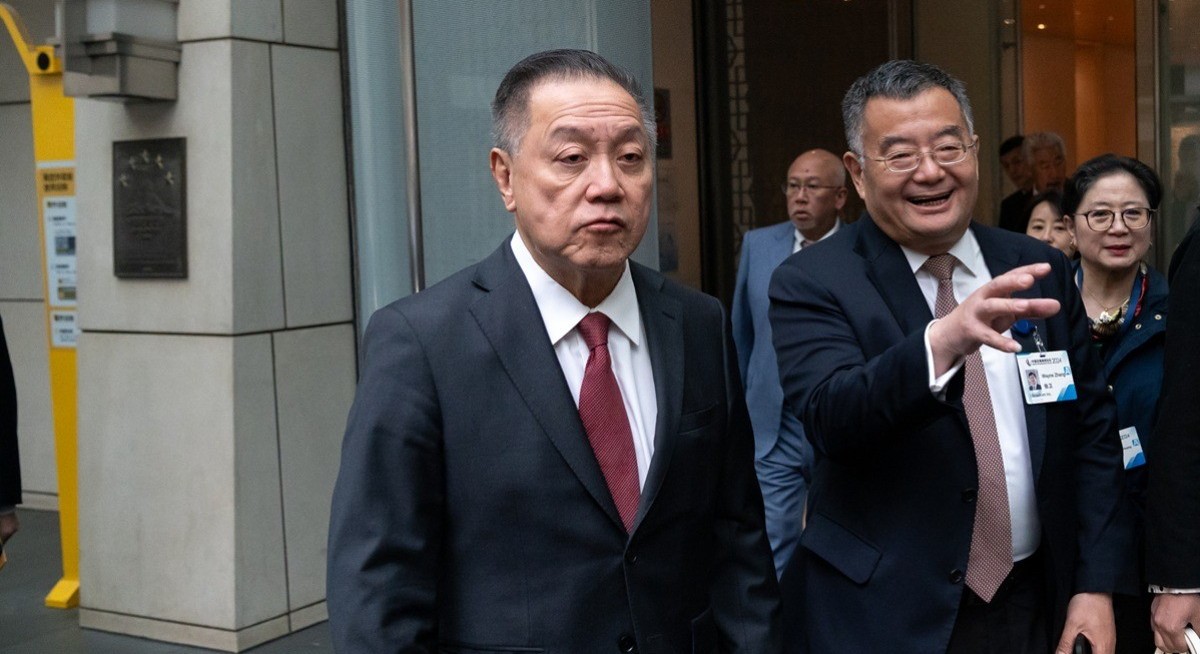


(March 5): Broadcom Inc chief executive officer Hock Tan said the company expects its artificial intelligence (AI) chip sales to top US$100 billion next year, marking major inroads into territory dominated by Nvidia Corp.
“We have line of sight” to reach this milestone in 2027, he said during a conference call with analysts on Wednesday. “We have also secured the supply chain required to achieve this.”
The company projects that AI chip revenue will be US$10.7 billion in the current quarter, so reaching an annual pace of US$100 billion would be a major jump. Broadcom reported US$20 billion in AI sales in 2025.
Broadcom shares rose as much as 4.2% on Thursday after trading got underway in New York.
Tan has increasingly hitched Broadcom’s fortunes to AI. Though Nvidia remains the biggest maker of accelerators — the chips that help train and run AI models — Broadcom has positioned itself as an alternative with its custom-made semiconductors. The company’s AI chip targets include both accelerators and networking semiconductors.
Broadcom also delivered a better-than-estimated quarterly outlook on Wednesday and announced a stock buyback plan worth as much as US$10 billion.

See also: US considers requiring permits for Nvidia, AMD global AI chip sales
Revenue will be about US$22 billion in the fiscal second quarter, which ends May 3, the company said. Analysts had predicted US$20.5 billion on average, though some projections topped US$22 billion, according to data compiled by Bloomberg.
The company had faced scepticism about its AI prospects this year, with Broadcom shares falling 8.3% through the close.
Investors have grown more concerned about a bubble in AI spending, and even a blockbuster earnings report from Nvidia last month led to a stock selloff. One key question is whether the current AI wave will extend beyond the next few years.
See also: Private credit’s canary in the coal mine moment
Broadcom had seen its valuation surge in recent years, helped by deals to make custom AI chips for companies like OpenAI and Anthropic PBC.
Its prospects have also benefitted from increased interest in Google’s TPU, or tensor processing unit, a chip that Broadcom helps develop for the search giant. And Broadcom just shipped the first units of a new generation of processors that it said will be adopted by about a half-dozen more clients this year.
In the fiscal first quarter (1Q), which ended Feb 1, sales rose to US$19.3 billion. Profit was US$2.05 a share, excluding some items. Analysts had projected revenue of US$19.3 billion and earnings of US$2.03 per share.
AI revenue more than doubled to US$8.4 billion in the period, Broadcom said, a faster clip than it anticipated. The increase was “driven by robust demand for custom AI accelerators and AI networking,” Tan said in a statement.
Even if Broadcom hits its targets, Nvidia will still dwarf the company in AI revenue. Nvidia is expected to generate US$333 billion in fiscal 2027 from AI data centre customers.
Tan said on the conference call that he expects OpenAI to begin shipping its Broadcom chip in volume next year, reaching more than one gigawatt (GW) of computing capacity.
He also said that demand for Google’s TPU is strong and will accelerate further in 2027. Broadcom plans to ship chips to Anthropic, which is using Google’s TPUs, to enable 1GW of capacity this year and more than 3GW next year.
To stay ahead of Singapore and the region’s corporate and economic trends, click here for Latest Section
Tan also discussed progress with another chip customer, Meta Platforms Inc. He took issue with recent reports that Meta might be moving away from planned work with Broadcom on custom accelerators, saying the road map was “alive and well”. Products are shipping now and next-generation versions will “scale to multiple gigawatts in ’27 and beyond,” he said.
Separately, Meta touted its ambitions for the chips on Wednesday. Chief financial officer Susan Li said the company was aiming to develop chips that can train its AI models.
Beyond Broadcom’s custom AI chip work, the company continues to update its networking equipment to better link up the computing needed to run AI models. Tan also has built a large software operation through acquisitions.
The new buyback plan, which follows US$7.8 billion in stock repurchases during 1Q, will run through the end of the year, the Palo Alto, California-based company said.
Uploaded by Felyx Teoh




