






For the past decade, the global conversation about sustainable cities has been converging on a single destination: net zero. Governments have committed to it, developers have pledged it and certification schemes have been redesigned around it. Net zero has become the definition of success.
It is the wrong finish line.
The progress net zero has driven is important. But it is a target defined entirely by harm reduction. A city that reaches net zero has stopped making things worse, ceasing to be a problem.
That is not the same as becoming a solution, and the distinction matters.
We are, by nature, a regenerative species. Living systems — every organism, every ecosystem — work through reciprocity, adaptation and interdependence.
Humans, with the cities we built, broke from that pattern, harnessing stored energy and altering entire landscapes in ways that deplete the very systems we depend on.
See also: UK apartment owners are getting locked out of money-saving green tech
Net zero says: “Stop depleting quite so much.” Regeneration asks something harder: “What can a city actively give back?”
Responding with characteristic determination, Singapore illustrates both the achievement and the limitation.
Buildings account for over 20% of the country’s carbon emissions. With no hinterland to absorb its footprint, the stakes are immediate. The Building and Construction Authority’s (BCA) Green Mark scheme has grown from 17 certified buildings at its launch to almost 3,000 today, offsetting carbon equivalent to replanting a forest more than 13 times the size of the island, and delivering some $1.3 billion in annual cost savings.
The Singapore Green Building Masterplan sets targets for 80% of buildings to be green, and 80% of new developments to meet Super Low Energy standards by 2030. As of late 2025, close to 66% of Singapore’s buildings have been greened.
These are real achievements. And yet Singapore remains a net extractor; more carbon enters its atmosphere than its ecosystems can absorb. Its urban waterways, soils and biodiversity are managed rather than restored.
By the logic of net zero, this is a city making excellent progress. By the logic of regeneration, it is a city still in deficit.
The question is: Which logic should govern what we build next?
Part of the answer lies in how we measure. The dominance of carbon accounting has narrowed our imagination. Carbon can be counted, priced, traded and disclosed — so capital flows toward it, policy organises around it and certification schemes reward it.
Biodiversity, community health, watershed integrity and ecological interdependence are harder to pin down; some resist quantification altogether. The result is a planning and finance system that is very good at measuring one dimension of urban performance, while the others go largely untracked.
So what happens is that a city of certified buildings can still have degraded waterways, fragmented habitats and communities whose health is not improving. Net zero at the building level does not automatically produce ecological health at the city level.
Net zero asks: “How little damage can we do?”
Regeneration asks: “What can this city actively contribute to its ecosystems, its communities, the living systems that make urban life possible?”
It is a different design philosophy, a different measurement framework and a different investment thesis. And there are proof points.
In Kaua’i, Hawaii, the Economic Resilience Center treats ecological health as a structural requirement. The health of surrounding coral reefs and wetlands is understood as inseparable from the building’s own resilience.
Indigenous knowledge is woven into the design. Ecological, social and economic performance are measured as one system, because they are one system. This is what net zero frameworks cannot easily capture: a building in an active relationship with its surroundings.
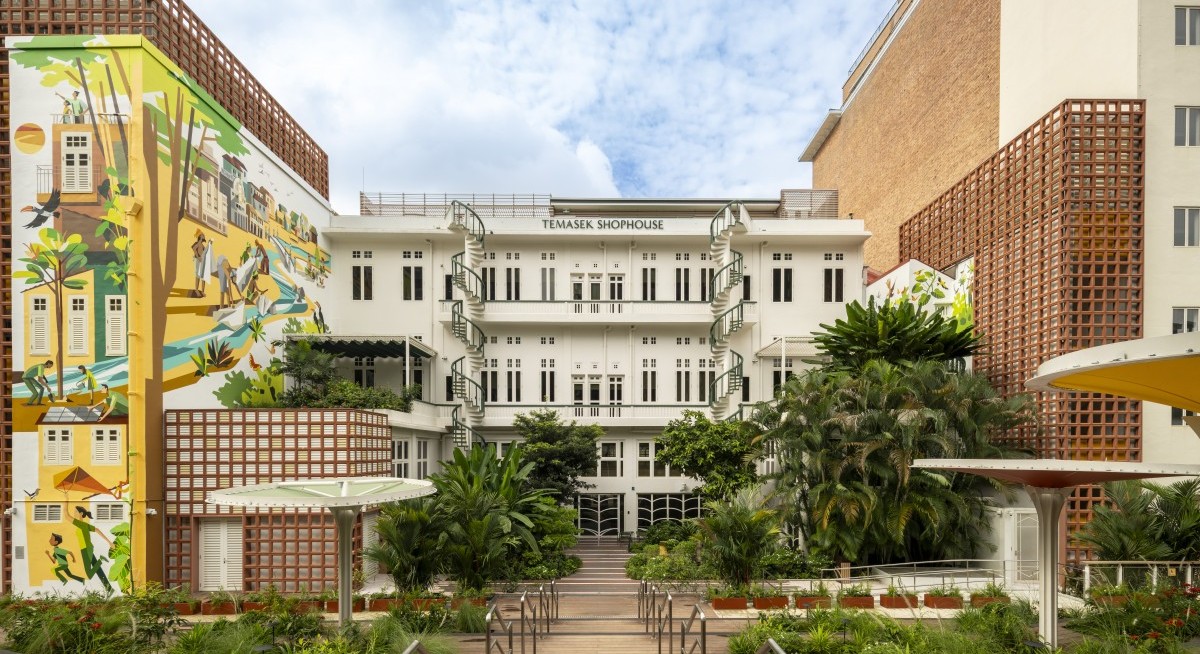
In Singapore, Temasek Shophouse shows what this looks like within a conserved heritage structure: solar, rainwater harvesting and native planting combining for 47% energy savings, putting it on course to become the city’s first heritage building to achieve BCA Green Mark Platinum Zero Energy.
At Jewel Changi Airport, over 2,000 trees and 100,000 shrubs actively purify the air and moderate the temperature, with greenery as the infrastructure for regeneration. Jurong Lake District takes the logic to district scale, embedding regenerative measurement from the ground up and tracking what the precinct gives back.
The New Lowell masterplan in Canada and the Biomimicry Building in India go further — quantifying CO2 sequestration, oxygen production, stormwater retention and air purification before a single foundation is laid.
These buildings and districts have crossed the line from managing harm to actively restoring the systems around them. The question is how to make this the norm instead of the exception.
A cognitive city is how. A smart city optimises what it has; a cognitive city goes further.
Layered with AI-driven monitoring and adaptive decision-making, it makes legible the complexity that regeneration demands — how green spaces affect urban heat, how building design connects to community health, how water moves through an urban landscape and what that means for biodiversity downstream.
It surfaces patterns no human planner could track across an entire city in real time, and continuously learns as conditions change.
Regenerative design provides the direction, and digital intelligence provides the feedback loop. Together, they describe a city that knows its impact and knows how to adjust its course to improve.
A cognitive city understands itself in real time, its energy flows, its carbon balance and the full web of systems that determine whether it is truly liveable: how its green spaces perform, how its communities are faring and how its water, air and biodiversity are responding to the choices embedded in its design.
It knows how it is doing continuously, across every dimension, adjusting and improving as conditions change.
It treats the city as a living system to be tended, and manages accordingly.
The city that truly knows itself understands its own performance across every dimension that sustains life.
It knows that net zero was never the finish line; it was always just the start.

Sean Chiao is the group CEO of Surbana Jurong (SJ Group)




