



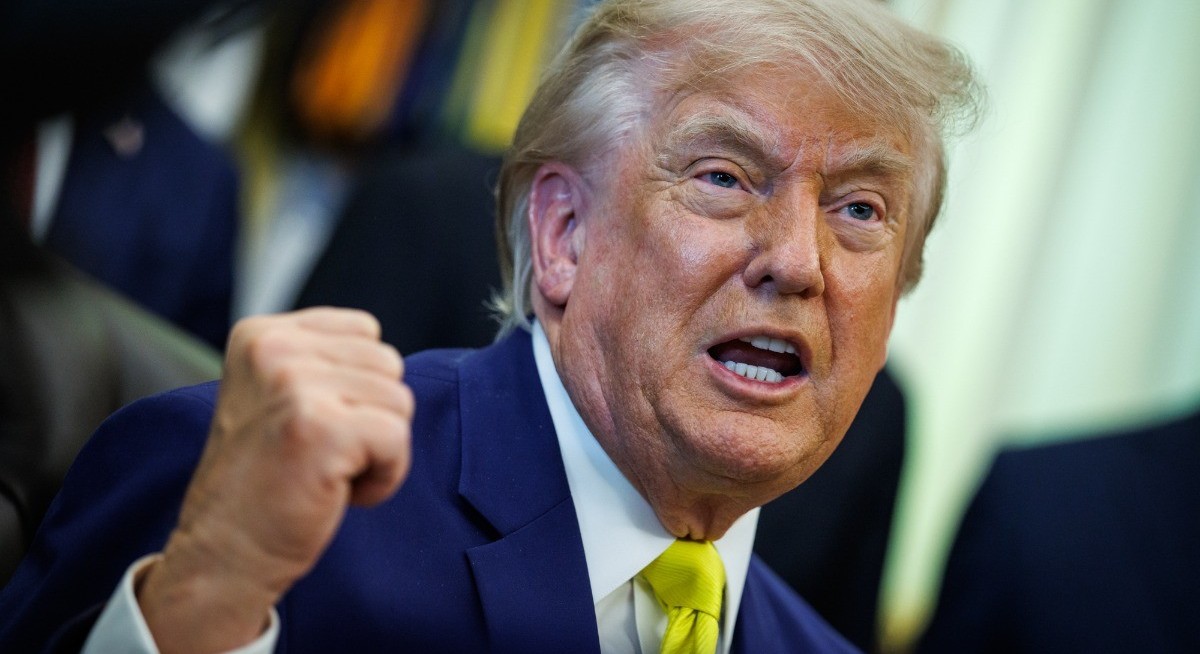



(July 15): US President Donald Trump backed away from his plan to impose a 20% charge on cargo shipments through the Strait of Hormuz after US allies in the Gulf urged him to drop it.
Trump announced the decision on Tuesday, just one day after rolling out the fee, saying that the expected revenue would be replaced by forthcoming direct investments in the US from Gulf states. He did not specify a dollar amount or which countries would participate.
“I have decided to replace the 20% US reimbursement fee with trade and investment deals that the various Gulf states will be making into the US,” Trump posted on social media.
Even as Trump dropped that plan, the US announced it had resumed its blockade on Iranian shipping to and from its ports and coastal areas, effective at 4pm Washington time. American forces also launched a fresh wave of strikes on Iranian targets, meant to degrade its abilities to hit commercial ships in the strait.
Trump’s scrapping of the fee underscored his slapdash decision making regarding the status of the vital waterway, which carried roughly one-fifth of global oil flows prior to the war. In the following months, US officials have wavered on whether passage should be free and, if not, who should impose fees. Iran has maintained that it controls the strait and can regulate transit as it sees fit.
It also reinforced the “TACO” — or Trump always chickens out — dynamics that emerged among traders last year as the president vacillated over his tariff policies.
See also: EU warns push to diversify away from China will need funding
Asked by reporters later why he dropped the plan, Trump said he spoke to representatives from Saudi Arabia, Qatar, Bahrain, Kuwait and the United Arab Emirates, who urged him to “do it a different way” with financial commitments to America.
“I don’t like the concept of a fee,” Trump said. “They are going to be making massive investments into the US, and I like that much better.”
It’s unclear if any Gulf states have made new financial pledges. At least one regional government has said it had not agreed to increase its existing commitments in exchange for waiving the transit fee through the strait, according to a person familiar with the matter.
See also: India, NZ plan strategic partnership including maritime security
Oil pared gains after Trump’s post and then rebounded. Brent crude ended the session nearly 2% higher at US$84.73 ($109.31) a barrel, the highest level in about a month.
In a Fox News interview that aired Tuesday evening, Trump said US strikes against Iran would broaden to attacks on bridges and power stations next week “unless they get to the table and negotiate”. He has previously made similar threats to attack civilian infrastructure — which critics say could constitute war crimes if carried out — but has not followed through.
The reversal on Hormuz illustrates the bind Trump is in, as hostilities with Iran resume and Tehran refuses to loosen its grip on the crucial waterway. Oil prices surged on Monday when the president first announced his proposal for a so-called “reimbursement” for facilitating shipping in the strait, threatening a rebound in gasoline costs for Americans ahead of November’s midterm elections.
After Trump announced the 20% fee on Monday, at least one Gulf Cooperation Council member state had reached out to the US government to clarify Trump’s comments on the plan, while another doubted it would ever be implemented, according to people familiar with the matter.
One more person said Gulf states were still united in wanting to ensure no tolls or fees are imposed on ships travelling through the strait.
A Gulf energy official said after Trump’s announcement Monday of the fee that there was concern that it would encourage others, including China, to do the same in waterways across the world.
US Energy Secretary Chris Wright said the 20% fee is now “off the table”.
To stay ahead of Singapore and the region’s corporate and economic trends, click here for Latest Section
“It led to a great place and we got the right answer but there will not be tolls through the Strait of Hormuz,” Wright said on Tuesday on CNBC.
Traders, analysts and industry stakeholders had dismissed the idea as unworkable and unlikely to be fully implemented, since it would be so difficult to administer and poisonous to allies around the globe.
“I think it’s patently ridiculous and totally irrelevant. It’s Trump nonsense,” Jay Hatfield, the chief executive officer of Infrastructure Capital Management, said before Trump’s retreat.
If imposed, the charge may have amounted to a roughly US$30 million cost for full supertankers carrying oil — far higher than the tolls Iran has charged, according to people familiar with the matter.
“The figure itself seems entirely arbitrary and, if imposed, would amount to an extortionate charge,” John Calabrese, a senior fellow at the Middle East Institute, said before the president changed course. “More fundamentally, the proposal treats freedom of navigation less as an international principle to be upheld than as a service to be sold.”
Any fees — whether imposed by Iran or the US — would directly affect American allies worldwide, including crude-producing Gulf countries as well as Asian nations dependent on those supplies. They could set a precedent for similar levies in other waterways, even though international law prohibits coastal states from assessing tolls on passing ships.
New charges also would run counter to Trump’s goal of combating inflation ahead of midterm elections, which are expected to be shaped by voters’ cost-of-living concerns. A 20% fee on oil cargoes, assessed on crude priced at US$78 per barrel, would likely translate into an additional 37 cents in the cost of every gallon of gasoline, according to analysis by ClearView Energy Partners, a Washington-based consulting firm.
While Trump shelved the idea on Tuesday, it might not go away completely, despite the insistence of the president’s advisers.
He has floated the possibility of US-collected fees since early April — with the late Senator Lindsey Graham also voicing support last month. That suggests he might still have some appetite to seek reimbursement for US naval activity in the strait.
Uploaded by Tham Yek Lee




