






A contact lens is challenging to inspect. Its curved, transparent surface can be hard for conventional industrial cameras to capture consistently, which affects quality checks, product yield and scrap rates. That was the starting point for Singapore’s Emage Vision.
Founded in 2011, the company built custom optical and illumination systems for eye-care manufacturers rather than selling standard industrial cameras. It has since expanded into Emage Group, which includes Emage Vision and its subsidiaries and associate companies. Wong Soon Wei, Emage Group’s founder, CEO and chief technology officer, says the company chose to focus on specialised, highly regulated manufacturing like eye care.
“When we [started], we looked at the advanced production part of the market. We build custom physical solutions rather than off-the-shelf products, and we target a specific industry that is actually highly regulated, for a good reason,” Wong tells DigitalEdge.
He adds that once a system has been proven and certified in such an industry, it can be rolled out across the customer’s manufacturing sites rather than repeatedly re-evaluated. Case in point: Emage Group initially supplied machine-vision systems for contact-lens manufacturing at a multinational eye-care company, and later expanded into that customer’s surgical and aseptic operations.
From inspection to legacy machinery
Interestingly, Emage Group’s work with contact lens inspection led it to address a broader problem faced by factories: how to add new computing and automation tools to legacy equipment.
See also: BeeX, SIT launch test site for AI underwater inspection systems
Manufacturers often retain legacy machines that remain reliable and certified for specific processes. However, that equipment may have outdated software, and replacing or altering it can require significant spending and further validation.
In 2021, Wong and fellow engineer Kundapura Parameshwara Srinivas filed a US patent application for a system Emage Group calls a “proxy interpreter”. The system sits between a factory machine and the human operator. It observes the same screen, keyboard and mouse used to run the equipment, then learns the sequence of actions performed by the human worker. Wong compares this training process to “teaching an intern” how to operate the machine.
“[The proxy interpreter system] connects to the [existing certified equipment] without disrupting the latter, and from there, you can tap the external hardware for the AI computation,” Wong says, adding that the approach may cost “about 20% of what a manufacturer would spend to upgrade the legacy system” so that it can tap into AI.
See also: Local start-up Aires targets compliance-driven quantum encryption market
Besides that, the proxy interpreter can analyse operating and inspection data to identify potential problems and support preventive maintenance of legacy systems.
Patents tied to customer needs
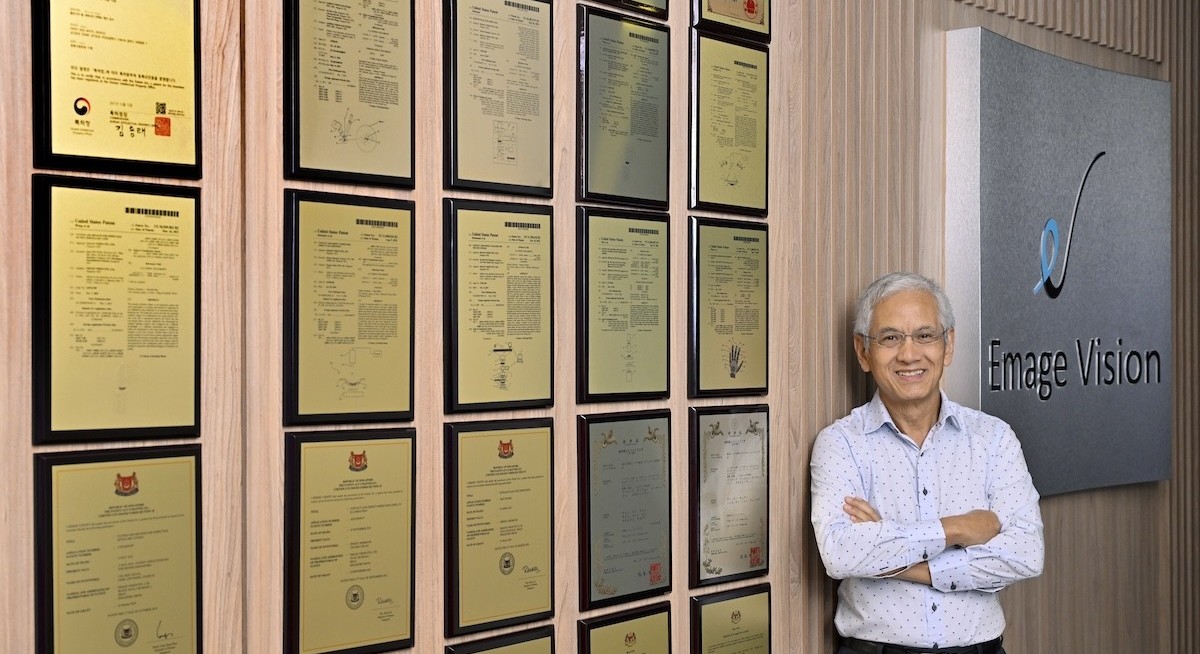
Emage Group holds 97 granted patents and 85 pending applications across nine markets: the US, Germany, China, Japan, Singapore, South Korea, Malaysia, Taiwan and Indonesia.
Its intellectual property (IP) strategy is not an exercise in building a patent wall for its own sake.
Our R&D is tied to the commercial value or the end-user needs for a solution. We don’t spend money [on R&D and IP] just for science’s sake. We actually invest in a solution that we need to provide to the customer.Wong Soon Wei, founder, CEO and chief technology officer, Emage Group.

Its solutions, he adds, are trained on customer-specific data because manufacturing methods differ between customers, particularly in the eye-care industry.
To stay ahead of the latest tech trends, click here for DigitalEdge Section
Emage Group’s work with its first customer, a multinational eye-care company’s contact-lens manufacturing unit, illustrates the strategy. Charles Cher, Emage Group’s chairman, says the company secured the contract by resolving inspection and yield issues that the customer’s existing suppliers had not fully addressed.
That work led to custom machine-vision systems, including US patents for measuring optical power and detecting edge defects in dry contact lenses. Emage Group later expanded from machine vision into AI and robotics for the eye-care provider’s other business units, including surgical and aseptic operations.
A shift towards physical AI
Emage Group is now focusing on physical AI, which it describes as using AI, sensors and robotics to carry out work in the physical world. The World Economic Forum has identified industrial operations as an early application area, while the International Federation of Robotics announced in January 2026 that the global market value of industrial robot installations has reached US$16.7 billion ($21.7 billion).
The company’s latest product in that push is Tomo, an AI-driven industrial robot designed for complex factory automation tasks requiring precision, adaptability and continuous operation. It became commercially available in 2024 and has since been deployed on a factory floor. The first Tomo system, says Wong, ran for a year to demonstrate that the new technology could operate continuously in a manufacturing environment, before the customer placed a repeat order the following year.
When asked how Tomo differs from the growing field of humanoid and general-purpose robots, Cher says: “We are actually not in a crowded space at all. Global giants are building general-purpose robots for homes, for warehouses, and even for academic research. Tomo is designed for 24x7 industrial manufacturing. It lives in the factory.”
Tomo’s patented robotic hand is also intended to reduce the space and equipment required on production lines. Traditional automation systems often use separate modules for different objects or production steps. Wong says Tomo’s hand is “toolable and interchangeable”, allowing it to switch between different instrument types and handle a range of objects within one compact workspace. As such, Tomo can reduce factory floor space by up to 60% and automation costs by up to 50%, while using less power than conventional automation systems.

Tomo is an AI-driven industrial robot designed for continuous factory automation and features a patented tool-changing robotic hand. Photo: Emage Group
Growth without venture capital
Emage Group has remained profitable since its first year and funded its growth from operations rather than external capital. “When we first started off in 2011, we established a very highly disciplined financial foundation. In our very first year, we were profitable, generating about $3.7 million in revenue — all through organic funding,” says Cher.
He continues: “Over the last few years, we took a very tough decision to restructure and divest anything that’s non-core and low-value, so that we can focus our resources towards this high-end, high-growth physical AI business. Last year, in 2025, we achieved $7.5 million in revenue after intentionally positioning ourselves in the physical AI market.”
One of the businesses it exited was semiconductor inspection in China. Cher says the company’s equipment was left inside customers’ facilities for about two years during the pandemic, preventing it from supporting those installations.
Emage Group operates across India, Malaysia, Singapore and Vietnam. It currently employs 137 people, with the majority being engineers. Singapore houses strategy and R&D; India supports software development; and Vietnam covers software and optical engineering. Cher adds that the company plans to add engineering staff and production space at its Johor production and engineering centre.
Looking beyond its existing operations, Cher says Emage Group may consider an IPO when it is ready to enter new markets and needs capital to scale its robotics and factory-automation business globally. “We hope to be the first Singapore robotics physical AI company to be listed on SGX… but going public for us is not an exit; it’s just the next chapter.”




