



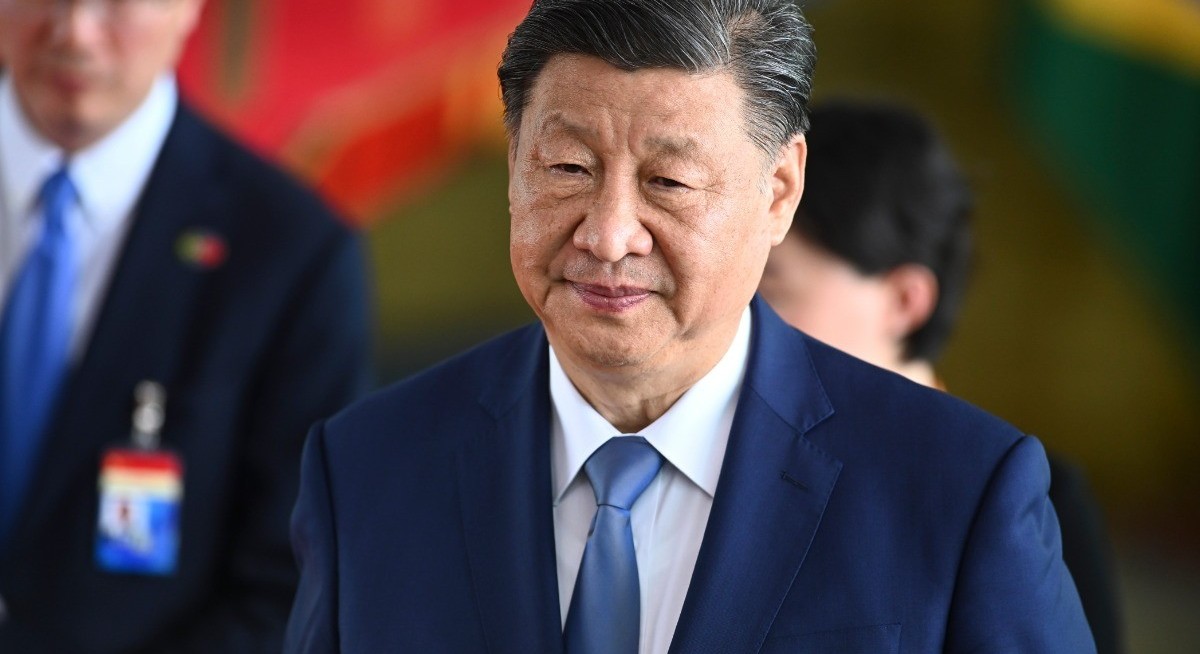



(July 17): President Xi Jinping hailed China’s progress in developing low-cost artificial intelligence (AI), pressing his personal imprint on the country’s rapidly expanding global influence to call for a more open technological order.
Xi used his first appearance at the World AI Conference in Shanghai on Friday to urge the world to adhere to an inclusive approach, encouraging collaboration without rivalries. “AI development should not be a solo performance by a single country, but a symphony of international cooperation,” he said, adding that safety risks must be contained.
His presence at the gathering, attended by scores of tech and government leaders, conveys a potent signal of China’s ambitions to dominate a technological sphere with the potential to revolutionise industry and economies — an effort that’s shot to the top of the nation’s agenda. Chinese models are winning over companies worldwide, with their share of US firms’ AI usage nearing a record 60% on the popular marketplace OpenRouter.
China’s tech-heavy Star 50 Index held steady in the run-up to Xi’s speech but slid 3% as it became clear he wasn’t going to unveil new investment or policies to spur the domestic industry. Instead, Xi sought to position China as a champion of AI for all, calling for efforts to help countries in the Global South expand their AI capacity. But he stopped short of offering any concrete funding, vowing to provide just 5,000 training courses for people in less developed nations. He hailed the founding of the China-led World AI Cooperation Organization as “an important milestone” after 29 countries including Russia and Brazil signed an agreement to join the group late on Thursday, a year after it was first proposed by Premier Li Qiang.
Behind the rhetoric, Beijing is grappling with the balance between openness and national security as models grow more capable. Chinese officials recently discussed with companies including Alibaba Group Holding Ltd — developer of the popular Qwen models — how to mitigate the security risks posed by their increasingly powerful models, people familiar with the matter said. The talks are early, with no enforcement planned, but restricting foreign access to top models was among the options raised, the people said. Reuters previously reported that Beijing was weighing curbs on overseas access. Alibaba and the Commerce Ministry didn’t respond to requests for comment.
Global AI governance has emerged as a new battleground for the world’s leading powers. With the cybersecurity threat of cutting-edge AI looming large, Washington has in recent weeks pressured prominent American labs such as Anthropic PBC to curtail foreign access to advanced models.
See also: Compute costs, tokens and the AI bubble
China is looking to build its own AI ecosystem that offers its citizens and global customers a cheaper alternative to US technology. It also wants to secure its own AI supply chain that can guarantee access for its companies and government agencies. As part of this effort, Beijing has earmarked two trillion yuan ($380 billion) over the next five years to creating a network of inter-connected data centres across the country, Bloomberg News reported last month.
Beijing is expected to mobilise its institutions and enact supportive policies to fire up an industry considered key to countering the US, while weaning the local market off American technologies that Washington is restricting access to. That effort relies on the sustained growth and advancement of national champions including Nvidia Corp-rival Huawei Technologies Co, memory chip linchpin CXMT Corp and pioneering AI labs such as DeepSeek.
The over-arching plan represents Beijing’s most aggressive endeavour yet to lay the foundation for future Chinese AI development. It recalls the undertakings of years past that channelled resources to support national champions like Huawei, with the aim of replacing US technology.
See also: DeepSeek champions China’s bid to flood world with cheap AI
But the venture pales in comparison to the US$725 billion ($935.61 billion) that US leaders such as Meta Platforms Inc and Microsoft Corp are setting aside for AI this year alone. Chinese data centres in general cost less than in the US because of cheaper labour, component and construction costs, and local government incentives.
In May, Xi hosted US President Donald Trump and discussed AI guardrails and Nvidia’s H200 chips, which are starting to trickle into China after a government ban. Xi and Trump are due to meet again in September, with the AI race top of the agenda.
Uploaded by Chng Shear Lane




