



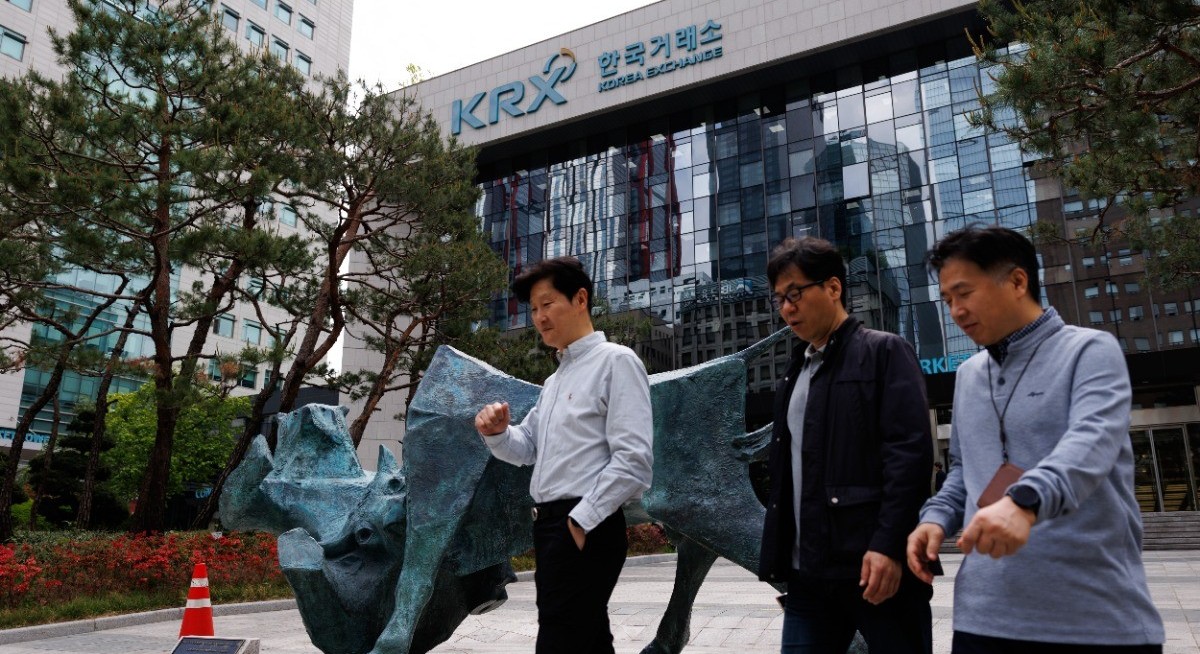



(June 23): South Korean stocks tumbled from a record high as investors sold off chip heavyweights, delivering another outsized swing that has become a feature of the world’s best-performing market this year.
The Kospi closed down 10%, with SK Hynix Inc and Samsung Electronics Co both sliding more than 12%. Losses extended after a 20-minute trading suspension was implemented by the Korea Exchange during the afternoon.
What started as a modest risk-off session, mirroring losses in US tech stocks, morphed into a rout with foreign investors offloading more than US$2.5 billion (RM10.37 billion) of Kospi shares. Market watchers cited a combination of forced liquidation hitting retail investors trading on borrowed money, compounded by a wave of selling tied to leveraged exchange traded funds (ETFs) tracking the two chip giants.
“The magnitude of the move had everything to do with the inherent frothiness of the Korean market because it’s now exclusively retail driven,” Alexander Redman, chief equity strategist for CLSA in Singapore, said at a briefing. “It’s truly unnerving you are seeing this kind of volatility.”

Tuesday’s selloff occurred amid relatively heavy volume, with trading activity 52% higher than the average over the past 20 days, according to data compiled by Bloomberg.
See also: Tech sell-off drags Asian stocks lower from record, oil down
The pullback underscores the growing volatility of what has been the world’s best-performing major equity gauge this year. The Korea Exchange triggered its circuit breaker for the fourth time this year. There were none in 2025, and only one in 2024. A volatility gauge tracking Korean stocks rose to near 90, marching toward its early-June peak.
Such have been the swings that the top financial watchdog expressed regret having allowed leveraged ETFs tracking Samsung and SK Hynix, warning that their negative side effects have grown significantly. The products magnify market volatility through their daily rebalancing to maintain targeted leverage ratios. A Samsung Asset Management product targeting twice the daily return of SK Hynix lost more than 25% on Tuesday.

See also: US futures slip, oil climbs on renewed Iran threat
Margin debt, or borrowing to buy stocks, rose to a record 38.5 trillion won this month, according to Korea Financial Investment Association data. “It looks like forced liquidation kicked in around 2pm to 3pm, with sell orders accelerating the downside,” said Kim Namho, a fund manager at Timefolio Investment Management in Seoul.
Sentiment over high-flying tech stocks turned wobbly in US trading on Monday with SpaceX shares sliding and attention shifting to memory chipmaker Micron Technology Inc’s quarterly results later this week. Investors also focused on a local media report that SK Hynix is adjusting the pace of production for its High Bandwidth Memory 4 (HBM4) chips and stepping up efforts in the commodity DRAM market, though views varied on whether that’s negative for the stock.
“Shifting production from HBM4 to commodity DRAM is probably a reflection of the company’s view on the profitability of the respective products, rather than an indication of lower demand,” said Vey-Sern Ling, managing director at Union Bancaire Privee in Singapore.
While institutions and foreigners were net sellers, retail investors snapped up more than eight trillion won of Kospi shares, a record amount, underscoring their appetite to buy into the selloff.
“The selloff appears to be driven mainly by profit-taking after the recent sharp rally, as the market had become increasingly overbought,” said Ha SeokKeun, chief investment officer at Eugene Asset Management in Seoul. “Elevated retail leverage and margin balances have likely amplified the decline, making the market more sensitive to negative catalysts.”
Uploaded by Felyx Teoh




