

Floating Button
Home Views STI watch

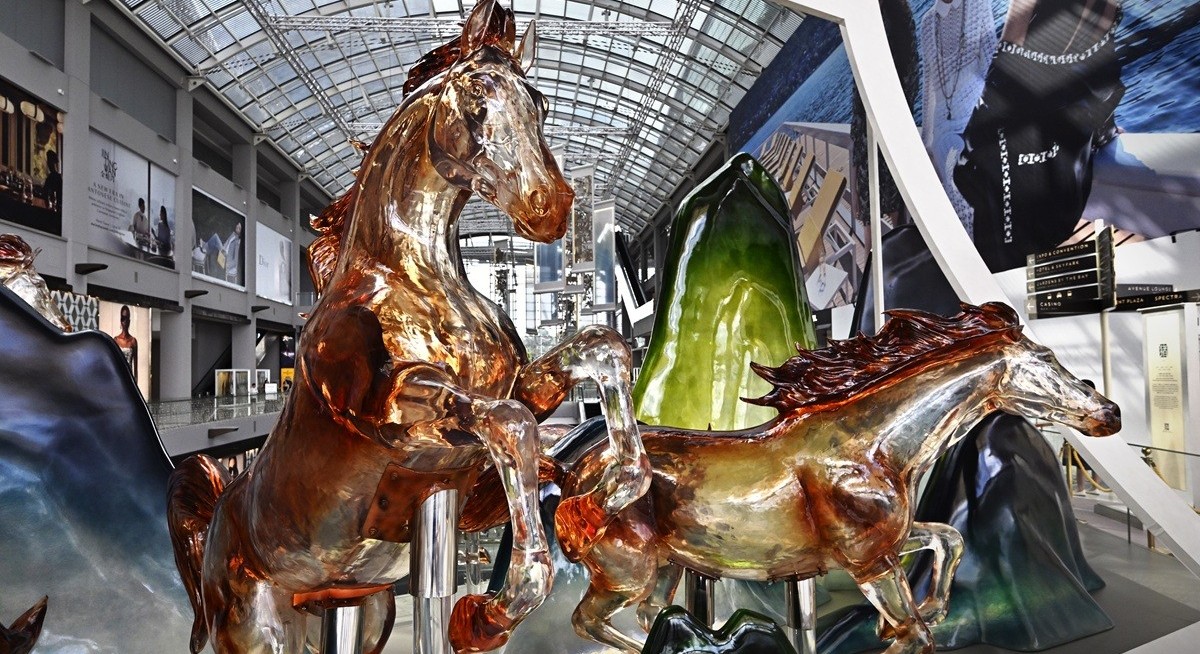
Local horses aplenty to make this a ‘no horse run’ year

Chew Sutat
Chew Sutat • 9 min read
Local horses aplenty to make this a ‘no horse run’ year
Investors who have not fled our shares are getting rewarded further with the Straits Times Index at a new all-time-high. Photo: Albert Chua/ The Edge Singapore
Font Resizer
Share to Whatsapp
Share to Facebook
Share to LinkedIn
Scroll to top
Follow us on Facebook and join our Telegram channel for the latest updates.

Among Singapore’s army boys, “no horse run” refers to the especially fleet-footed among them. The uniquely Singapore phrase, a direct translation from Hokkien bo beh zao, which came from the horse-racing crowd, used to refer to incomparable thoroughbreds in a league of their own.

The Turf Club is gone, but local punters have plenty of other horses to bet on. Certainly, as we enter into the rain-soaked Year of the Double Fire Horse, investors who have not fled our shares are getting rewarded further with the Straits Times Index (STI) at a new all-time high of above 5,000 points, as Prime Minister Lawrence Wong delivered his budget speech.

For those who bothered keeping tabs, it was just over six months ago last July when we first vaulted the 4,000 barrier — a level once considered impenetrable, a mark where we stopped shy back in 2007, not long before the global financial crisis struck. Impressive as it is for now, this run may have further tailwinds with an additional $1.5 billion in Equity Market Development
Programme (EQDP) funds to backstop the final $1.1 billion to be deployed from the initial $5 billion.

‘Never look a gift horse in the mouth’ is an adage, but it is still a wonder to me that so many I met this Chinese New Year are still married to US tech, a stale bull running since 2022, or clinging on to Bitcoin, which has halved since its October 2025 peak. They are still insisting that these wild horses couldn’t drag them away from beloved foreign or murky pastures, preferring to believe this is a passing flu instead of a longer bout of pneumonia.

Of course, given the scepticism that the market review measures issued a year ago will bear any fruit, and having backed some wrong horses, it is understandably hard to change course.

Horses in front of carts

See also: Buybacks may drive the Straits Times Index

After an extended drought, the pace of Singapore Exchange IPOs picked up in the second half of last year. To encourage the listing pipeline to flow on, an additional $1 billion has been added to the Startup SG Equity scheme, which will cover growth-stage companies in addition to early-stage start-ups.

And we have yet another committee, the Chee Hong Tat-led Growth Capital Workgroup announced just before Valentine’s Day, to focus on venture capital, private equity, credit and securitised assets. With the intention of bridging the gap between private funding and public listings, let’s all hope for larger IPOs to come.

Although the work is only expected to be completed by the end of 2027, which is some time away, larger IPOs are expected to slowly build from last year’s emergence from the stables to a heavier canter in 2026. There is even hope for more local but global champions to return to our market, including 65 Equity Anchor fund companies like Hi-P International and Neon Global.

See also: Will the STI be lifted high to 4,000 by the Snake?

Bit between the teeth

These moves add to the “positive policy initiatives” flagged by global and local strategists as reasons for upgrading STI targets to 6,000 and beyond. They have reasons to be optimistic as there are macro trends at play.

With the USD back-trotting, and the USD-SGD rate now at $1.26 with loose speculative long-term talk of USD-SGD parity, the return of some institutional and private capital back from the US, coupled with net international capital interest in SGD assets, has kept our interest rates low.

This has helped positive revaluations of physical real estate, recognised with growing frequency by transactions at market values, thereby driving a revival in many listed real estate stocks which had been trading well below their NAVs. City Developments is one such prime example, and it is still theoretically trading well below its RNAV.

Elsewhere, investors patient with Low Keng Huat have by now received their Chinese New Year ang pows from the completion of the 78 cents per share privatisation offer — almost double last year’s level. Insiders obviously have a view, as the IFA report shows an RNAV of $1.37, but without any interlopers forcing a much fairer bid for minorities, another one has bitten the dust. With markets still discovering stocks that have yet to undergo “value unlock”, I am happy to surrender my shares to the offeror and recycle my capital into new opportunities.

A smattering are already out of their stables on a bit of a trot, including Banyan Tree Holdings, Bukit Sembawang Estates, Ho Bee Land, Stamford Land Corp, Singapore Land Group, Tuan Sing Holdings, UOL Group and Wing Tai Holdings. It is probably not yet time to hold your horses on real estate names if they are still trading well within their NAVs. Rumours abound, including assets parked within REITs such as One Raffles Place in OUE REIT, which are up for value realisation. REITs continue to be a good carry insofar as rates are not going up and refinancing at lower levels is continuing in earnest this year. This will flow through the bottom lines.

Getting a free rein

Sink your teeth into in-depth insights from our contributors, and dive into financial and economic trends

Singapore is no longer a one-horse town, and our market is not just banks and real estate. Growth has bolted out, and support has come in for healthcare and tech stocks. After some heavy feet at the start of the gates, UltraGreen.ai and even the first mainboard IPO on the tracks last year — Info-Tech Systems — are performing well above their debut run. The latter issued a profit guidance of a “considerable increase” in net profit. Its stock price recovered from the low of 77 cents to 99 cents as of Feb 23 in anticipation.

Others like CSE Global, with customer Amazon as an investor too, have reached the billion-dollar market cap club on a good run for those who followed the broking house research upgrades. Small caps like Addvalue Technologies and iX Biopharma have popped up on re-rating stories from satellites to US military contracts.

There is ample capital for secondary fundraising, as EQDP funds participate in not just REIT placements but also mid and small caps. With animal spirits emboldened, even speculative retail capital has also helped facilitate more listed companies to raise growth capital at more sensible valuations for the companies and their existing shareholders. The challenge is, of course, to differentiate between the wheat and the chaff.

Horse sense

Fortunately, sell-side analysts are getting more resources with better market activities to pay their dues and research grants. The rising tide is commensurate with companies communicating more, the sell side issuing more and better-quality reports on small and mid-caps, where research is particularly scarce.

Take SoilBuild Construction Group. This column commented last year after the company’s first half results, which were already more than the previous full year in 2024, that the coverage initially from Phillip Securities simply mirrored a previous mid-single digit valuation model and gave a target price that computed out of its historical undervalued trap.

The construction supercycle that this column first talked about in July last year was already underway, and the company’s order book was growing. With more information released by the company, corporate actions announced, and order book wins, eventually a FY2026 7.5 times multiple, which translates to 85 cents (adjusted for 1:4 split in January), was arrived at.

As the share price continued its re-rating, Phillip Securities upgraded its target price from 85 cents to $1.40 — a tad after the horse had bolted. The new target price is based on a higher multiple of 13 times. Even so, at this level, it is a mere 33% discount to the 19.4 times fetched by its peers.

Unlike its peers on full-run, Soilbuild’s share price can be better described as being on a quiet canter. With full-year results to come, there is potential that analysts and investors alike, warming to the opportunity, may kick over the traces to get ahead. It will not be the only one to continue to be discovered and rated more fairly as we “value up” our market.

Trojan horse

Last week saw yet more US political drama, as the US Supreme Court struck down President Donald Trump’s signature horse-trading tariff moves. In response, he unleashed some profanities and charges of disloyalty on the three Supreme Court judges appointed under Republican rule — including two by his own hand. In addition, Trump hikes the global tariff rate from 10% to 15%, which makes global investors wonder how much more horsing around is going to happen in Washington and how effective he will be at the negotiating tables. Meanwhile, calls are growing among American importers to claim back some US$130 billion ($164 billion) of “illegal” tariffs they had paid.

With some irony, amongst the organisations that brought the amicus brief to the Supreme Court on the legality of the President’s signature policy was Advancing American Freedom, championed by Mike Pence, his former vice president, equally “disloyal”.

In this respect, the US too is in a league of its own, running its own race. Some optimists hope that this, along with fractures among Republicans in Congress — who, fearing mid-term electoral defeat this coming November, have started to vote against Trump’s agenda in the House and Senate — signals a shift. The bipartisan and internal split in MAGA (Make American Great Again) faithful on the Jeffrey Epstein files, and the withdrawal of United States Immigration and Customs Enforcement (ICE) in Minnesota after the unfortunate shootings of civilians, are two signs that normalcy may return in the US.

It might just be horse trading, and a temporary pause, since none of Trump’s key cabinet members running defence, homeland security and the Attorney-General has taken accountability for the messiness in the stables yet.

Or worse, with polls worsening, Republicans losing by-elections in Red-states seats like Texas, Trump has speculated about cancelling the midterms altogether. There remain fears that it will be a war in Iran or some domestic unrest created to wag the dog to justify cancelling the polls.

It is unclear whether the legislative and judicial branches of the US government can rein in Trump’s freewheeling attempts to extend his authority, even if there appears to be some willingness to act. Things may well get fiery, like the Fire Horse year itself. For me, it’s all domestic races this Fire Horse year.

Chew Sutat retired from the Singapore Exchange after 14 years on its executive management team. During his watch, the exchange transformed from an Asian gateway into a global multi-asset exchange. He was awarded FOW’s Lifetime Achievement Award.

×
The Edge Singapore
Download The Edge Singapore App
Google playApple store play
Keep updated
Follow our social media
© 2026 The Edge Publishing Pte Ltd. All rights reserved.

