



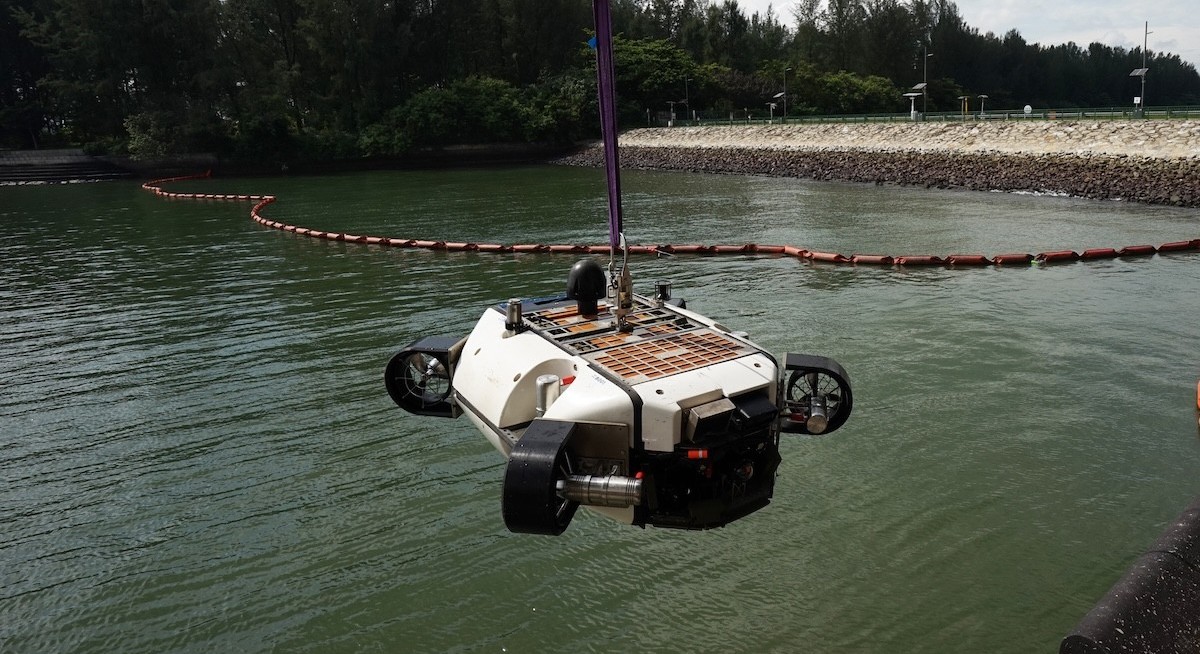



Singapore’s maritime robotics start-up BeeX has launched a test site with the Singapore Institute of Technology (SIT) to accelerate the development of AI-enabled underwater drones for infrastructure inspection, environmental monitoring, and coastal protection.
Called the Autonomous Marine Foundry (AMF), the facility at SIT’s Punggol Campus will support applied research and trials of maritime robotics and autonomous underwater systems.
It will explore applied research in coastal protection, maritime robotics and underwater autonomy. Future proposals may include using BeeX’s autonomous underwater drones to collect data from coastal protection structures and detect anomalies under relevant national research programmes such as Singapore’s Coastal Protection and Flood Management Research Programme.
According to BeeX, the AMF could help test autonomous underwater vehicles more often without having to arrange offshore trials each time. Doing so could speed up development of systems aimed at reducing the cost and manpower needed for underwater inspection, a field that still often relies on vessels, divers or human-piloted remotely operated vehicles, BeeX’s CTO and co-founder Goh Eng Wei tells DigitalEdge.
Underwater inspections, he adds, are becoming more important because offshore energy assets, pipelines and telecom cables now sit at the intersection of maintenance, insurance and national security. Damage to such assets can affect companies and countries, making routine monitoring harder to treat as a back-office engineering task.
The AMF also gives BeeX access to a growing pool of specialised engineering talent. Through SIT’s Integrated Work Study Programme (IWSP) attachments, capstone projects and mentorship opportunities, students will work with BeeX engineers on autonomous systems, robotics integration and maritime applications.
See also: How Emage Group uses contact lens inspection foothold to expand into industrial physical AI
SIT will start with one IWSP student this year, with the aim of having BeeX take in two to three IWSP students a year through the AMF, says Associate Professor Victor Wang, SIT’s assistant provost for applied research and deputy cluster director for engineering. “As the work BeeX does is multi-disciplinary, students from a wide range of engineering degree programmes – like mechanical engineering, robotics, AI, and computing – can be part of this,” he adds.
Besides that, SIT and BeeX plan to co-develop technical workshops, hackathons and applied learning opportunities.
“The Autonomous Marine Foundry brings together strategic industry partnerships, applied research, and authentic learning on a single platform to co-create solutions that address real-world challenges and opportunities. Beyond advancing maritime autonomy, this collaboration creates rich opportunities for SIT students and staff to participate in research, develop industry-relevant capabilities, and gain hands-on experience with cutting-edge autonomous marine technologies,” says Professor Susanna Leong, SIT’s deputy president for academic and provost.
See also: Local start-up Aires targets compliance-driven quantum encryption market
Wang adds that SIT would count the AMF as successful after a year if it leads to work on national projects, student participation through IWSP and capstone projects, and improvements to BeeX’s systems and prototypes.
Why underwater work is hard
Building robots that can operate autonomously underwater is harder than building unmanned land or aerial systems. Optical sensors are of limited use underwater, while sound-based sensing can be noisy. Underwater datasets are also less available than those used in land-based areas, such as self-driving cars, shares Goh.
These limits mean autonomous underwater vehicles cannot rely on a human pilot to watch a clear live feed and steer continuously. As such, BeeX’s vehicles rely on acoustic sensing and survey tools to collect underwater data, including 3D sonar and multibeam sensors.
They are also built to operate without a cable. Since signals travel more slowly underwater than through the air, position updates can come every two to three seconds. Between those updates, the vehicle has to stay stable, continue its task and make more decisions on board.
That is why Goh describes BeeX’s technology as an autonomy stack rather than a single AI feature. The stack combines robotic control, navigation, path planning and onboard modules that allow the vehicle to hold position, move around structures and flag anomalies during inspection.
While BeeX uses open-source AI tools where useful, its stack is proprietary and developed in-house, adds Goh. This matters because it has to work with BeeX’s own drones, sensors and underwater data.
To stay ahead of the latest tech trends, click here for DigitalEdge Section
“Our unique selling point is that we’ve been collecting underwater data for autonomy for 14 years now. Underwater data as a repository requires time to build up, [giving us a headstart over newer competitors],” says the company’s CEO and co-founder Grace Chia.
She continues: “Without that data, you cannot develop the [autonomous underwater vehicles] behaviour”, referring to how underwater vehicles are trained to operate.
Selling inspection, not hardware
Founded in 2018, BeeX designs, builds and operates autonomous underwater vehicles for defence, offshore energy, coastal infrastructure and environmental monitoring.
It offers commercial customers inspection as a service rather than selling the robot alone. A job can include visual inspection, cathodic protection assessment, non-destructive testing, scour surveys, multibeam data collection and reporting for classification or compliance needs, according to a company representative, says Goh.
He adds that BeeX can help cut inspection costs by about 50% by using vessels already deployed near the inspection site, where possible, rather than arranging dedicated vessel operations. The approach can also reduce on-site personnel and carbon emissions compared with conventional work-class remotely operated vehicles and specialised vessels that use dynamic positioning systems to hold position at sea.
For example, BeeX’s A.IKANBILIS autonomous underwater vehicle was used at the Deutsche Bucht offshore wind farm in Germany to inspect wind turbine generators, offshore substations, inter-array cables, and cathodic and cable-protection systems.
The vehicle was lowered from a crane on an offshore wind turbine, avoiding the use of larger tethered remotely operated vehicles (ROV) that usually require more costly vessel support. BeeX says the work showed its productivity could match that of work-class ROVs and that the data quality met standards set by Germany’s Federal Maritime and Hydrographic Agency.
According to Chia, commercial customers can typically mobilise BeeX’s service within seven to 14 days, depending on how close the job is to one of BeeX’s deployment bases. For instance, it deploys its autonomous underwater vehicles from Singapore for customers in the Asia Pacific and from Germany for parts of Europe.
Beyond Singapore and Germany, BeeX is operational in six other countries, including Malaysia, Taiwan, the Netherlands, the UK and Turkmenistan. Those locations tend to have regulatory inspection needs, large coastal infrastructure or offshore energy assets, says Chia.
In terms of customer mix, about 70% of BeeX’s revenue comes from defence, while the remaining 30% is split across commercial lines including energy, coastal infrastructure and environmental monitoring, shares Chia. She hopes for that mix to move closer to 50-50 in the coming years.
BeeX’s technology has been used by organisations including ST Engineering, Shell, Chevron, Vattenfall, PUB, Sembcorp, Jurong Port and PSA.




