



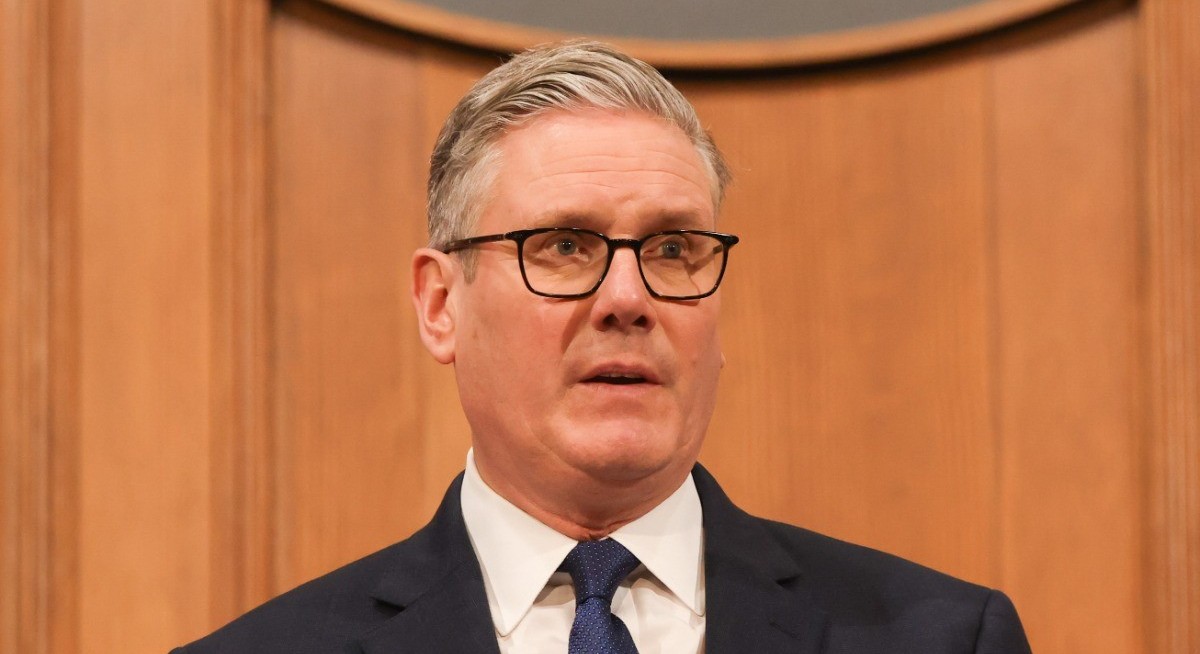


(April 10): UK Prime Minister Keir Starmer said Donald Trump’s rhetoric this week threatening to destroy Iran does not fit with British values, the latest public disagreement with the US president amid strained ties between the two nations.
“Let me be really clear about this. They are not words I would use — ever use — because I come at this with our British values and principles,” Starmer told ITV in an interview when asked about Trump’s Truth Social post on Tuesday warning Tehran to come to a deal or face dire consequences.
The remarks came before Starmer and Trump spoke by phone on Thursday evening to discuss a plan to reopen the Strait of Hormuz, the key waterway that remains effectively shut despite the US-Iran ceasefire deal announced on Tuesday.
“The leaders discussed the need for a practical plan to get shipping moving again as quickly as possible,” according to a readout provided by Starmer’s office.
Speaking on Times Radio on Friday morning, Defence Minister Luke Pollard reiterated the UK’s earlier position that it would not accept the US or Iran charging tolls for boats to pass through the Strait of Hormuz.
“Open for the UK means a freedom of navigation for all vessels and no tolls to pay, as Iran may be hinting at,” he said.
See also: US intelligence shows China set to supply Iran arms, CNN reports
The two transatlantic allies have had a string of public disagreements over trade, Greenland, the sovereignty of a joint UK-US military base in the Indian Ocean, and Trump’s attacks on Iran.
Since Starmer failed to grant the US the level of access they were seeking to British bases during the Iran conflict, Trump has fired a volley of insults at the British prime minister, saying he’s no Winston Churchill — a reference to Britain’s World War II leader — and appearing to liken him to Neville Chamberlain, the prime minister at the onset of that war whose name became synonymous with the appeasement of Adolf Hitler.
Before the US and Iran agreed on a ceasefire, Trump threatened to destroy the Islamic republic’s bridges and power plants. The president’s claim that “a whole civilisation will die tonight, never to be brought back again” if Iran didn’t agree to his terms has been widely criticized as threatening war crimes.
See also: Trump threatens Iran as Vance heads to Pakistan for talks
“I am clear that for the United Kingdom, we have our principles, we have our values. We will be guided by them in everything that we do,” Starmer said.
“That’s why I have said — and obviously it’s caused a degree of criticism and pressure in the last few weeks — I have been saying we are not going to be dragged into this war,” the prime minister added, referring to Trump’s repeated criticism of him for not expanding Britain’s role in the war beyond allowing US forces use of UK military bases for defensive operations.
Starmer was speaking in Bahrain as part of a multi-country tour of the Middle East to shore up relations with Gulf partners and discuss next steps as the allies seek to restore shipping back to normal through the Strait of Hormuz.
Earlier, the British prime minister attended a meeting in Abu Dhabi of defence officials from the United Arab Emirates, Saudi Arabia, Bahrain, Jordan, Qatar, Kuwait, Oman, Iraq and Egypt that was chaired by UK Chief of Defence Staff Richard Knighton. He reiterated that Iran must not hold the Strait of Hormuz “to ransom”.
Starmer also used the interview to criticise Israeli operations in Lebanon, calling them “wrong”.
“That shouldn’t be happening. That should stop. That’s my strong view,” he said.
The prime minister has sought to cast the Iran war as a defining moment for his leadership, which has come under intense pressure as he approaches the second anniversary of his July 2024 election victory. He has departed from his previous approach of trying to hold Trump close and tried to win political capital by publicly opposing the conflict, which he has described as “not our war”.
To stay ahead of Singapore and the region’s corporate and economic trends, click here for Latest Section
“The consequences of this war are going to be long felt. They are already being felt and we can’t immunise ourselves from that,” Starmer said.
He indicated he would prioritise three policy areas in response to the conflict: the economy, including closer ties to the European Union; energy independence; and defence and security.
Starmer also suggested he did not oppose granting new licences for the Rosebank and Jackdaw oil and gas fields, conceding that they would bring “benefits are in terms of revenue and in terms of jobs”.
“I am not fighting the principle. I want oil and gas to be part of the mix for many years to come,” he said. But he also said the direction of travel would remain to “push harder” into renewables.
“I am fed up with the fact that families across the country see their bills go up and down on energy, businesses’ bills go up and down on energy because of the actions of Putin or Trump,” Starmer said, referring to Russian President Vladimir Putin. “We need energy independence, and the only way to get energy independence is to go even more quickly to renewables because we are not going to get it on the international market.”
Uploaded by Tham Yek Lee




